

American Dog Tick

Dermacentor variabilis
The American dog tick (Dermacentor variabilis) is a hard-bodied tick commonly found across much of the United States, especially in the eastern and central regions. It can transmit several pathogens that cause human illness, including Rocky Mountain spotted fever, tularemia, and Francisella-like illness, although it is most commonly associated with rocky Mountain spotted fever.

Nymphs and adult females are the stages most often reported biting people, although larvae can also bite humans.

Common in grassy, brushy & wooded-edge areas

Active spring through fall; highest risk in spring & summer

Can transmit serious diseases

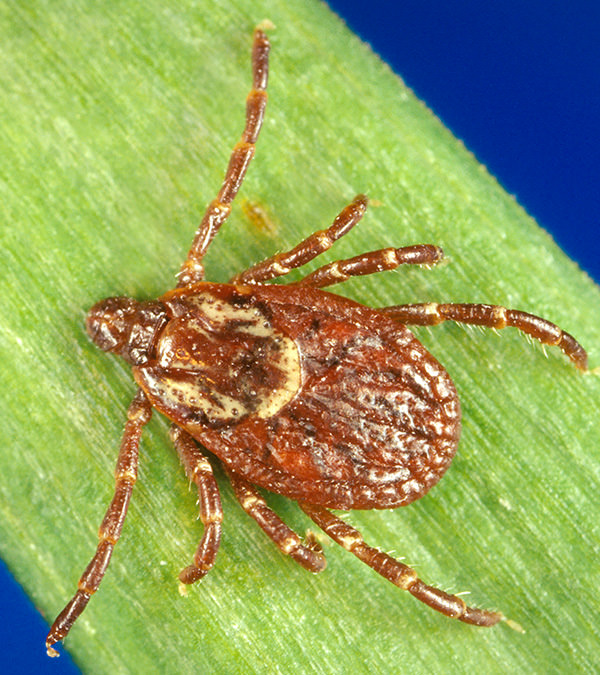
The American dog tick is a relatively large, ornate tick with a reddish-brown to dark-brown body and distinctive white, gray, cream, or silvery markings.

Adult Female

  • Reddish-brown body.
  • Pale or silvery markings are concentrated on the scutum, the shield-like area near the front of the back.
  • The remainder of the abdomen is mostly reddish brown.
  • The abdomen expands considerably after feeding.
  • Adult females are the stage most likely to bite humans.

Adult Male

  • Pale, cream, gray, or silvery markings extend across most of the back.
  • The scutum covers essentially the entire upper surface of the male’s body.

Other Identification Features

  • Larvae have 6 legs, while nymphs and adults have 8 legs.
  • Adults have relatively short mouthparts compared with some other common tick species.
  • Small grooves called festoons are present along the rear edge of the body.
  • Immature American dog ticks do not display the prominent ornamental markings seen on adults.
  • Using a magnifier can help make the tick’s markings and identification features easier to see.

Identification Note

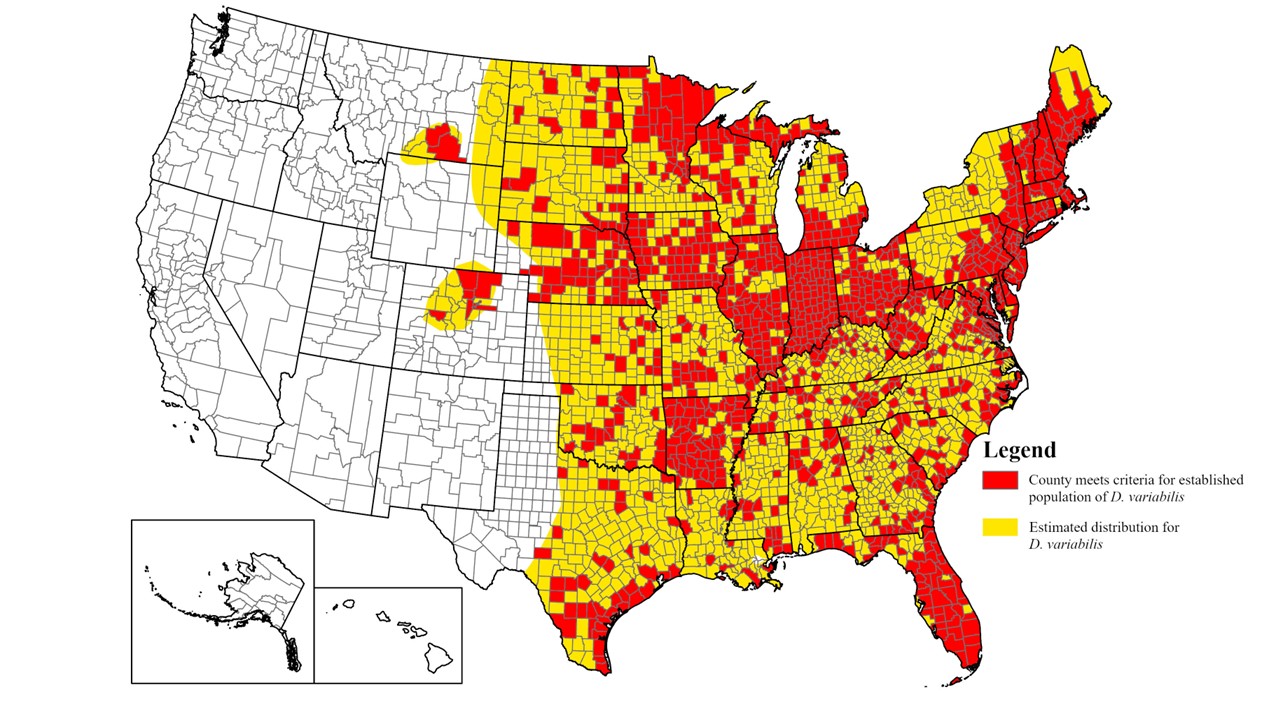
Dermacentor similis was recognized as a distinct species in 2021 and is closely related to D. variabilis. It occurs primarily west of the Rocky Mountains. Many western ticks historically classified as D. variabilis are now recognized as D. similis. However, true D. variabilis populations also occur in limited areas west of the Rockies.

The American dog tick is widely distributed throughout much of the United States east of the Rocky Mountains, with additional established populations in limited areas west of the Rockies.

Its distribution should not be confused with that of the closely related Dermacentor similis, which occurs primarily in western North America.

Common Habitats Include:

  • Grassy fields and meadows
  • Brushy and shrubby areas
  • Woodland edges
  • Roadsides
  • Trail edges
  • Parks and recreational areas
  • Overgrown lots
  • Residential areas and lawns
  • Areas frequently visited by dogs, wildlife, and other mammals

American dog ticks commonly use a behavior called questing, in which they climb onto grass or other low vegetation and extend their front legs while waiting for a passing host.

Ticks do not jump or fly onto people or animals.
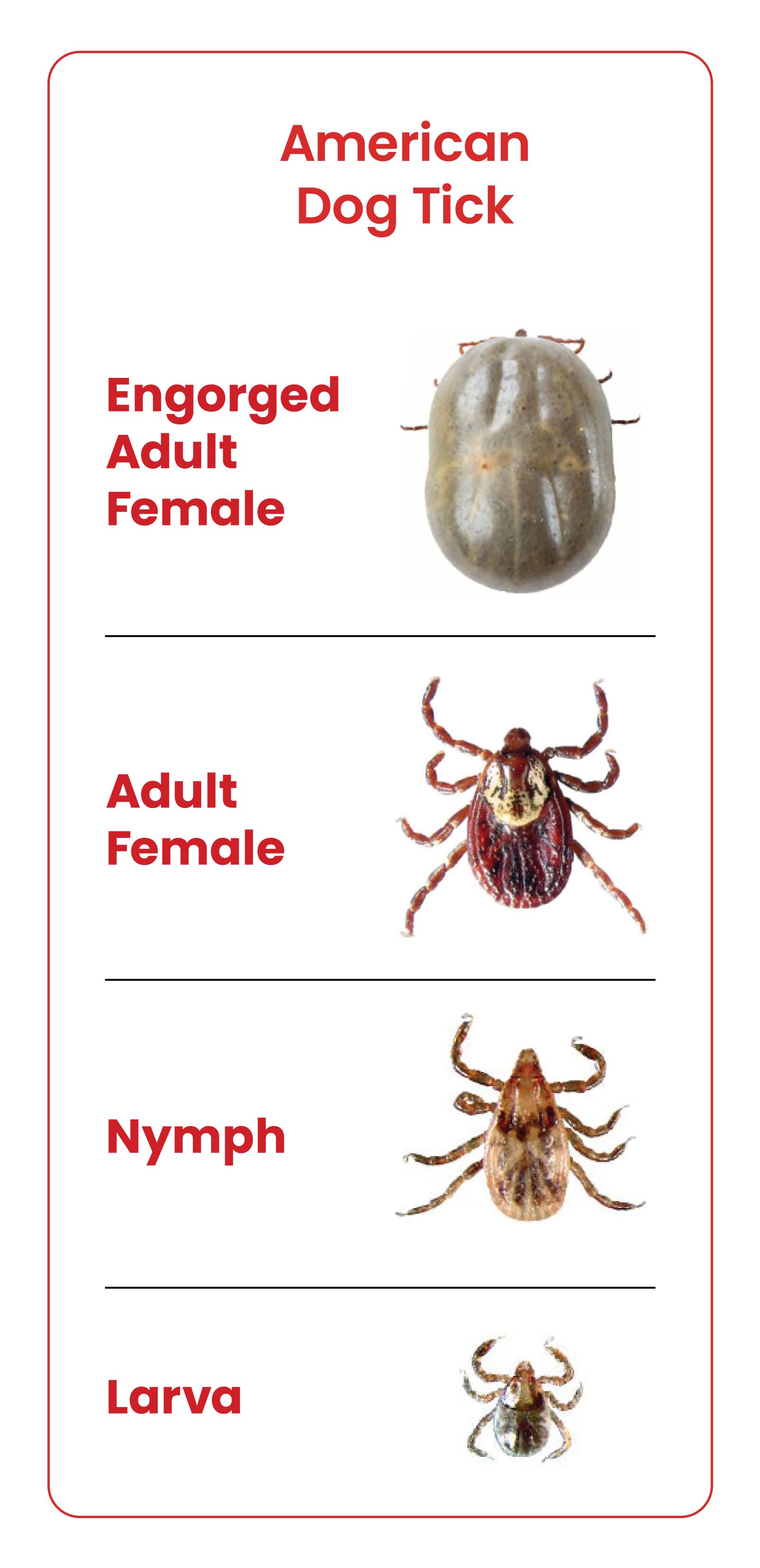
The American dog tick has a four-stage life cycle:

Egg → Larva → Nymph → Adult

It is a three-host tick, meaning that the larva, nymph, and adult typically feed on a different host individual at each feeding stage before dropping off to molt or, in the case of an engorged adult female, lay eggs.

Larvae

  • Have 6 legs.
  • Primarily feed on small mammals such as mice, voles, and other rodents.
  • After feeding, they drop from the host and molt into nymphs.

Nymphs

  • Have 8 legs.
  • Primarily feed on small-to-medium-sized mammals.
  • After feeding, they drop from the host and molt into adults.

Adults

  • Have 8 legs.
  • Commonly feed on dogs and other larger mammals.
  • May also feed on wildlife, livestock, and humans.
  • Adult females are the stage most likely to bite humans.

After feeding and mating, an engorged adult female drops from the host and lays a large mass of eggs.

The complete life cycle can vary greatly in length. Under favorable conditions it may be completed relatively quickly, but in natural environments it can take up to about two years, depending on temperature, environmental conditions, host availability, and geographic location.

Seasonal Activity

Human encounters with American dog ticks are most common during spring and summer.

Adult activity generally increases during spring and often peaks during late spring or early summer, although exact timing varies by location, weather, and climate.

Ticks may occasionally be encountered outside their typical peak season when environmental conditions are favorable.

American dog ticks are medically important because they can transmit certain disease-causing bacteria to humans.

Rocky Mountain Spotted Fever — RMSF

Cause: Rickettsia rickettsii

The American dog tick is a recognized vector of the bacterium that causes Rocky Mountain spotted fever.

RMSF can become severe or life-threatening if treatment is delayed.

Possible symptoms include:

  • Fever
  • Headache
  • Muscle aches
  • Nausea
  • Vomiting
  • Abdominal pain
  • Rash

A rash often does not appear during the first few days of illness, and some people with RMSF may never develop a rash.

Anyone who becomes ill after a recent tick bite or possible tick exposure should contact a healthcare provider promptly and mention the tick exposure.

Tularemia

Cause: Francisella tularensis

American dog ticks can transmit the bacterium that causes tularemia.

Possible symptoms of tick-associated tularemia may include:

  • Fever
  • Chills
  • Fatigue
  • Headache
  • Muscle aches
  • Swollen lymph nodes
  • A skin ulcer at or near the site where the bacteria entered the body

Symptoms can vary depending on how the infection was acquired.

Tick Paralysis

American dog ticks have been associated with rare cases of tick paralysis.

Tick paralysis is not an infectious disease. It results from a neurotoxin produced in the saliva of certain feeding ticks.

Symptoms may include:

  • Tingling or unusual sensations
  • Unsteadiness or difficulty walking
  • Muscle weakness
  • Progressive weakness
  • Paralysis in severe cases

Symptoms often improve rapidly after the responsible tick is removed.

Progressive weakness, paralysis, trouble swallowing, or difficulty breathing requires immediate medical attention. Difficulty breathing is a medical emergency.

Important Lyme Disease Clarification

The American dog tick does not transmit the bacteria that cause Lyme disease.

In the United States, Lyme disease bacteria are transmitted by infected Ixodes ticks, primarily the blacklegged tick (Ixodes scapularis) and western blacklegged tick (Ixodes pacificus).

Finding an American dog tick attached to a person does not indicate exposure to Lyme disease bacteria from that tick.

Important to Know

Finding a tick does not automatically mean it is infected or that disease transmission occurred.

The risk of tick-borne disease depends on several factors, including:

  • Tick species
  • Geographic location
  • Local pathogen prevalence
  • Whether the tick was infected
  • How long the tick was attached
  • The specific pathogen involved

Taking precautions outdoors can help reduce your chances of encountering American dog ticks and other tick species.

When Outdoors

  • Avoid direct contact with tall grass, brush, and dense vegetation when possible.
  • Walk near the center of maintained trails.
  • Use an EPA-registered insect repellent according to label directions.
  • Treat clothing and outdoor gear with products containing 0.5% permethrin, or use pretreated clothing and gear.
  • Wear long pants, long sleeves, and closed-toe shoes when practical.

After Outdoor Activity

Perform a thorough tick check after spending time outdoors.

Pay special attention to:

  • In and around the hair
  • In and around the ears
  • Under the arms
  • Around the waist
  • Inside and around the belly button
  • Behind the knees
  • Between the legs
  • Around the groin

Also inspect:

  • Children
  • Pets
  • Clothing
  • Backpacks
  • Outdoor equipment

Showering within two hours after coming indoors may help wash away unattached ticks and provides a good opportunity to perform a full-body tick check.

Protect Pets

Dogs are common hosts for adult American dog ticks.

  • Check pets carefully after they spend time outdoors.
  • Pay particular attention in and around the ears, around the eyelids, under collars, under the front legs, between the toes, between the back legs, and around the tail.
  • Remove attached ticks promptly.
  • Ask a veterinarian about appropriate tick-prevention products for your pet.

If You Find an Attached Tick

Remove the tick as soon as possible.

Do not delay removal while waiting to see a healthcare provider.

How to Remove a Tick

  1. Use clean, fine-tipped tweezers whenever available.
  2. Grasp the tick as close to the skin’s surface as possible, avoiding squeezing the tick’s body.
  3. Pull the tick away from the skin with steady, even pressure.
  4. Do not twist, jerk, crush, or squeeze the tick.
  5. If mouthparts remain in the skin and can be removed easily with tweezers, remove them. If they cannot be removed easily, leave them alone and allow the skin to heal.
  6. Dispose of the tick safely or place it in a sealed container.
  7. Thoroughly clean the bite area and your hands with soap and water, rubbing alcohol, or hand sanitizer.
  8. Perform another careful tick check because additional ticks may be present.

If fine-tipped tweezers are unavailable, current CDC guidance states that regular tweezers or your fingers may be used, taking care to grasp the tick close to the skin and avoid squeezing its body.

Do Not Use:

  • Petroleum jelly
  • Nail polish
  • Heat
  • Matches
  • Essential oils
  • Other substances or chemicals intended to make the tick detach

These methods should not be used in place of prompt mechanical removal.

After a tick bite, watch for fever, rash, headache, muscle aches, unusual fatigue, or other signs of illness during the following days to weeks.

Contact a healthcare provider if concerning symptoms develop and mention the recent tick exposure, including when and where the bite likely occurred.

CDC generally does not recommend testing a removed tick to guide medical treatment decisions.

Adult Female

  • Reddish-brown body
  • Pale or silvery markings on the front shield
  • Smaller scutum covering only the front portion of the back

Adult Male

  • Pale or silvery markings across most of the back
  • Scutum covering nearly the entire back

Engorged Female

  • Enlarged body after feeding
  • Abdomen expands behind the scutum
  • Appearance changes significantly after a blood meal

Life Stages

  • Egg
  • Six-legged larva
  • Eight-legged nymph
  • Adult female
  • Adult male

Gallery Note: Use images specifically verified as Dermacentor variabilis because the closely related Dermacentor similis can look very similar.
Need Help OR

Have a question?

Email us anytime at
sales@ticktweezers.com
and we will be happy to help.

While you're here, check out our
Resources and Product pages to
learn more.

Be Tick free