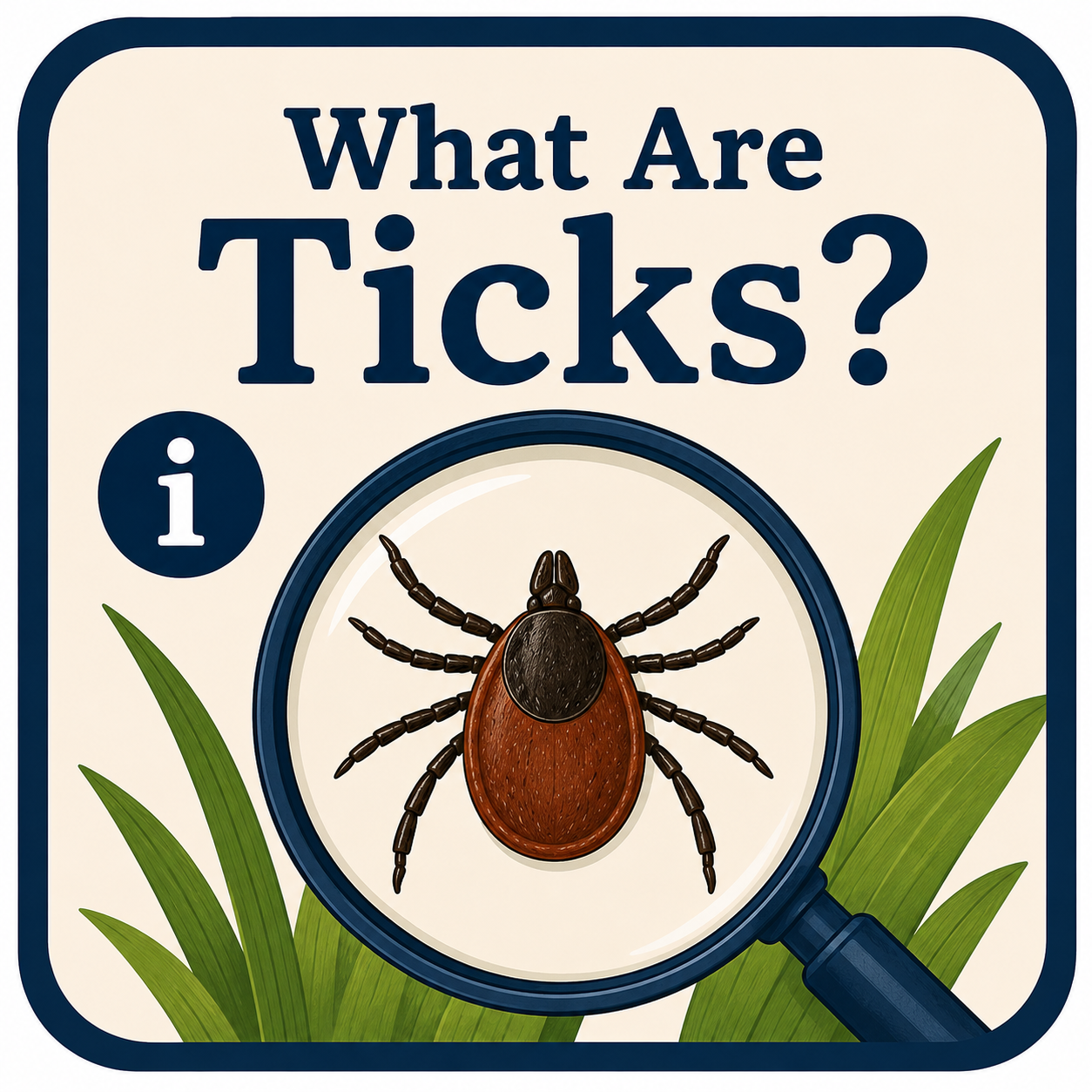
What are Ticks?
What Are Ticks?
Ticks are small, blood-feeding arachnids found in many environments throughout the United States and around the world. Although they may be tiny, certain tick species can carry bacteria, viruses, or parasites capable of causing illness in people and animals.
Understanding what ticks are, where they live, how they find hosts, how they feed, and how to prevent tick bites can help you make informed decisions when spending time outdoors.
Whether you’re hiking, gardening, camping, working outdoors, walking your dog, visiting a park, or simply enjoying your backyard, being tick-aware is an important part of protecting yourself, your family, and your pets.
What Exactly Is a Tick?
Ticks are arachnids, not insects. They belong to the same broad group of arthropods as spiders and mites.
Adult ticks and nymphs have eight legs, while tick larvae have six legs. In comparison, adult insects have six legs.
Ticks are parasites that depend on blood meals from animals or people. Depending on the species and life stage, their hosts may include:
- People
- Deer and other large mammals
- Rodents and other small mammals
- Birds
- Reptiles
- Pets
- Livestock
- Other wildlife
Ticks cannot fly or jump. They generally wait for a suitable host to pass nearby and then climb onto the person or animal.
Hard Ticks vs. Soft Ticks
Ticks are generally divided into two major groups that are important to human and animal health:
Hard Ticks
Hard ticks belong to the family Ixodidae and include many of the ticks people commonly encounter outdoors.
Examples include:
- Blacklegged ticks
- Lone star ticks
- American dog ticks
- Rocky Mountain wood ticks
- Gulf Coast ticks
Hard ticks have a firm outer plate called a scutum and generally remain attached to a host for an extended period while taking a blood meal.
Soft Ticks
Soft ticks belong to the family Argasidae. They have a softer, more leathery appearance and behave differently from hard ticks.
Soft ticks often live in protected environments such as:
- Rodent nests
- Burrows
- Caves
- Rustic buildings
- Rodent-infested cabins
Many soft ticks feed much more quickly than hard ticks. Some Ornithodoros species can transmit bacteria responsible for soft tick relapsing fever
Understanding Tick Anatomy
Although different tick species vary in appearance, hard ticks share several basic anatomical features.
Mouthparts
A tick uses specialized mouthparts to attach to its host and take a blood meal.
Scutum
The scutum, or dorsal shield, is the firm plate found on the back of hard ticks.
In adult males, the scutum covers most or nearly all of the upper surface of the body. In adult females, it covers only the front portion, allowing the abdomen to expand substantially while feeding.
Legs
Tick larvae have six legs.
Nymphs and adults have eight legs.
Body
Unlike insects, ticks do not have the clearly separated head, thorax, and abdomen typically associated with insects.
As a female hard tick feeds, its body can expand considerably and become visibly engorged.
The Tick Life Cycle
Most hard ticks progress through four major life stages:
Egg → Larva → Nymph → Adult
Ticks generally need to take a blood meal during their active developmental stages before progressing through their life cycle.
Egg
The tick life cycle begins when a female lays eggs.
After development, the eggs hatch into larvae.
Larva
Tick larvae are extremely small and have six legs.
Depending on the tick species, larvae may feed on small mammals, birds, reptiles, or other available hosts.
Nymph
After feeding and molting, a larva develops into an eight-legged nymph.
Nymphs can be extremely small and may be difficult to notice when attached to the skin.
For some tick-borne diseases, infected nymphs are particularly important in transmission because their small size can allow them to remain attached without being detected.
Adult
Adult ticks have eight legs and are generally larger and easier to see than nymphs.
Adult females of many hard tick species take a substantial blood meal before producing eggs.
Depending on the tick species, environmental conditions, and availability of hosts, completion of the tick life cycle may take months to several years.
How Small Are Ticks?
Tick size varies greatly depending on:
- Species
- Life stage
- Sex
- Whether the tick has recently taken a blood meal
Larvae and nymphs can be especially difficult to see.
Adult ticks are usually easier to recognize, but even adults can be quite small before feeding.
As some female ticks feed, their bodies expand considerably, making an engorged tick look dramatically different from an unfed tick of the same species.
Size alone should not be used to identify a tick. Color, markings, body shape, geographic location, and other physical characteristics may also be important.
How Do Ticks Find You?
Ticks don’t need to chase their hosts.
Many hard ticks use a behavior commonly known as questing.
A tick may climb onto grass, brush, leaves, or other vegetation and wait with its front legs extended. When a person or animal brushes past, the tick can climb aboard.
Ticks can respond to several cues associated with potential hosts, including:
- Carbon dioxide
- Body heat
- Movement
- Moisture
- Odors and other chemical signals
Once a tick gets onto a host, it may crawl around before finding a suitable location to attach and feed.
Where Do Ticks Live?
Tick activity varies by species, geographic region, weather, and life stage.
Although many people associate ticks only with spring and summer, ticks can be active during other seasons as well.
For example, adult blacklegged ticks may search for hosts during fall and winter whenever temperatures are above freezing.
This means tick awareness is important even outside the warmer months, particularly during periods of mild winter weather.
How Do Ticks Feed?
Ticks feed by attaching their mouthparts to the skin of a suitable host and taking a blood meal.
Unlike mosquitoes, which generally feed and leave quickly, many hard ticks may remain attached for several days while feeding.
As the tick feeds, its body may gradually become larger and engorged.
If a tick is infected with a disease-causing pathogen, that pathogen may potentially be transmitted during feeding.
However, transmission time varies depending on the particular tick and pathogen. There is no single attachment-time rule that applies to every tick-borne infection.
For that reason, attached ticks should be removed promptly and properly.
Why Are Tick Bites a Concern?
Most tick bites do not result in illness.
However, certain tick species can carry pathogens capable of causing disease in people.
Ticks in the United States are associated with a variety of bacterial, viral, and parasitic infections, including:
- Lyme disease
- Anaplasmosis
- Ehrlichiosis
- Babesiosis
- Rocky Mountain spotted fever
- Other spotted fever rickettsioses
- Tularemia
- Powassan virus disease
- Colorado tick fever
- Hard tick relapsing fever
- Soft tick relapsing fever
- Heartland virus disease
- Bourbon virus disease
- Other established or emerging tick-associated infections
Different tick species are associated with different pathogens and geographic regions.
Not Every Tick Carries Disease
Finding an attached tick can be concerning, but a tick bite does not automatically mean that a person will become sick.
The potential risk following a tick bite depends on several factors, including:
- Tick species
- Geographic location
- Whether the tick carries a pathogen
- The pathogen involved
- Tick life stage
- Whether the tick was attached and feeding
- Duration of attachment for pathogens where feeding time affects transmission
Correct identification can therefore provide useful information after a tick encounter.
Ticks to Know in the United States
Many tick species occur in the United States, but only a subset commonly bite people or play an established role in transmitting human pathogens.
Here are several important ticks to recognize.
Blacklegged Tick / Deer Tick
Ixodes scapularis
The blacklegged tick is widely distributed across the eastern United States.
It can transmit pathogens associated with:
- Lyme disease
- Anaplasmosis
- Babesiosis
- Hard tick relapsing fever
- Ehrlichia muris eauclairensis ehrlichiosis
- Powassan virus disease
Nymphs and adult females are the stages most frequently associated with bites to people.
Western Blacklegged Tick
Ixodes pacificus
The western blacklegged tick occurs along the Pacific Coast of the United States, particularly in northern California.
It can transmit pathogens responsible for:
- Lyme disease
- Anaplasmosis
- Hard tick relapsing fever
Although all active life stages may bite people, nymphs and adult females are reported most frequently from humans.
Lone Star Tick
Amblyomma americanum
The lone star tick is an aggressive human-biting tick distributed widely across portions of the Northeast, South, and Midwest.
It is associated with:
- Ehrlichiosis
- Tularemia
- Heartland virus disease
- Bourbon virus disease
- Southern tick-associated rash illness (STARI)
Evidence also strongly associates bites from lone star ticks with alpha-gal syndrome, a potentially serious allergy to products containing alpha-gal.
Adult females can often be recognized by the distinctive pale or white spot on their backs.
American Dog Tick
Dermacentor variabilis
The American dog tick is widely distributed east of the Rocky Mountains and occurs in more limited areas farther west.
It can transmit pathogens associated with:
- Rocky Mountain spotted fever
- Tularemia
Adult females are the stage most likely to bite people, with bite risk generally highest during spring and summer.
What About Dermacentor similis?
Ticks west of the Rocky Mountains that were historically grouped with Dermacentor variabilis include a closely related species now recognized as Dermacentor similis.
CDC notes that additional research is needed to better understand its role in disease transmission.
Rocky Mountain Wood Tick
Dermacentor andersoni
The Rocky Mountain wood tick occurs primarily in Rocky Mountain states and parts of southwestern Canada, particularly at elevations of approximately 4,000–10,500 feet.
It can transmit pathogens responsible for:
- Rocky Mountain spotted fever
- Colorado tick fever
- Tularemia
Adult ticks are primarily associated with transmission to humans.
Gulf Coast Tick
Amblyomma maculatum
The Gulf Coast tick occurs primarily in the southeastern United States, with additional localized populations elsewhere.
Adult Gulf Coast ticks can transmit Rickettsia parkeri, the bacterium responsible for R. parkeri rickettsiosis, a type of spotted fever rickettsiosis.
Brown Dog Tick
Rhipicephalus sanguineus
The brown dog tick occurs worldwide and is unusual among medically important ticks because it can become established around homes, kennels, and other environments where dogs live.
Dogs are its primary host, although brown dog ticks can also bite people and other mammals.
In the southwestern United States and along portions of the U.S.–Mexico border, brown dog ticks can transmit the pathogen responsible for Rocky Mountain spotted fever.
Pacific Coast Tick
Dermacentor occidentalis
The Pacific Coast tick is found along portions of the western coastline, including California, Oregon, and Washington.
It can transmit the bacterium responsible for Pacific Coast tick fever, a spotted fever rickettsiosis. CDC currently identifies the causative organism as Rickettsia rickettsii subsp. californica.
Asian Longhorned Tick
Haemaphysalis longicornis
The Asian longhorned tick is an invasive tick species first reported in the United States in 2017.
It has since been identified in multiple states and has been found on:
- Livestock
- Wildlife
- Pets
- People
Unlike many native U.S. ticks, female Asian longhorned ticks can reproduce without mating, which can allow large populations to develop.
Compared with several common native ticks, Asian longhorned ticks appear less attracted to humans.
Researchers are continuing to study their potential role in transmitting human pathogens in the United States. CDC notes that they are not currently considered likely to contribute significantly to Lyme disease transmission.
Other Medically Important Ticks
Some ticks rarely bite people but are still important because they participate in the natural transmission cycles of disease-causing pathogens.
Groundhog Tick / Woodchuck Tick
Ixodes cookei
The groundhog tick primarily feeds on groundhogs and other mammals and rarely bites people.
However, it is one of the tick species capable of transmitting Powassan virus.
Squirrel Tick
Ixodes marxi
The squirrel tick primarily feeds on squirrels and other small mammals and also rarely bites humans.
It is another tick species associated with transmission of Powassan virus.
Soft Tick
Ornithodoros hermsi
Ornithodoros hermsi is a soft-bodied tick associated mainly with mountainous areas of the western United States.
Human exposure is often linked to sleeping in rodent-infested cabins.
Infected O. hermsi ticks can transmit Borrelia hermsii, one of the bacteria responsible for soft tick relapsing fever.
Unlike many hard ticks, these ticks may feed for only a short period, often while a person is sleeping, so the bite may never be noticed.
Soft Tick
Ornithodoros turicata
Ornithodoros turicata occurs primarily in portions of the south-central United States and is associated with environments such as caves and rodent burrows.
It can transmit Borrelia turicatae, another bacterium responsible for soft tick relapsing fever.
Tick Myths vs. Facts
Myth: Ticks are insects.
Fact: Ticks are arachnids and are more closely related to spiders and mites.
Myth: Ticks can fly.
Fact: Ticks do not have wings and cannot fly.
Myth: Ticks jump onto people.
Fact: Ticks do not jump. Many climb onto a host after contact with vegetation or another surface.
Myth: Every tick carries Lyme disease.
Fact: Different tick species carry different pathogens, and many ticks are not infected with a disease-causing organism.
Myth: All ticks are deer ticks.
Fact: Numerous tick species live in the United States, including blacklegged ticks, lone star ticks, dog ticks, Gulf Coast ticks, wood ticks, soft ticks, and others.
Myth: Ticks disappear completely during winter.
Fact: Activity depends on species and weather. For example, adult blacklegged ticks can search for hosts during winter when temperatures rise above freezing.
Prevention & Protection
You can’t always avoid ticks, but several practical precautions can help reduce your chances of being bitten.
Before Going Outdoors
- Wear long pants, long sleeves, and closed-toe shoes when appropriate.
- Consider tucking pants into socks in areas with heavy tick exposure.
- Use an EPA-registered insect repellent according to label directions.
- Consider clothing and gear treated with permethrin according to product instructions.
- Avoid dense brush, tall grass, and leaf litter when possible.
- Walk near the center of maintained trails.
After Coming Indoors
Perform a thorough tick check after spending time outdoors.
Pay close attention to:
- Scalp and hairline
- Around and behind the ears
- Under the arms
- Around the waist
- Inside the belly button
- Behind the knees
- Between the legs
- Around the groin
- Around the ankles
Also inspect:
- Clothing
- Shoes
- Backpacks
- Outdoor equipment
- Pets
Showering after returning indoors also provides another opportunity to look for ticks that may be crawling on the body.
What Should You Do If You Find an Attached Tick?
If you discover an attached tick, remove it promptly and properly.
Using clean, fine-tipped tweezers:
- Grasp the tick as close to the skin’s surface as possible.
- Pull upward with steady, even pressure.
- Do not twist or jerk the tick.
- After removal, clean the bite area and your hands.
- Consider photographing or saving the tick if identification may be useful later.
Avoid using methods such as:
- Burning the tick
- Applying petroleum jelly
- Covering it with nail polish
- Applying other substances in an attempt to force it to detach
The goal is to remove the tick promptly and mechanically.
After a Tick Bite
After removing an attached tick, pay attention to how you feel during the following days and weeks.
Contact a healthcare professional if you develop concerning symptoms following a known or possible tick exposure, particularly symptoms such as:
- Fever
- Rash
- Headache
- Unusual fatigue
- Muscle or body aches
- Nausea
- Vomiting
- Other unexplained symptoms
Tell your healthcare provider:
- That you had a known or possible tick bite
- Approximately when it happened
- Where you believe the exposure occurred
- Whether you still have the tick or a photograph of it
Tick Identification Matters
Not all ticks are the same.
Different tick species:
- Live in different regions
- Prefer different habitats
- Feed on different hosts
- Have different seasonal activity patterns
- Can be associated with different pathogens
Identifying the tick you encountered can provide valuable information following a bite.
Our Tick Identification Guide can help you learn about common tick species, identifying characteristics, geographic ranges, and associated health concerns.
More Tick Education & Resources
Continue learning about ticks, tick identification, prevention, removal, and protection:
- Your Ultimate Guide to Tackling Ticks
- How to Safely Remove Ticks
- Tick Check Yourself!
- Tick Identification Guide
- Tick Prevention Tips
- Tick Wars
- Protecting Your Pets From Ticks
- Frequently Asked Questions
I would keep these linked to the existing resource pages you already have.
Be Tick Smart
Ticks are a natural part of many outdoor environments, but understanding them can help you reduce your risk.
Know which ticks may occur in your area.
Take steps to prevent tick bites.
Check yourself, children, pets, clothing, and gear after outdoor activities.
Remove attached ticks promptly and properly.
Stay informed about ticks and tick-borne diseases.
A little tick awareness can make a big difference when enjoying the outdoors.
Educational Disclaimer
This information is provided for educational purposes only and is not intended to replace professional medical advice, diagnosis, or treatment.
If you develop a fever, rash, unusual fatigue, headache, body aches, nausea, vomiting, or other concerning symptoms following a known or possible tick exposure, contact a qualified healthcare provider and mention the potential tick exposure