
Lyme Arthritis: A Joint Complication of Lyme Disease
What Is Lyme Arthritis?
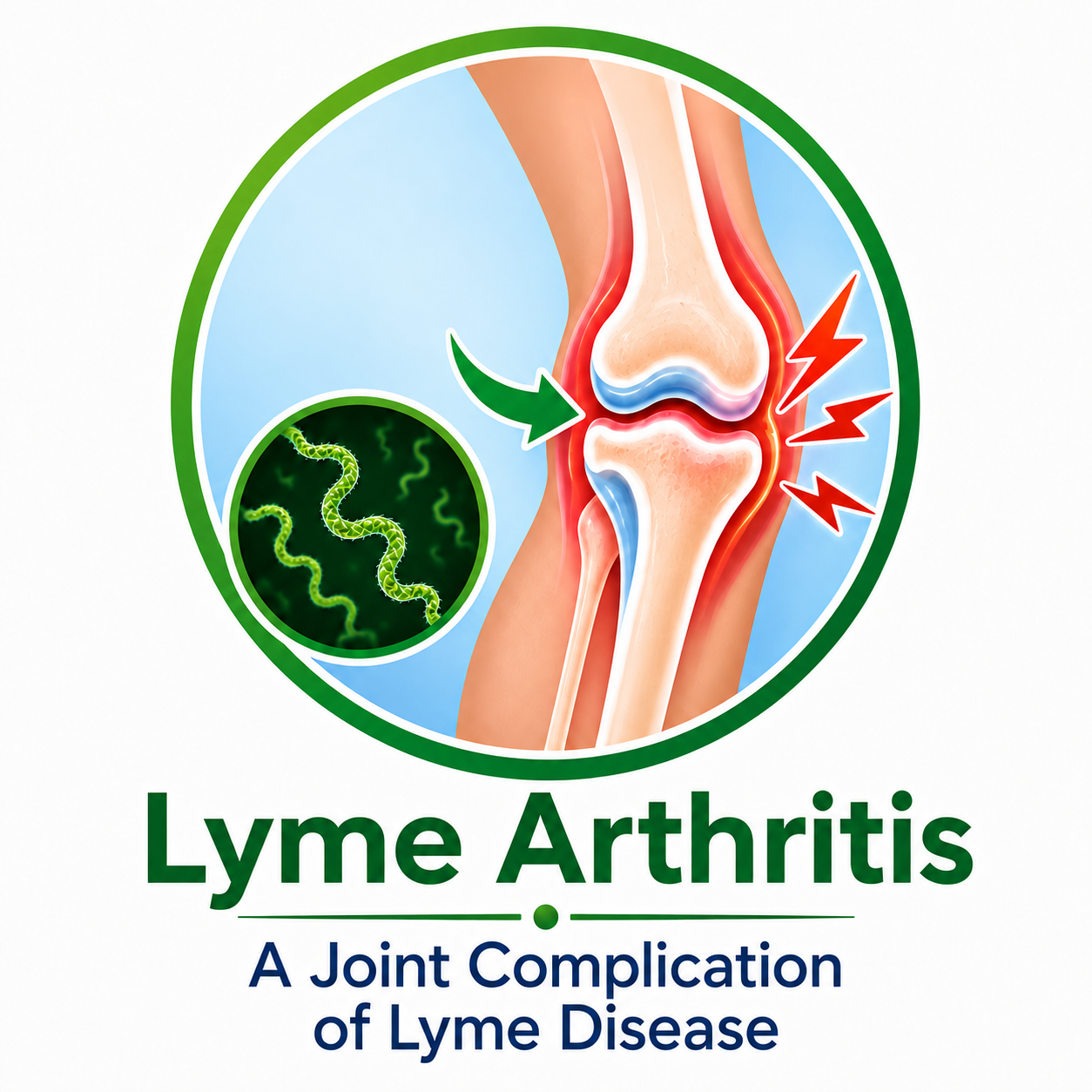
Lyme arthritis is a manifestation of Lyme disease in which Lyme disease bacteria enter joint tissue and cause inflammation.
The main feature is usually obvious swelling of one or a few joints, most often the knee. Other large joints can also be affected.
Lyme arthritis typically develops within one to a few months after infection. It is a later manifestation of Lyme disease that can occur when infection has not been identified and treated earlier.
Lyme arthritis is different from the temporary muscle and joint aches that can occur during earlier Lyme disease. True Lyme arthritis involves objective joint inflammation and swelling.
What Causes Lyme Arthritis?
Lyme arthritis occurs when the bacteria that cause Lyme disease spread to joint tissue and trigger inflammation.
In the United States, Lyme disease is caused by:
- Borrelia burgdorferi
- Rarely, Borrelia mayonii
Borrelia mayonii was originally recognized as a cause of Lyme disease in Minnesota and Wisconsin. In June 2026, CDC reported the first evidence of locally acquired B. mayonii infection and local tickborne transmission in New York, based on a human case and infected ticks identified in 2025. This remains an uncommon cause of Lyme disease.
Lyme disease bacteria causing human infection in the United States are transmitted through the bites of infected blacklegged (Ixodes) ticks.
In the northeastern, mid-Atlantic, and north-central United States, the primary vector is the:
Blacklegged tick (Ixodes scapularis)
In areas along the Pacific Coast, Lyme disease is transmitted by the:
Western blacklegged tick (Ixodes pacificus)
Lyme arthritis itself is not a separate infection acquired from a tick. It is a manifestation that can develop after infection with Lyme disease bacteria.
When Does Lyme Arthritis Develop?
- Erythema migrans (EM) rash
- Fever
- Headache
- Fatigue
- Muscle aches
- Joint aches
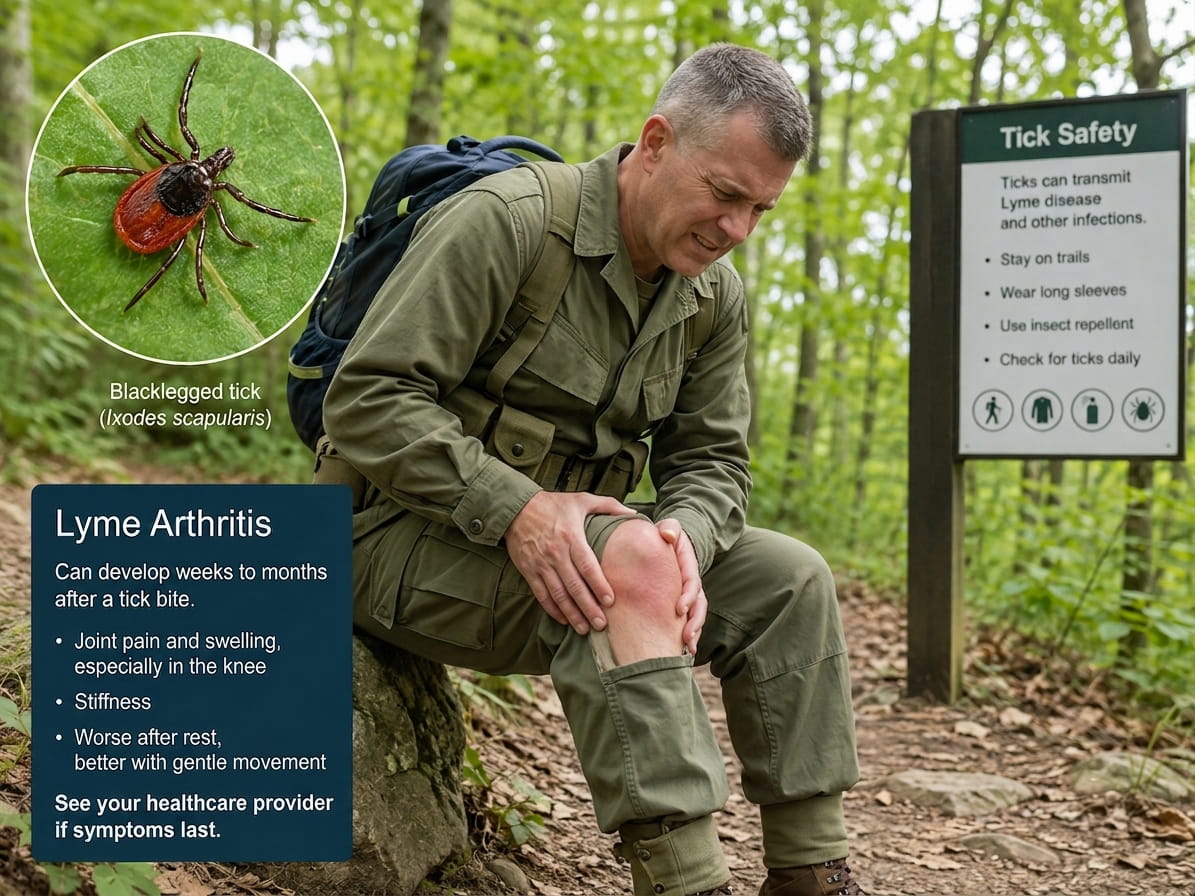
However, not everyone with Lyme arthritis remembers having a tick bite or an earlier Lyme disease rash.
Untreated Lyme disease can cause later manifestations involving the joints, nervous system, and heart.
What Are the Symptoms of Lyme Arthritis?
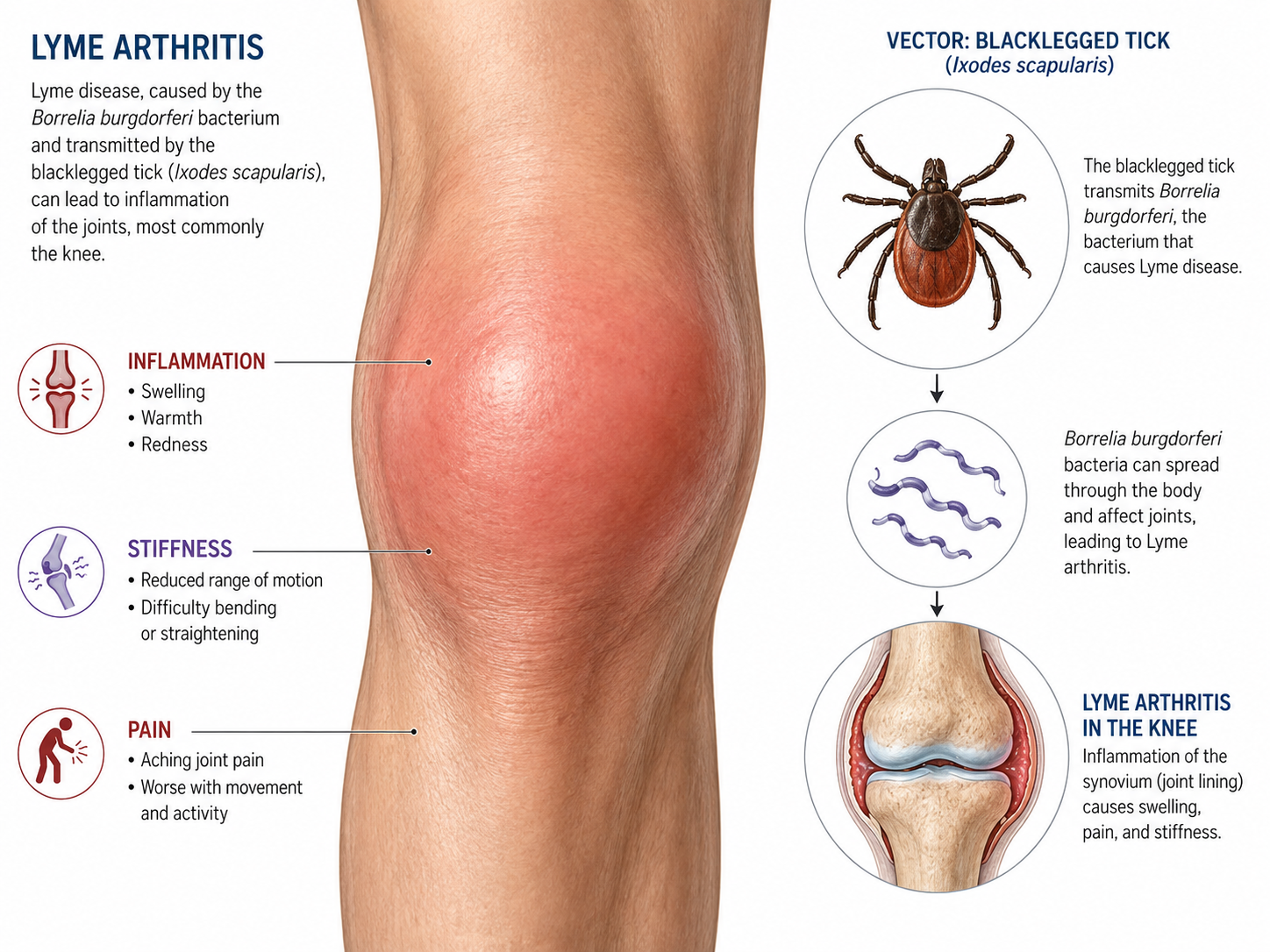
The hallmark of Lyme arthritis is obvious swelling of one or a few joints.
Symptoms and findings may include:
- Significant joint swelling
- Joint warmth
- Pain or discomfort during movement
- Swelling that comes and goes
- Swelling that may move from one joint to another
The amount of swelling can sometimes be substantial.
The knee is affected most often, but Lyme arthritis can also involve other large joints, including the:
- Shoulder
- Ankle
- Elbow
- Jaw
- Wrist
- Hip
Lyme arthritis usually affects one or a few joints rather than many joints throughout the body.
Which Joint Is Most Commonly Affected?
The knee is the joint most commonly affected by Lyme arthritis.
A person may develop noticeable or substantial swelling around the knee, sometimes accompanied by warmth or pain during movement.
Other large joints can also become inflamed, and joint swelling may come and go or move from one joint to another.
Lyme Arthritis vs. Joint Pain
Joint pain alone does not necessarily mean Lyme arthritis.
Muscle aches and joint aches—known as myalgias and arthralgias—can occur with Lyme disease without objective arthritis.
Lyme arthritis involves objective joint inflammation and swelling.
A simple way to understand the distinction is:
Arthralgia → joint pain or aching
Arthritis → joint inflammation with objective swelling
For public-health surveillance purposes, CDC’s Lyme disease case definition describes musculoskeletal involvement as recurrent, brief attacks of objective joint swelling in one or a few joints, sometimes followed by more persistent arthritis.
Important: Surveillance definitions are designed for public-health reporting and classification. They are not intended to replace clinical judgment or serve as diagnostic criteria for an individual patient.
How Common Is Lyme Arthritis?
Lyme arthritis is a well-recognized manifestation of Lyme disease.
CDC states that Lyme arthritis accounts for approximately 1 out of every 4 Lyme disease cases reported to CDC.
However, CDC specifically cautions that because of surveillance and reporting practices, this statistic may overstate how frequently arthritis occurs among patients seen in routine clinical practice.
Therefore, the “1 in 4” figure should be understood as a statistic based on reported surveillance cases, not as the exact probability that an individual with Lyme disease will develop arthritis.
Who Is at Risk?
Anyone with Lyme disease can potentially develop Lyme arthritis, particularly when the infection is not identified and appropriately treated before later manifestations develop.
In the United States, Lyme disease is most common in the:
- Northeast
- Mid-Atlantic
- Upper Midwest
Lyme disease also occurs in areas along the Pacific Coast.
People who spend time outdoors in areas where infected blacklegged ticks occur may have greater opportunities for exposure.
Tick exposure can occur in places such as yards and neighborhoods, not only in remote wooded areas. CDC specifically advises checking for ticks after outdoor activity, including time spent in your own backyard.
Can Children Develop Lyme Arthritis?
Yes.
Lyme arthritis can occur in both children and adults.
In children, Lyme arthritis can sometimes resemble septic arthritis, a serious bacterial infection of a joint.
Distinguishing between the two conditions is important because their treatment can be very different. Septic arthritis may require surgical intervention, whereas Lyme arthritis generally does not.
There can be considerable overlap between Lyme arthritis and septic arthritis, especially in children.
A child with substantial unexplained joint swelling, severe pain, fever, or difficulty using or bearing weight on an affected limb should receive prompt medical evaluation.
How Is Lyme Arthritis Diagnosed?
Diagnosis is based on a combination of:
- Symptoms and physical examination
- Likelihood of exposure to infected blacklegged ticks
- Geographic exposure
- Laboratory testing
- Evaluation for other possible causes of joint swelling
CDC recommends a two-step serologic testing process using FDA-cleared assays when laboratory testing for Lyme disease is indicated.
Both steps are required.
Standard two-tier testing (STTT) uses an enzyme immunoassay (EIA) as the first step. If the first test is positive or equivocal, Western blotting is used as the second step.
Modified two-tier testing (MTTT) uses two sequential enzyme immunoassays in an FDA-cleared testing algorithm.
Because Lyme arthritis is generally a later manifestation of infection, antibody testing has very high sensitivity in patients with Lyme arthritis.
Studies reviewed by the AAN/ACR/IDSA guideline found approximately 95–100% sensitivity for conventional two-tier serologic testing in patients with Lyme arthritis.
Patients with Lyme arthritis generally have a strong IgG antibody response. The AAN/ACR/IDSA guideline states that the diagnosis of Lyme arthritis should be questioned in a patient who has only IgM seroreactivity without IgG seroreactivity.
Lyme disease antibodies may remain detectable for months to years after infection and cannot be used by themselves to determine whether an infection is currently active or whether treatment has been successful. Laboratory results must therefore be interpreted together with the patient’s clinical history and findings.
Is Joint-Fluid Testing Used?
Sometimes.
PCR testing of synovial—or joint—fluid can detect Borrelia DNA and may be useful as an additional diagnostic test in selected patients.
However, PCR testing of synovial fluid should not be the first laboratory test used for suspected Lyme arthritis.
Serum antibody testing is the preferred initial laboratory approach.
The AAN/ACR/IDSA guideline recommends serum antibody testing over PCR or culture of blood, synovial fluid, or synovial tissue when initially evaluating possible Lyme arthritis.
In selected patients who are already seropositive but for whom additional diagnostic information is needed, PCR testing of synovial fluid or synovial tissue may be considered.
A positive PCR result after treatment does not necessarily mean that active infection remains, because Borrelia DNA may remain detectable for a period after antimicrobial treatment.
What Other Conditions Can Resemble Lyme Arthritis?
A swollen joint can have many possible causes.
Depending on a person’s age, symptoms, medical history, and other findings, healthcare providers may consider conditions including:
- Septic arthritis
- Other inflammatory forms of arthritis
- Juvenile idiopathic arthritis
- Reactive arthritis
- Gout or other crystal-associated arthritis
- Joint injury or trauma
- Other infectious causes of arthritis
Septic arthritis is particularly important to consider because it can require urgent treatment.
There can be considerable overlap between Lyme arthritis and septic arthritis, especially in children.
A severely painful, hot, swollen joint—particularly when accompanied by fever, inability to bear weight, or systemic illness—should receive prompt medical evaluation rather than being assumed to be Lyme arthritis.
How Is Lyme Arthritis Treated?
Lyme arthritis is treated with antibiotics.
CDC and the AAN/ACR/IDSA guideline recommend an initial 28-day course of oral antibiotic therapy for Lyme arthritis.
Recommended oral antibiotics include:
- Doxycycline
- Amoxicillin
- Cefuroxime axetil
The appropriate antibiotic, dose, and treatment plan depend on factors such as age, medical history, underlying health conditions, pregnancy status, and medication allergies.
Treatment should be determined by a qualified healthcare professional.
What If Joint Swelling Continues After Treatment?
Joint swelling does not always disappear immediately after antibiotic treatment.
For someone who has improved but still has mild residual joint swelling after the initial 28-day oral antibiotic course, CDC states that either:
- Observation, or
- A second course of the same oral antibiotic
may be considered.
The AAN/ACR/IDSA guideline does not make a firm recommendation between observation and a second oral course for patients with a partial response because of limited evidence, but it states that another oral course may be reasonable in selected patients.
For patients with no or minimal response to initial oral antibiotic treatment, the AAN/ACR/IDSA guideline suggests a 2- to 4-week course of intravenous ceftriaxone rather than another oral antibiotic course.
CDC lists intravenous ceftriaxone for 14–28 days as the preferred second antibiotic regimen for patients who have had no response to the initial oral antibiotic course.
Treatment decisions should be individualized by the patient’s healthcare provider.
What Is Post-Antibiotic Lyme Arthritis?
In some patients, joint swelling and inflammation can persist or recur even after appropriate antibiotic treatment.
This is commonly referred to as post-antibiotic Lyme arthritis.
The condition was previously called “antibiotic-refractory Lyme arthritis,” but the AAN/ACR/IDSA guideline uses the term post-antibiotic Lyme arthritis to avoid confusion with antibiotic resistance.
The cause of persistent arthritis is not fully understood, but CDC states that it is thought to be driven by immunologic factors.
CDC notes that when joint swelling and pain persist or recur after two courses of antibiotics, additional antibiotics have not been shown to improve these symptoms, and referral to a rheumatologist should be considered.
The AAN/ACR/IDSA guideline more specifically recommends referral to a rheumatologist or another appropriately trained specialist when arthritis persists after one appropriate course of oral antibiotics followed by one appropriate course of intravenous antibiotics.
Depending on the individual case, specialist treatment may involve therapies such as anti-inflammatory medications, disease-modifying antirheumatic drugs, biologic agents, intra-articular steroids, or arthroscopic synovectomy.
The guideline states that antibiotic therapy longer than 8 weeks is not expected to provide additional benefit for persistent arthritis when treatment has already included an appropriate course of intravenous antibiotics.
Can Lyme Arthritis Cause Permanent Joint Damage?
Yes.
CDC warns that people who do not receive prompt treatment for Lyme arthritis are at risk of developing permanent joint damage.
For this reason, unexplained joint swelling—particularly swelling of the knee in someone who lives in or has traveled to an area where Lyme disease occurs—should be evaluated by a healthcare professional.
Can Lyme Arthritis Be Prevented?
The best way to reduce the risk of Lyme arthritis is to:
- Prevent Lyme disease infection
- Recognize Lyme disease when it occurs
- Receive appropriate treatment before later complications develop
To reduce the risk of tick bites, CDC recommends:
- Use an EPA-registered insect repellent according to label instructions.
- Wear long-sleeved shirts and pants when appropriate.
- Use clothing and gear pretreated with 0.5% permethrin.
- Avoid grassy, brushy, or wooded areas where ticks may live when practical.
- Check your body, clothing, gear, and pets for ticks during and after outdoor activities.
- Shower soon after being outdoors to help wash off unattached ticks.
- Perform a careful tick check after spending time where ticks may be present.
- Remove attached ticks as soon as possible.
In general, CDC states that infected blacklegged ticks must remain attached for more than 24 hours to transmit Lyme disease infection.
Removing an attached tick promptly can therefore greatly reduce the risk of infection.
Can Antibiotics Help Prevent Lyme Disease After a Tick Bite?
In certain circumstances, yes.
CDC states that a single dose of doxycycline after certain tick bites in an area where Lyme disease is common may lower the risk of Lyme disease.
The AAN/ACR/IDSA guideline recommends preventive doxycycline for an identified high-risk Ixodes tick bite when treatment can begin within 72 hours after tick removal.
Under that guideline, a bite is considered high risk when all three of the following apply:
- The tick is an identified Ixodes species capable of transmitting Lyme disease.
- The bite occurred in a highly endemic area.
- The tick was attached for 36 hours or longer.
If the bite cannot confidently be classified as high risk, the guideline recommends a wait-and-watch approach rather than routine preventive antibiotics.
A healthcare professional should determine whether post-exposure antibiotic treatment is appropriate.
How to Remove an Attached Tick
If you find an attached tick, CDC recommends removing it as soon as possible. Do not delay removal while waiting to see a healthcare provider.
- Use clean, fine-tipped tweezers to grasp the tick as close to the skin’s surface as possible.
- If fine-tipped tweezers are unavailable, CDC states that regular tweezers or your fingers may be used. When using fingers, avoid squeezing the tick’s body.
- Pull the tick away from the skin using steady, even pressure.
- Do not twist or jerk the tick.
- If mouthparts break off and remain in the skin, remove them with tweezers if they can be removed easily. If they cannot be removed easily, leave them alone and allow the skin to heal.
- Dispose of the live tick by placing it in a sealed container, wrapping it tightly in tape, flushing it down the toilet, or placing it in alcohol.
- Do not crush the tick with your fingers.
- Clean the bite area and your hands thoroughly with soap and water, rubbing alcohol, or hand sanitizer.
- Check the rest of your body carefully for additional ticks and promptly remove any that are attached.
Do not use petroleum jelly, heat, nail polish, or other substances to try to make an attached tick detach.
When Should You Contact a Healthcare Provider?
Seek medical evaluation if you develop:
- New or unexplained joint swelling
- A noticeably swollen knee or other large joint
- Recurring episodes of joint swelling
- Joint warmth or pain during movement
- Difficulty walking or using an affected joint
This is particularly important if you:
- Recently had a known tick bite
- Live in an area where Lyme disease occurs
- Recently traveled to an area where Lyme disease occurs
- Previously experienced an expanding rash or other symptoms compatible with Lyme disease
A person does not need to remember a tick bite for Lyme disease or Lyme arthritis to be considered.
A severely painful, hot, swollen joint—especially with fever, inability to bear weight, or systemic illness—requires prompt medical evaluation because conditions other than Lyme arthritis, including septic arthritis, may require urgent treatment.
Key Facts About Lyme Arthritis
- Lyme arthritis is a manifestation of Lyme disease.
- It occurs when Lyme disease bacteria enter joint tissue and cause inflammation.
- The main feature is obvious swelling of one or a few joints.
- The knee is affected most often.
- Other large joints—including the shoulder, ankle, elbow, jaw, wrist, and hip—can also be involved.
- Lyme arthritis typically develops within one to a few months after infection.
- Joint swelling may come and go or move between joints.
- Lyme arthritis is different from ordinary joint aches because it involves objective joint inflammation and swelling.
- Lyme disease in the United States is caused primarily by Borrelia burgdorferi and, rarely, Borrelia mayonii.
- In 2026, CDC reported the first evidence of locally acquired B. mayonii Lyme disease in New York, based on a 2025 investigation.
- CDC recommends two-step serologic antibody testing when laboratory testing is indicated.
- Both standard two-tier testing and modified two-tier testing are accepted testing approaches when appropriate FDA-cleared assays are used.
- Conventional two-tier antibody testing has very high sensitivity—approximately 95–100% in published studies—in patients with Lyme arthritis.
- PCR testing of joint fluid may sometimes be helpful as an adjunct, but it is not the preferred first laboratory test.
- Initial Lyme arthritis is generally treated with 28 days of oral antibiotics.
- Patients with no or minimal response to initial oral treatment may require IV ceftriaxone.
- Some people experience persistent joint inflammation after appropriate antibiotic treatment.
- Persistent post-antibiotic arthritis is thought to involve immunologic factors rather than antibiotic resistance.
- Additional prolonged antibiotics have not been shown to improve persistent arthritis after appropriate recommended treatment courses.
- Untreated Lyme arthritis can result in permanent joint damage.
- Preventing tick bites, removing attached ticks promptly, and appropriately treating Lyme disease can help reduce the risk of later complications.
- In certain high-risk situations, a single dose of doxycycline after a tick bite may reduce the risk of Lyme disease when recommended by a healthcare professional.
Educational Disclaimer
This information is provided for educational purposes only and is not a substitute for professional medical advice, diagnosis, or treatment.
If you develop significant or unexplained joint swelling, joint warmth, difficulty walking, or other concerning symptoms after known or possible tick exposure, contact a qualified healthcare provider and mention the possible tick exposure.
A severely painful, hot, swollen joint—especially with fever, inability to bear weight, or systemic illness—requires prompt medical evaluation, because conditions other than Lyme arthritis, including septic arthritis, may require urgent treatment.

