Rocky Mountain Spotted Fever (RMSF): A Serious Tickborne Bacterial Disease
What Is Rocky Mountain Spotted Fever?
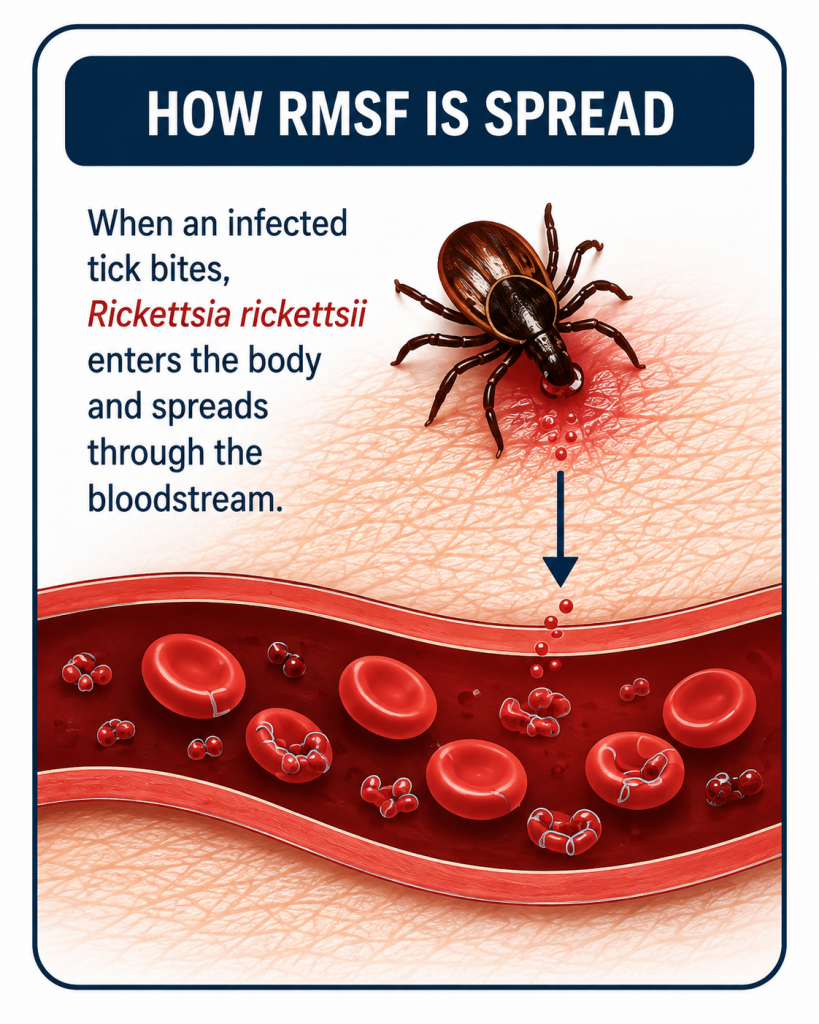
Rocky Mountain spotted fever (RMSF) is a tickborne disease caused by the bacterium Rickettsia rickettsii. It is transmitted to people primarily through the bite of an infected tick.
RMSF can cause serious and potentially life-threatening illness. Early symptoms can be nonspecific, but the disease can progress rapidly if appropriate treatment is delayed. CDC describes RMSF as the most severe rickettsiosis in the United States and notes that, without early doxycycline treatment, it can be fatal within days.
Early recognition and prompt treatment are critical. Doxycycline is most effective at preventing severe complications when treatment begins within the first 5 days of illness.
RMSF is one of several diseases reported under the broader surveillance category spotted fever rickettsiosis (SFR). SFR, including RMSF, is a nationally notifiable condition in the United States. Because commonly used antibody tests may cross-react with several closely related Rickettsia species, reported SFR surveillance totals should not automatically be interpreted as confirmed RMSF cases.
How Do Ticks Spread RMSF?
RMSF is primarily transmitted through the bite of an infected tick.
Important U.S. vectors include:
- American dog tick (Dermacentor variabilis)
- Rocky Mountain wood tick (Dermacentor andersoni)
- Brown dog tick (Rhipicephalus sanguineus)
The American dog tick is found extensively east of the Rocky Mountains, while the Rocky Mountain wood tick occurs primarily in the Rocky Mountain region. The brown dog tick serves as the primary RMSF vector in parts of the southwestern United States and Mexico.
Brown dog ticks are often found on or near domestic dogs and can occur in kennels, yards, and even inside homes. This contributes to a different pattern of RMSF transmission in parts of Arizona and northern Mexico, where exposure can occur in and around the home.
Tick bites are often painless, and many people with RMSF do not remember being bitten by a tick. Therefore, not recalling a tick bite does not rule out a tickborne infection.
Where Does RMSF Occur?
RMSF cases occur across the United States. However, CDC surveillance generally reports RMSF together with other spotted fever rickettsioses under the broader SFR category.
SFR cases are reported in each of the lower 48 states. CDC states that more than 60% of reported SFR cases come from:
- North Carolina
- Oklahoma
- Arkansas
- Tennessee
- Missouri
These surveillance data include RMSF and other spotted fever rickettsioses, so they should not be interpreted as meaning that every reported SFR case is confirmed RMSF.
Although SFR cases are reported throughout the year, most reported cases occur during May through August.
What Are the Symptoms of RMSF?
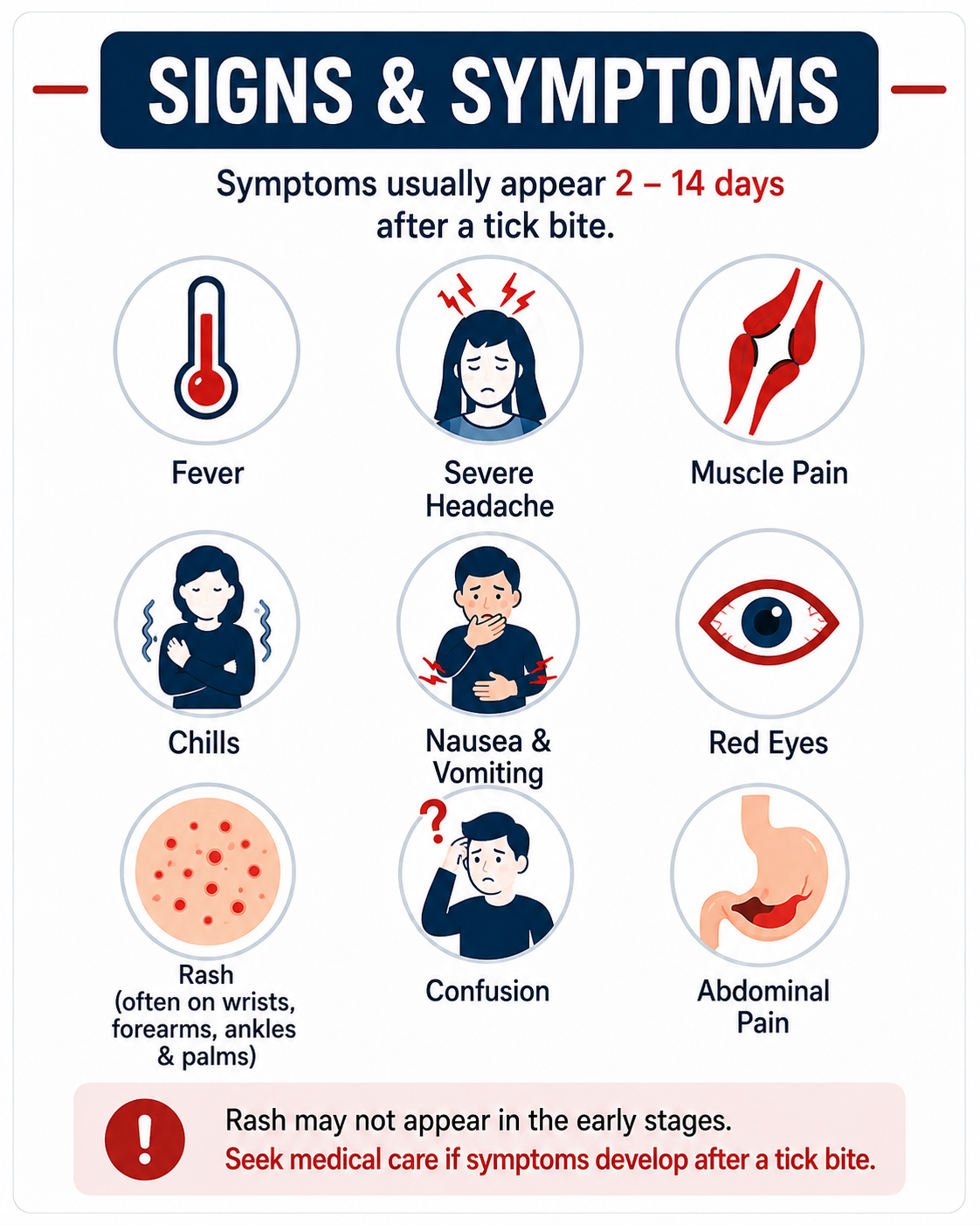
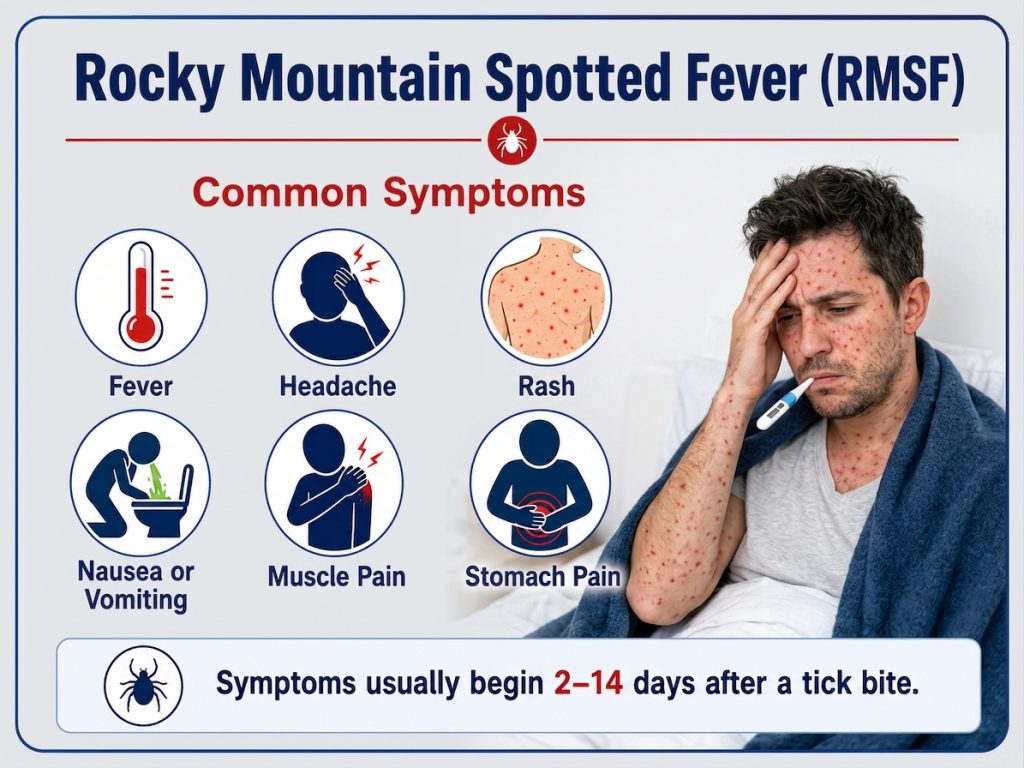
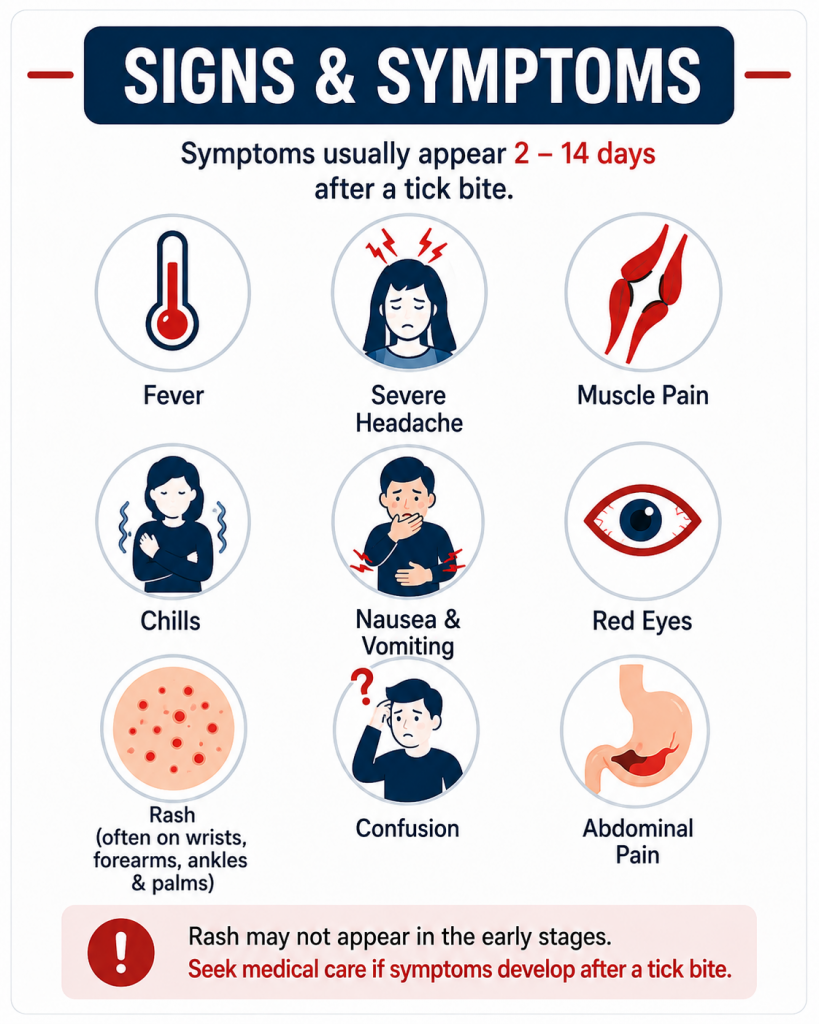
Signs and symptoms generally begin 3 to 12 days after the bite of an infected tick. Illness often begins suddenly with fever and headache.
Early symptoms may include:
- Fever
- Headache
- Nausea
- Vomiting
- Loss of appetite
- Abdominal pain
- Muscle pain
- Rash
- Swelling around the eyes or on the backs of the hands
One of the most important facts about RMSF is that a rash may not be present early in the illness.
CDC states that approximately 90% of people with RMSF eventually develop a rash, but fewer than 50% have a rash during the first 3 days of illness, when many people first seek medical care. Therefore, RMSF should still be considered when other signs, symptoms, and exposure history are compatible even if a rash is not present.
What Does the RMSF Rash Look Like?
In a classic case, the rash typically appears 2 to 4 days after the onset of fever.
The early rash may consist of small, flat, pink spots that begin on areas such as the:
- Wrists
- Forearms
- Ankles
The rash may then spread to the trunk and sometimes involve the palms of the hands and soles of the feet. However, the appearance and distribution of the rash can vary considerably.
A later petechial rash—small red or purple spots caused by bleeding into the skin—typically does not appear until around day 5 or 6 of illness. CDC considers petechiae a sign of severe disease and emphasizes that treatment should begin before this stage develops.
Because the rash may appear late, look different from the classic pattern, or occasionally not develop, healthcare providers should not wait for a rash before considering treatment for suspected RMSF.
Why Can RMSF Be Serious?
RMSF can progress rapidly without appropriate treatment.
Later or severe illness can involve:
- Altered mental status or coma
- Brain swelling
- Respiratory complications
- Kidney failure
- Damage to multiple organ systems
- Skin and soft-tissue necrosis, which can result in amputations or skin grafts
CDC identifies several factors associated with an increased risk of severe illness:
- Delayed treatment
- Children younger than 10 years
- Glucose-6-phosphate dehydrogenase (G6PD) deficiency
People who survive severe RMSF requiring prolonged hospitalization may experience long-term health problems, including neurological deficits, internal-organ damage, or vascular damage that can require amputation.
Importantly, CDC states that there is no evidence that Rickettsia rickettsii causes persistent or chronic infection. Long-term problems in survivors result from damage caused during the severe acute illness rather than an ongoing infection.
How Is RMSF Diagnosed?
RMSF can be difficult to diagnose because its early signs and symptoms are nonspecific and may resemble other illnesses.
Healthcare providers consider factors such as:
- Symptoms
- Recent tick bites
- Exposure to areas where ticks are found
- Geographic location
- Recent travel
- Exposure to dogs in areas where brown dog ticks transmit RMSF
Importantly, treatment should never be delayed while waiting for laboratory test results when RMSF is clinically suspected. Treatment also should not be withheld because of an initially negative laboratory result.
Antibody Testing
The standard serologic test for RMSF is an indirect fluorescent antibody (IFA) test for immunoglobulin G (IgG) antibodies using R. rickettsii antigen.
CDC recommends paired acute and convalescent serum samples collected 2 to 10 weeks apart to demonstrate evidence of a fourfold seroconversion.
Antibody titers are frequently negative during the first week of illness, and RMSF cannot be confirmed using a single acute antibody result.
Closely related spotted fever group Rickettsia species share similar antigens, so antibodies may cross-react. Most commercial laboratories cannot reliably distinguish one spotted fever infection from another using commonly available serologic tests.
For this reason, paired and appropriately timed antibody testing provides better evidence of recent infection than a single antibody test.
PCR Testing
PCR testing may also be used to help diagnose RMSF.
However, R. rickettsii primarily infects the endothelial cells lining blood vessels and may not circulate in large numbers in the blood until the disease has progressed to a more severe stage. Therefore, a negative PCR result does not rule out RMSF, and treatment should not be withheld because of a negative PCR result.
PCR may also be performed on a skin biopsy from a rash lesion in appropriate circumstances.
How Is RMSF Treated?
Doxycycline is the treatment of choice for RMSF.
CDC recommends doxycycline for presumptive treatment in patients of all ages, including young children and pregnant women.
Treatment should begin promptly when RMSF is suspected and should not be delayed while waiting for laboratory confirmation. Doxycycline is most effective at preventing severe complications when treatment begins within the first 5 days of illness.
CDC notes that using antibiotics other than doxycycline is associated with a higher risk of fatal outcomes from RMSF.
Patients with suspected RMSF should generally be treated with doxycycline for at least 3 days after the fever subsides and there is evidence of clinical improvement, with a minimum treatment course of 5 to 7 days. The exact treatment plan should be determined by a healthcare professional.
When appropriately treated with doxycycline, fever generally begins to subside within 24 to 48 hours, although severely ill patients may take longer to improve.
CDC also notes that short courses of doxycycline used to treat rickettsial diseases in children have not been shown to stain permanent teeth or cause enamel hypoplasia. Concern about tooth staining should therefore not delay potentially lifesaving treatment for suspected RMSF in children.
Are Antibiotics Recommended After a Tick Bite?
CDC does not recommend post-tick-bite antibiotic prophylaxis specifically to prevent RMSF.
People who have been bitten by a tick should watch for signs and symptoms and contact a healthcare provider if fever, rash, or other symptoms develop within two weeks of the tick bite.
Treatment of people who do not have symptoms is not currently recommended for RMSF.
How Can RMSF Be Prevented?
There is no vaccine to prevent RMSF. Preventing tick bites is the primary way to reduce the risk of infection.
To reduce your risk:
- Use an EPA-registered insect repellent according to label directions.
- Treat clothing and gear with products containing 0.5% permethrin, or use pretreated clothing and gear.
- Avoid wooded and brushy areas with high grass and leaf litter when possible.
- Walk in the center of trails.
- Check your body and clothing for ticks after spending time outdoors.
- Examine gear and pets for ticks.
- Shower soon after returning indoors.
- Promptly remove any attached ticks.
Tick exposure can occur throughout the year, although ticks are generally most active during the warmer months.
What Should You Do If You Find an Attached Tick?
CDC recommends removing an attached tick as soon as possible. Delaying tick removal can increase the risk of acquiring a tickborne disease.
- Use clean, fine-tipped tweezers to grasp the tick as close to the skin’s surface as possible.
- Pull the tick away from the skin using steady, even pressure.
- Do not twist or jerk the tick.
- After removing the tick, thoroughly clean the bite area and your hands with soap and water, rubbing alcohol, or hand sanitizer.
- Check the rest of your body carefully for additional ticks and promptly remove any you find.
CDC advises not to use petroleum jelly, heat, nail polish, or other substances to try to make an attached tick detach.
When Should You Contact a Healthcare Provider?
Contact a healthcare provider if you develop fever, rash, headache, or other concerning symptoms after a tick bite or possible tick exposure.
Do not assume RMSF is impossible simply because you do not remember a tick bite or because a rash has not appeared. Tick bites are often painless, and the characteristic RMSF rash may not develop until several days after illness begins.
Tell your healthcare provider:
- About any recent tick bite or possible tick exposure
- When the exposure may have occurred
- Where the exposure occurred
- About recent travel
- What symptoms you are experiencing
Because RMSF can progress rapidly, early medical evaluation and treatment are important when compatible symptoms develop following possible tick exposure.
RMSF: Important Facts to Remember
- RMSF is caused by Rickettsia rickettsii.
- It is a serious bacterial tickborne disease that can become life-threatening.
- Important U.S. vectors include the American dog tick, Rocky Mountain wood tick, and brown dog tick.
- Symptoms generally begin 3 to 12 days after an infected tick bite.
- About 90% of patients eventually develop a rash, but fewer than half have one during the first 3 days of illness.
- A classic rash usually appears 2 to 4 days after fever begins.
- Healthcare providers should not wait for a rash or laboratory confirmation before treating suspected RMSF.
- Doxycycline is the recommended treatment for patients of all ages, including young children and pregnant women.
- Treatment is most effective at preventing severe complications when started within the first 5 days of illness.
- CDC identifies delayed treatment, age younger than 10 years, and G6PD deficiency as risk factors for severe illness.
- Preventive antibiotics after a tick bite are not recommended specifically to prevent RMSF in people without symptoms.
- RMSF is reported as part of the broader spotted fever rickettsiosis (SFR) surveillance category, so reported SFR totals should not automatically be interpreted as confirmed RMSF cases.
- Preventing tick bites and promptly removing attached ticks are important ways to reduce the risk of tickborne disease.
Educational Disclaimer
This information is provided for educational purposes only and is not intended to replace professional medical advice, diagnosis, or treatment.
If you develop a fever, rash, unusual fatigue, headache, body aches, nausea, vomiting, or other concerning symptoms following a known or possible tick exposure, contact a qualified healthcare provider and mention the potential tick exposure.