
Pajaroello Tick
Ornithodoros coriaceus
Humans can be bitten, though bites are uncommon. Pajaroello ticks are most often found in dry, brushy, and wooded habitats, particularly in areas where deer or cattle rest. The bite can be very painful and may cause a strong local reaction, but this tick not known to transmit an established human disease in the United States.
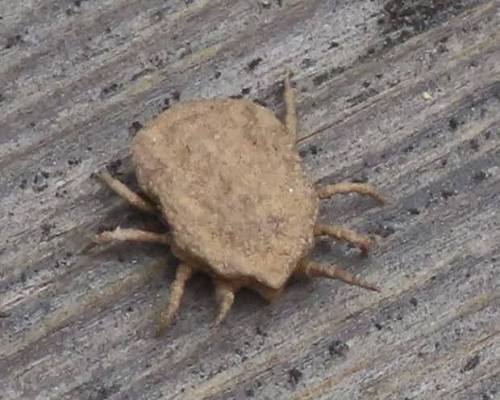
Primarily associated with deer and cattle, but may feed on other mammals and Occasionally humans.
Found in dry, brushy, and wooded areas, especially in soil, leaf litter, and areas where deer or cattle rest, primarily in the western United States and parts of Mexico.
Bites can be very painful and cause a significant local reaction. Not known to transmit an established human disease, but it is an important vector of epizootic bovine abortion (foothill abortion) in cattle.
 Identification & Key Features
 Identification & Key Features
 The Pajaroello tick looks very different from most familiar hard ticks.
As a soft tick, it:
- Lacks a hard dorsal scutum
- Has a tough but leathery body
- Has a rough, granular, or pebbled surface
- Has a broad body with a somewhat pointed anterior end
- Possesses two pairs of eyes along the sides of the body
- In nymphs and adults, has mouthparts positioned on the underside of the body
- In nymphs and adults, generally has mouthparts that are not visible when viewed from above
The presence of two pairs of eyes is an especially useful identification feature. Detailed morphological studies describe O. coriaceus as the only Ornithodoros species in the Western Hemisphere known to have two pairs of eyes.
Adults are relatively large for soft ticks, generally measuring roughly around 1 centimeter in length when unfed, although size varies among specimens and sources.
Adult Female
Adult females:
- Have 8 legs
- Lack a scutum
- Have a broad, leathery body
- Are generally earthy tan, grayish tan, or brown
- Have a rough, granular surface
- Have a somewhat pointed anterior end
- Have mouthparts located underneath the body
- Have two pairs of lateral eyes
- Feed rapidly compared with most hard ticks
- Live primarily off-host between blood meals
Unlike female hard ticks, female Pajaroello ticks do not have a small anterior scutum surrounded by a dramatically expandable abdomen.
The entire dorsal surface has the characteristic soft-tick appearance.
Adult Male
Adult males:
- Have 8 legs
- Lack a scutum
- Have a leathery, rough-textured body
- Have mouthparts positioned underneath the body
- Have two pairs of eyes
- Resemble adult females externally
- Feed rapidly and spend most of their lives away from hosts
Unlike many hard ticks, the difference between adult male and female Pajaroello ticks is not immediately obvious from the dorsal surface.
Adult sex is more reliably determined by examining structures such as the genital opening on the underside of the tick, generally under magnification.
Nymph
Nymphs:
- Have 8 legs
- Lack a scutum
- Resemble smaller adults
- Have a rough, leathery body
- Have mouthparts positioned ventrally
- Lack the developed genital opening used to distinguish adult males and females
- Feed rapidly
- Drop from the host after feeding
- May pass through multiple nymphal instars
Pajaroello ticks have a multihost soft-tick life cycle.
Depending on environmental conditions, nymphs may take blood meals from several different hosts, dropping off and molting between feeding episodes before eventually developing into adults.
Larva
Larvae:
- Have 6 legs
- Are considerably smaller than nymphs and adults
- Are the first feeding stage after hatching
- Respond to host cues such as heat and carbon dioxide
- Attach to suitable vertebrate hosts
- Feed much longer than nymphs and adults
- Drop from the host after feeding
- Later molt into the first nymphal stage
Unlike the later life stages, the larval capitulum and mouthparts project from the anterior portion of the body rather than being positioned entirely on the underside.
Studies have reported larval feeding periods ranging roughly from 7–14 days.
This is a major contrast with the later stages:
Larva — prolonged feeding
versus
Nymphs and Adults — rapid feeding, generally within approximately 15–60 minutes.
Other Identification Features
Important characteristics of Ornithodoros coriaceus include:
- Soft tick — family Argasidae
- No dorsal scutum
- Rough, leathery or granular integument
- Pointed or “nosed” anterior end
- Two pairs of eyes
- Adults and nymphs with 8 legs
- Larvae with 6 legs
- Mouthparts generally hidden from above in nymphs and adults
- Rapid-feeding nymphs and adults
- Strong association with deer and cattle resting sites
Older CDC morphological keys also identify O. coriaceus by the combination of lateral eyes and characteristic structures on the leg tarsi.
Using a magnifier can help make the tick’s eyes, body texture, legs, body margins, and other identification features easier to see.
Reliable identification—particularly of immature soft ticks—may still require microscopic examination.
Distinguishing It From Other Soft Ticks
The Pajaroello tick may be confused with other western Ornithodoros ticks.
A particularly useful distinction is:
Pajaroello Tick — Ornithodoros coriaceus
- Relatively large
- Rough, leathery body
- Distinctive pointed anterior end
- Two pairs of eyes
- Associated particularly with deer and cattle bedding sites
- Painful human bite
- Established vector of Epizootic Bovine Abortion
Relapsing-Fever Soft Ticks — e.g., Ornithodoros hermsi and O. turicata
- Lack the distinctive two pairs of eyes characteristic of O. coriaceus
- Are strongly associated with rodent nests, cabins, caves, or burrows
- Certain species are established vectors of Soft Tick Relapsing Fever
The combination of morphology, geography, and habitat is therefore useful when differentiating these ticks.
Geographic Distribution & Habitat
Geographic Distribution & Habitat The Pajaroello tick occurs in western North America.
Confirmed U.S. populations have been documented in:
- California
- Northern and western Nevada
- Southern Oregon
The range continues southward through parts of Mexico.
Regional vector resources describe O. coriaceus from elevations of approximately:
600–8,000 feet
although the species is not uniformly distributed throughout that entire elevation range.
California
California is the principal U.S. area associated with the Pajaroello tick.
UC Davis describes the species from coastal and Sierra foothill habitats extending from San Diego County north to Humboldt County.
Historically important habitats include:
- Coastal mountain ranges
- Sierra Nevada foothills
- Oak woodland
- Chaparral
- Foothill cattle ranges
Common Habitats
Pajaroello ticks are strongly associated with the resting places of large mammalian hosts.
Typical habitat includes:
- Deer bedding sites
- Cattle resting areas
- Soil beneath trees
- Leaf litter
- Chaparral
- Oak woodland
- Beneath shrubs
- Areas around large rocks
- Dry foothill environments
- Rangeland used by deer and cattle
Veterinary references describe the tick as occupying deer beds beneath trees and near large rocks in hillside scrub-oak habitat.
UC Davis similarly notes that the species occurs in and around the resting places of large mammalian hosts, particularly deer and cattle.
Host-Seeking Behavior
Pajaroello ticks spend most of their lives off the host.
They remain hidden in:
- Soil
- Leaf litter
- Organic debris
- Bedding sites
and respond rapidly when a suitable animal arrives.
Carbon dioxide from a resting animal is an important host cue. Field researchers have successfully collected O. coriaceus using dry ice as a carbon-dioxide attractant.
This ecology means a person may encounter the tick while:
- Hunting
- Camping
- Sitting or sleeping on the ground
- Resting beneath trees
- Entering deer bedding sites
Spending time around cattle resting areas
Life Cycle & Seasonal Activity
Life Cycle & Seasonal Activity The Pajaroello tick has the general soft-tick life cycle:
Egg → 6-Legged Larva → Multiple 8-Legged Nymphal Instars → Adult
It has a multihost life cycle.
Unlike the Winter Tick or Spinose Ear Tick, it does not normally remain on one host throughout its parasitic development.
Eggs
After blood feeding and mating, adult females seek protected areas in:
- Soil
- Leaf litter
- Organic debris
- Sheltered areas around animal bedding sites
and deposit eggs.
The eggs later hatch into 6-legged larvae.
Larvae
Larvae:
- Detect suitable hosts
- Attach and feed
- Remain attached considerably longer than later life stages
- Feed for a prolonged period, with studies reporting approximately 7–14 days
- Drop from the host
- Molt in the environment into a nymph
Because larvae remain attached for days, they have greater potential than later stages to be transported over longer distances by mobile animals such as deer.
Nymphs
Nymphs:
- Have 8 legs
- Live primarily in the environment between meals
- Locate resting hosts
- Feed rapidly
- Generally detach within approximately 15–60 minutes
- Return to the environment
- Molt into another nymphal instar
Several nymphal feeding and molting cycles may occur.
A detailed ecological study reported that nymphs may take blood meals from approximately three to seven hosts, dropping and molting between meals before eventually reaching adulthood.
Adults
Adults:
- Have 8 legs
- Spend most of their lives off-host
- Locate animals when they enter established bedding areas
- Feed rapidly
- Commonly reach repletion within less than an hour
- Drop back into the environment after feeding
Adult females subsequently seek sheltered sites in which to reproduce and lay eggs.
Rapid Feeding
Rapid feeding is an important feature of this tick.
Studies of nymphal and adult Pajaroello ticks report blood meals commonly completed in approximately:
15–60 minutes
after which the tick detaches.
This means a person may be bitten and the tick may already be gone before the bite reaction becomes obvious.
Seasonal Activity
Pajaroello tick activity is influenced strongly by:
- Temperature
- Moisture
- Host availability
- Local climate
UC Davis Veterinary Medicine reports that tick activity depends on temperature and moisture, with feeding occurring most during dry, hot months.
For a national website, the most accurate summary is:
Pajaroello ticks are particularly active during warm, dry conditions, but exposure depends heavily on local climate and whether people or animals enter infested deer or cattle bedding sites.
A rigid nationwide spring-to-fall activity period should not be assigned to this species.
Diseases & Health Risks
Diseases & Health Risks The Pajaroello tick is medically and veterinary important for two very different reasons:
- Its bite can cause a painful and sometimes severe local skin reaction in people.
- It is the established vector of Epizootic Bovine Abortion in cattle.
Importantly, current California public-health guidance does not recognize O. coriaceus as transmitting an established human infectious disease.
Painful Bite & Local Skin Injury
The Pajaroello tick is especially well known for the severity of its bite reaction.
Unlike many tick bites, which may initially be painless, a Pajaroello tick bite can be distinctly painful.
The bite can produce a marked local inflammatory and toxic reaction associated with components of the tick’s saliva.
Possible Bite-Site Reactions
A bite may produce:
- Immediate or developing pain
- Burning
- Redness
- Localized swelling
- Inflammation
- Blistering
- Pustule formation
- Ulceration
- Tissue damage
- A dark crust or eschar
Current medical references describe O. coriaceus bites as capable of causing vesiculation, pustulation, ulceration, eschar formation, swelling, and pain.
Repeated Bites
Repeated exposure may produce stronger local reactions in some people.
Regional vector guidance notes that subsequent Pajaroello tick bites can worsen the local response experienced with previous bites.
Secondary Infection
If an ulcer develops, damaged skin can occasionally become secondarily infected.
Seek medical evaluation for:
- Severe or increasing pain
- Expanding swelling
- Significant ulceration
- Drainage or pus
- Increasing redness
- Fever
- A wound that is not healing normally
Epizootic Bovine Abortion
Foothill Abortion
Cause: Pajaroellobacter abortibovis
Vector: Ornithodoros coriaceus
The Pajaroello tick is the established vector of Epizootic Bovine Abortion (EBA), commonly called:
Foothill Abortion
This is one of the most important veterinary associations of the species.
Geographic Importance
EBA is particularly important in beef cattle raised in:
- California
- Northern Nevada
- Southern Oregon
especially in foothill and mountain rangelands where Pajaroello ticks occur.
How Infection Occurs
A susceptible pregnant cow or heifer becomes infected when bitten by an infected Pajaroello tick.
The bacterium generally produces little or no significant illness in the adult cow, but infection can have devastating effects on the developing fetus.
Effects on Pregnancy
The disease may result in:
- Late-term abortion
- Stillbirth
- Birth of a weak calf
- Death of the calf shortly after birth
UC Davis reports that fetal loss typically occurs approximately four months after the cow becomes infected.
Current Pathogen Name
The causative bacterium is:
Pajaroellobacter abortibovis
The name specifically reflects the relationship between the organism, the Pajaroello tick, and bovine abortion.
Current 2026 veterinary research continues to identify Pajaroellobacter abortibovis as the etiologic agent of EBA.
Veterinary Prevention
A vaccine against EBA is available for cattle in affected western regions.
Because vaccination involves specific timing relative to breeding and pregnancy, cattle producers in endemic areas should work with a livestock veterinarian when considering vaccination or other EBA-prevention strategies.
Borrelia coriaceae — Important Clarification
A relapsing-fever-group spirochete called:
Borrelia coriaceae
has been isolated from and detected in Ornithodoros coriaceus.
The bacterium can persist transstadially, and occasional passage from infected females to eggs has also been demonstrated.
However, this requires an important clarification.
Human Disease Has Not Been Established
Current California Department of Public Health guidance states that O. coriaceus has no pathogen established as being transmitted to humans, and that the ability of its associated Borrelia coriaceae to infect and cause illness in humans remains unresolved.
Therefore:
Do not list Borrelia coriaceae infection or Soft Tick Relapsing Fever as an established human disease transmitted by the Pajaroello tick.
This distinction is especially important because other Ornithodoros ticks are established human relapsing-fever vectors.
Important Soft Tick Relapsing Fever Clarification
The Pajaroello tick belongs to the same genus as several relapsing-fever ticks, but that does not mean every Ornithodoros species is a proven STRF vector.
In the United States, well-established relationships include:
Herms’ Soft Tick
Ornithodoros hermsi
→ Borrelia hermsii
and
Turicata Soft Tick
Ornithodoros turicata
→ Borrelia turicatae
CDC recognizes these tick-pathogen associations with U.S. Soft Tick Relapsing Fever (STRF).
By contrast:
Ornithodoros coriaceus is not currently established as a human STRF vector.
Important Lyme Disease Clarification
The Pajaroello tick is not a recognized vector of Lyme disease.
The established U.S. Lyme disease vectors are:
- Ixodes scapularis — Blacklegged Tick
- Ixodes pacificus — Western Blacklegged Tick
The fact that O. coriaceus can harbor a Borrelia species should not be confused with Lyme disease transmission.
Important to Know
The greatest established human-health concern from a Pajaroello tick bite is:
The bite itself and the resulting local inflammatory/toxic reaction.
Its principal established infectious-disease role is veterinary:
Pajaroellobacter abortibovis → Epizootic Bovine Abortion
Detection of another microorganism within the tick does not automatically prove that the tick transmits that organism to humans or causes human disease.
Bite Prevention & Protection
Bite Prevention & Protection Prevention should focus on the Pajaroello tick’s unusual ecology.
These ticks are especially associated with animal resting and bedding sites, rather than simply questing high on vegetation like many hard ticks.
When Outdoors
To reduce exposure:
- Avoid sitting or sleeping directly in deer bedding areas.
- Avoid resting on soil or leaf litter beneath trees heavily used by deer or cattle.
- Be cautious around obvious cattle resting areas.
- Avoid placing sleeping bags directly on bare ground in suspected habitat.
- Use a tent, cot, sleeping pad, or ground barrier when camping.
- Use an EPA-registered insect repellent according to label directions.
- Treat clothing and outdoor gear with products containing 0.5% permethrin, or use commercially pretreated clothing.
- Wear long pants, socks, and closed shoes when practical.
Hunters and campers should be particularly careful when using sheltered sites beneath:
- Oaks
- Chaparral
- Large shrubs
- Rocks
that show signs of repeated deer or cattle use.
After Outdoor Activity
Check:
- Your skin
- Clothing
- Camping gear
- Sleeping bags
- Pets
- Equipment
However, tick checks have an important limitation for this species.
Because nymphal and adult Pajaroello ticks can complete a blood meal within less than an hour, the tick may have already detached by the time a person notices the bite reaction.
Therefore:
Not finding a tick does not rule out a Pajaroello tick bite.
Around Livestock
For cattle operations in Pajaroello tick habitat:
- Be aware of deer and cattle bedding areas.
- Discuss EBA risk with a livestock veterinarian.
- Consider appropriate EBA vaccination strategies where indicated.
- Manage pregnant susceptible cattle according to veterinary and local extension recommendations.
If You Find an Attached Tick
If a Pajaroello tick is still attached to accessible skin, remove it as soon as possible.
How to Remove a Tick
- Use clean fine-tipped tweezers.
- Grasp the tick as close to the skin’s surface as possible.
- Pull the tick away from the skin with steady, even pressure.
- Do not twist or jerk the tick.
- If mouthparts remain and can be removed easily with tweezers, remove them. If they cannot be removed easily, leave them alone and allow the skin to heal.
- Dispose of the tick safely.
- Thoroughly clean the bite area and your hands.
- Check the rest of your body for additional ticks.
CDC’s current June 9, 2026 guidance recommends prompt mechanical removal and advises against delaying removal while waiting for medical care.
Do not attempt to force a tick to detach using:
- Petroleum jelly
- Nail polish
- Heat
- Other substances or chemicals
After a Pajaroello Tick Bite
Because the bite itself may cause significant tissue inflammation, monitor the site carefully.
Seek medical attention for:
- Severe pain
- Significant swelling
- Blistering
- Pustule formation
- Developing ulceration
- A dark eschar
- Drainage
- Increasing redness
- Signs of secondary infection
- A lesion that fails to heal normally
A healthcare provider should be told that the suspected tick was:
Ornithodoros coriaceus — Pajaroello / Pajahuello Tick
because its characteristic bite reaction differs from that of many other ticks.
Tick Testing
CDC generally does not recommend commercial tick testing to guide medical treatment decisions after a tick bite.
This is particularly important for the Pajaroello tick because:
- It is not an established human vector of a major infectious disease
- Borrelia coriaceae may be found in the species
- Detection of a microorganism in the tick would not establish that human transmission occurred
Clinical decisions should therefore be based on the person’s symptoms, exposure history, and medical evaluation rather than a commercial tick-test result.
Identification Gallery
Identification Gallery Adult
- Large, soft-bodied tick
- Tan to gray-brown coloration
- Rough, leathery surface
- Pointed front end
- No scutum
- 8 legs
Adult Female
- Broad, leathery body
- Granular surface
- 8 legs
- Mouthparts generally hidden from above
- Two pairs of lateral eyes
Male and female Pajaroello ticks can look similar, so use a verified specimen when identifying sex.
Adult Male
- 8 legs
- Rough, soft body
- No scutum
- Two pairs of eyes
- Ventral genital structures when visible
Nymph
- Smaller than adults
- 8 legs
- Rough, leathery body
- No scutum
- Mouthparts generally hidden from above
If available, show more than one nymphal stage.
Larva
- Very small body
- 6 legs
- Mouthparts near the front
- Size comparison with a nymph or adult
Note: Pajaroello tick larvae may remain attached for approximately 7–14 days, much longer than nymphs and adults.
Fed vs. Unfed
Unfed → Fed
.
Dorsal vs. Ventral View
Dorsal View
- Rough, leathery surface
- No scutum
- Mouthparts generally hidden
- Paired eyes along the sides
Ventral View
- Mouthparts visible underneath
- Legs and other structures easier to see
Caption:
The Pajaroello tick has two pairs of eyes, a useful feature for distinguishing O. coriaceus from many other western soft ticks.
Life Stages
Egg → 6-Legged Larva → Nymphal Stages → Adult → Eggs
Larvae feed for several days, while nymphs and adults generally take much faster blood meals.
Pajaroello Tick vs. Herms’ Soft Tick
Pajaroello Tick — Ornithodoros coriaceus
- Larger, rough-bodied soft tick
- Two pairs of eyes
- Often associated with deer and cattle resting areas
- Bite can cause a strong local reaction
- Vector of Epizootic Bovine Abortion
- No established human pathogen transmission
Herms’ Soft Tick — Ornithodoros hermsi
- Commonly associated with rodent nests and mountain cabins
- Does not have the characteristic two pairs of eyes
- Vector of Borrelia hermsii
- Associated with Soft Tick Relapsing Fever
Pajaroello ticks live in soil and leaf litter near animal resting sites and emerge to feed when a host is present.
Pajaroello tick bites may cause pain, swelling, blistering, ulceration, or an eschar from the local effects of tick saliva.

