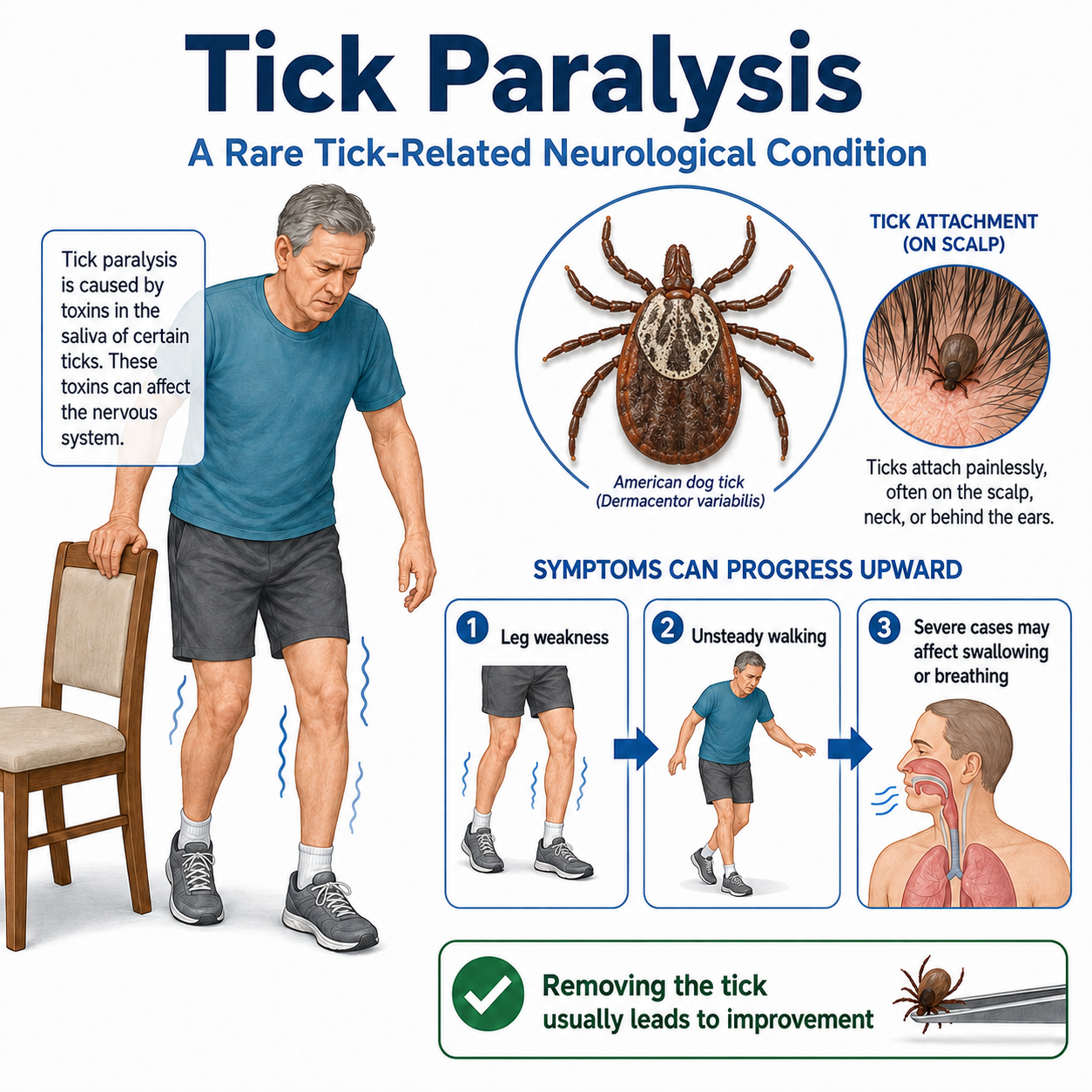
Tick Paralysis: A Rare Tick-Related Neurological Condition
What Is Paralysis?
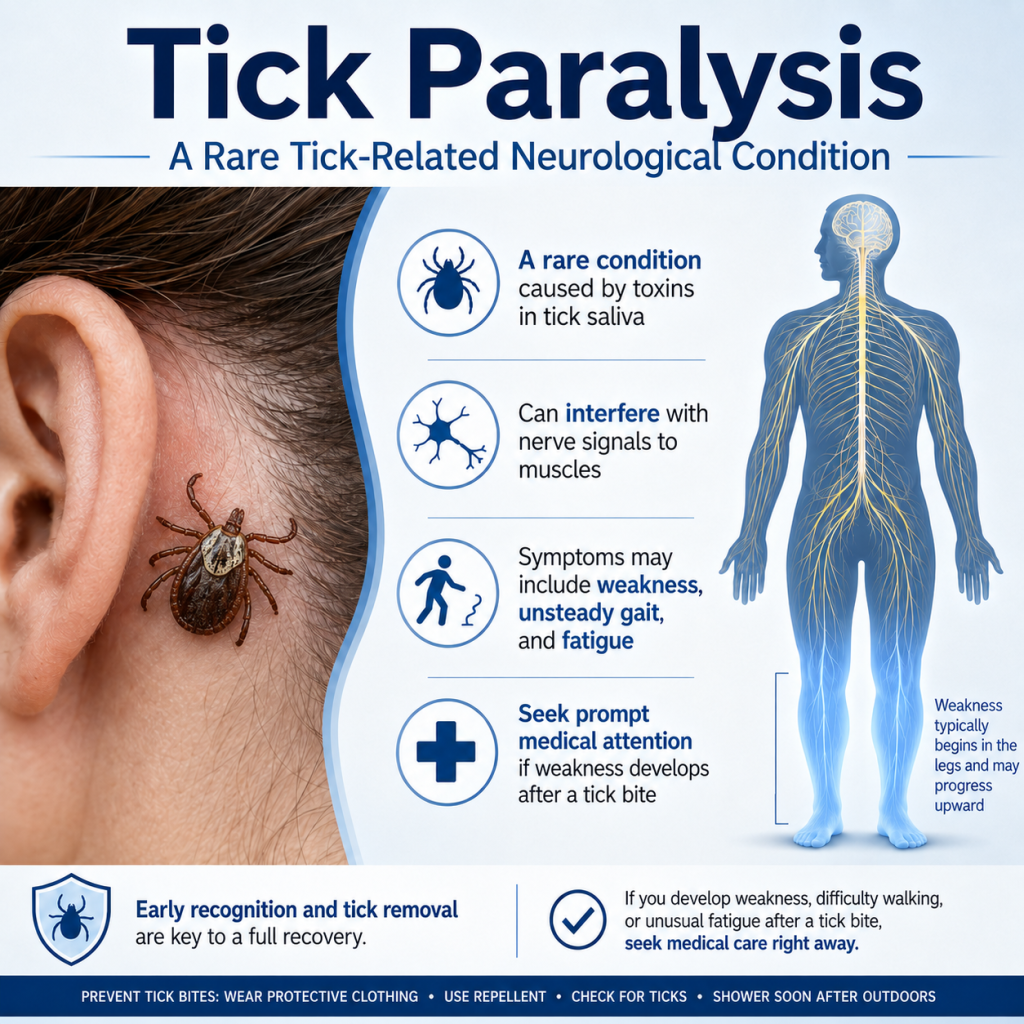
Tick paralysis is a rare but potentially serious neurological condition thought to be caused by a neurotoxin released in the saliva of certain ticks while they are attached and feeding.
Unlike Lyme disease, Rocky Mountain spotted fever, babesiosis, and many other illnesses associated with ticks, tick paralysis is not an infection. It is not caused by a bacterium, virus, or parasite. Instead, exposure to a toxin released during tick feeding can interfere with normal nerve and muscle function.
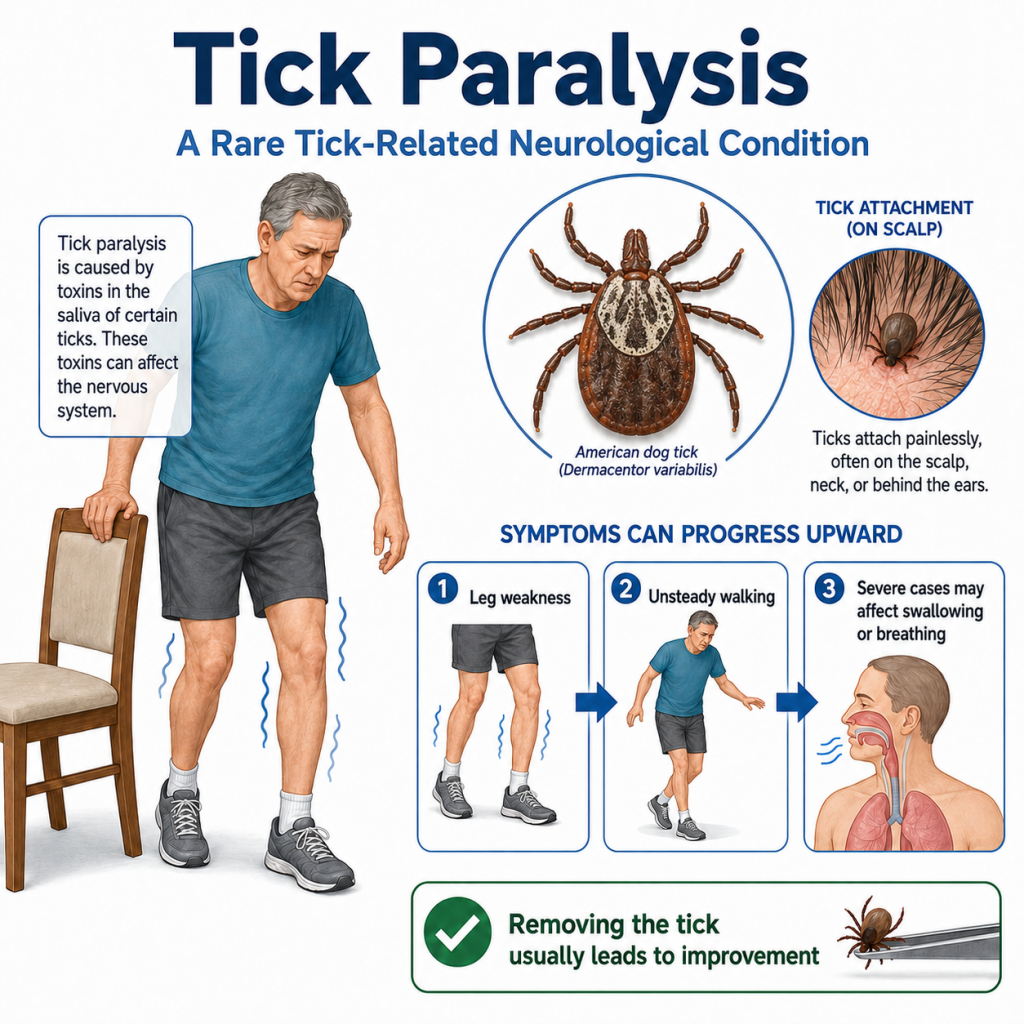
The condition typically develops after a tick has remained attached and fed for several days. If the tick is not discovered and removed, weakness can progress upward through the body and, in severe cases, affect the muscles needed for swallowing and breathing. Current Washington State guidance notes that symptoms typically begin after the tick has fed for approximately 4–7 days.
Tick paralysis is usually reversible when recognized and the responsible tick is promptly removed, although severe cases may require hospitalization and respiratory support.
What Causes Tick Paralysis?
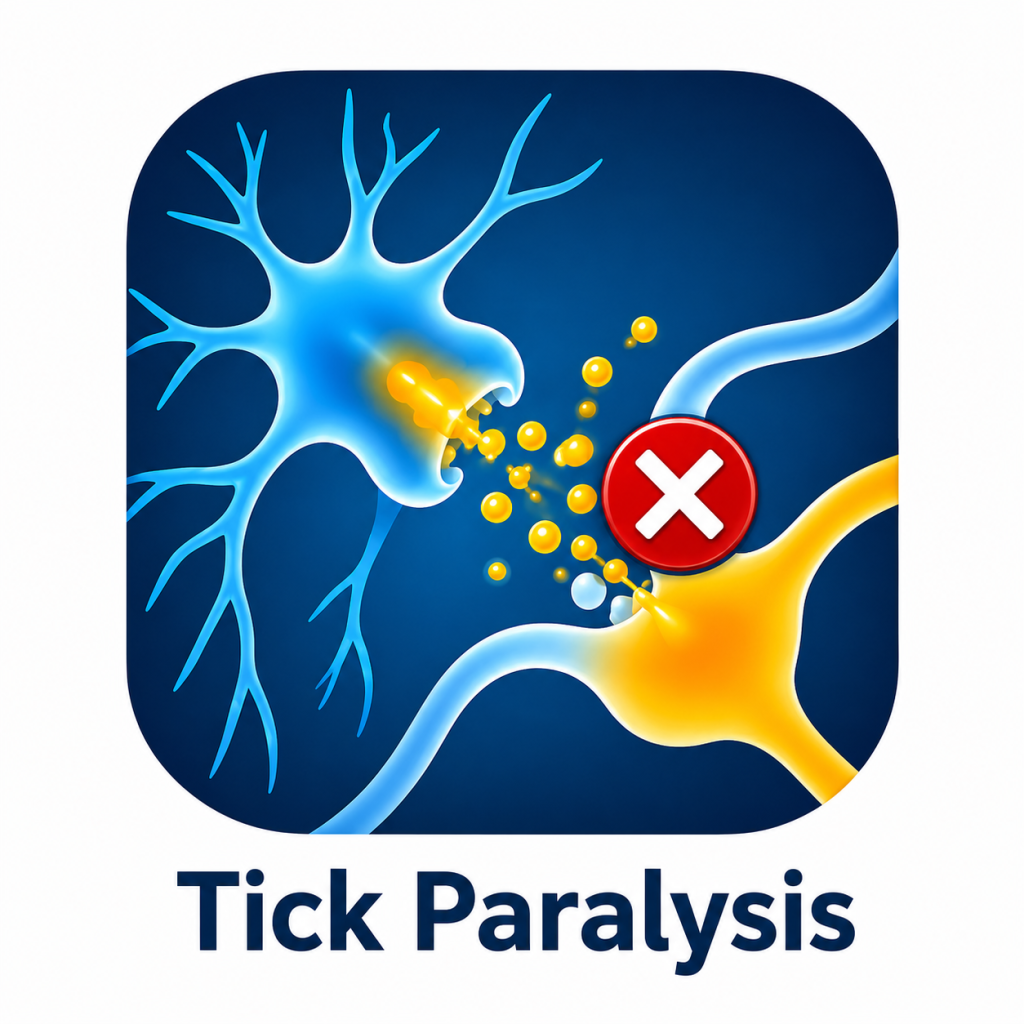
Tick paralysis is thought to result from a neurotoxin released in the saliva of certain attached, feeding ticks.
The toxin interferes with normal neuromuscular function and can disrupt the ability of nerves to properly activate muscles. The exact mechanism is not completely understood and may vary among tick species.
Paralysis generally does not occur immediately after a tick attaches. Symptoms usually develop after the tick has been feeding for several days, although the exact timing can vary.
Which Ticks Can Cause Tick Paralysis?
Many tick species around the world have been associated with tick paralysis.
In the United States and Canada, human tick paralysis has historically been associated most often with:
Rocky Mountain Wood Tick
Dermacentor andersoni
The Rocky Mountain wood tick has historically been an important cause of human tick paralysis in western North America.
American Dog Tick
Dermacentor variabilis
The American dog tick is another important species historically associated with human tick paralysis in North America.
Older CDC reports identify D. andersoni and D. variabilis as the species most often associated with recognized cases in the United States and Canada.
Western Dog Tick
Dermacentor similis
In 2021, scientists formally recognized Dermacentor similis as a distinct species comprising western populations that had previously been classified as Dermacentor variabilis.
CDC now recognizes D. similis as a distinct species found primarily west of the Rocky Mountains and notes that it is closely related to, but distinct from, D. variabilis.
Because many historical reports predate this taxonomic change, some older western U.S. records attributed to D. variabilis may actually have involved ticks now classified as D. similis.
Other tick species have also been implicated in tick paralysis, including species within the Dermacentor, Amblyomma, and Ixodes genera.
Where Does Tick Paralysis Occur?
Tick paralysis has been reported worldwide.
In North America, many historically recognized cases have occurred in the western United States and western Canada, although cases can occur in other regions where capable tick species are present.
In Australia, tick paralysis is strongly associated with the Australian paralysis tick (Ixodes holocyclus), particularly along portions of Australia’s eastern coast.
Historically, most recognized North American cases have occurred during spring and early summer, especially April through June, corresponding with seasonal activity of adult Dermacentor ticks involved in many reported cases.
However, tick activity varies according to tick species, geographic region, climate, and environmental conditions. Tick paralysis can potentially occur whenever a toxin-producing tick is active, attaches, and feeds long enough to cause symptoms.
What Are the Symptoms of Tick Paralysis?
Tick paralysis often begins with unsteadiness, loss of coordination, or weakness of the legs.
Symptoms can then progress over hours to days.
Possible symptoms include:
- Unsteady walking
- Loss of coordination
- Weakness in the legs
- Difficulty standing or walking
- Muscle weakness
- Reduced or absent reflexes
- Weakness spreading upward through the body
- Weakness of the arms
- Facial or other cranial nerve weakness
- Difficulty speaking
- Difficulty swallowing
- Difficulty breathing
The classic neurological pattern is known as ascending flaccid paralysis, in which weakness generally begins in the lower body and progresses upward.
Some people may also experience sensory symptoms such as numbness, but progressive muscle weakness and paralysis are the defining neurological features.
In severe cases, paralysis can involve the muscles responsible for breathing, resulting in respiratory failure.
What Is Ascending Paralysis?
Ascending paralysis means that muscle weakness or paralysis generally begins in the lower part of the body and progresses upward.
A possible progression is:
Unsteady walking → Leg weakness → Increasing paralysis → Arm weakness → Facial or swallowing weakness → Breathing difficulties
Not everyone with tick paralysis progresses through every stage.
Promptly finding and removing the responsible tick stops continued exposure to the tick’s toxin and is the most important part of treatment.
Who Is Most at Risk?
Tick paralysis can occur in both children and adults.
Historically, many reported North American cases have occurred in children, particularly young children. Older North American reports found a high proportion of cases among girls younger than 10 years.
One reason tick paralysis can be overlooked in children is that an attached tick may be hidden beneath the hair or on the scalp, making it difficult to detect.
Adults can also develop tick paralysis, including severe cases.
Anyone exposed to ticks can potentially be affected if a toxin-producing tick attaches and feeds long enough to cause symptoms.
Where Can the Tick Be Hidden?
The responsible tick may be difficult to find.
When tick paralysis is suspected, the entire body should be carefully examined, including:
- Scalp and hair
- Hairline
- Behind and around the ears
- Back of the head
- Neck
- Under the arms
- Around the waist
- Groin
- Behind the knees
- Other skin folds and difficult-to-see areas
The scalp, hair, and areas around the ears are particularly important because an attached tick can easily be concealed.
A careful search of the entire body is an important part of evaluating suspected tick paralysis.
How Is Tick Paralysis Diagnosed?
There is no single laboratory test that confirms tick paralysis.
Diagnosis is primarily based on:
- The person’s neurological symptoms
- Possible exposure to ticks
- A careful examination of the entire body
- Finding an attached tick
- Improvement after the responsible tick is removed
Finding an attached tick in someone with compatible neurological symptoms and observing improvement after its removal strongly supports the diagnosis.
Because tick paralysis can resemble other neurological disorders, it may initially be confused with conditions such as:
- Guillain-Barré syndrome
- Botulism
- Myasthenia gravis
- Certain spinal cord disorders
- Electrolyte or metabolic abnormalities
- Other neurological causes of acute weakness
For this reason, a careful full-body examination—including the scalp and hair—is particularly important in someone with unexplained rapidly progressing weakness or ascending paralysis.
How Is Tick Paralysis Treated?
The most important treatment is to find and promptly remove the responsible tick or ticks.
Treatment may include:
- Prompt removal of all attached ticks
- A thorough examination for additional ticks
- Monitoring of neurological function
- Monitoring of breathing and respiratory function
- Supportive medical care
- Oxygen or mechanical respiratory assistance if breathing muscles become affected
In many North American cases, improvement begins within hours after the responsible tick is removed, and recovery can occur rapidly.
However, recovery time can vary. Paralysis may occasionally continue to progress for 24–48 hours after tick removal, so people with significant neurological or respiratory symptoms may require continued medical observation.
Post-removal worsening is particularly important to recognize with some tick species, including the Australian paralysis tick (Ixodes holocyclus).
Severe cases may require hospitalization, oxygen therapy, airway management, or mechanical respiratory support.
Is Tick Paralysis Contagious?
No.
Tick paralysis is not contagious and cannot spread from person to person.
It results from exposure to a toxin associated with an attached feeding tick rather than from an infectious organism being transmitted between people.
When Is Tick Paralysis an Emergency?
Seek immediate medical care for unexplained or rapidly progressing:
- Muscle weakness
- Difficulty walking or standing
- Loss of coordination
- Weakness moving upward through the body
- Facial weakness
- Difficulty speaking
- Difficulty swallowing
- Shortness of breath
- Difficulty breathing
Difficulty breathing, rapidly progressing paralysis, difficulty swallowing, or severe muscle weakness is a medical emergency.
If tick exposure is possible, carefully check the entire body—particularly the scalp, hair, hairline, behind the ears, neck, and other difficult-to-see areas—for an attached tick.
U.S. Guidance
In the United States, CDC recommends removing an attached tick as soon as possible rather than waiting for a healthcare provider to remove it. However, tick removal should never delay emergency medical evaluation when a person has significant weakness, rapidly progressing paralysis, difficulty swallowing, or breathing problems.
Important Note for Australia
Tick-removal recommendations differ in Australia because disturbing the Australian paralysis tick (Ixodes holocyclus) may trigger a serious allergic reaction, including anaphylaxis, in susceptible individuals.
Australian allergy guidance advises against forcibly removing an attached tick with fine-tipped tweezers. Instead, it recommends killing the tick using an appropriate freezing product and allowing it to drop off, or seeking medical assistance when appropriate. People with known tick allergy should follow specialist medical guidance.
How Can Tick Paralysis Be Prevented?
Because tick paralysis develops after exposure to toxin from an attached, feeding tick, preventing tick bites and finding attached ticks early are important preventive measures.
When spending time in grassy, brushy, wooded, or other tick habitats:
- Use an EPA-registered insect repellent according to label instructions.
- Treat clothing and outdoor gear with products containing 0.5% permethrin, or use pretreated clothing and gear.
- Do not apply permethrin products intended for clothing and gear directly to the skin.
- Wear clothing that reduces exposed skin when appropriate.
- Avoid brushing against tall grass and dense vegetation when possible.
- Check yourself and children carefully for ticks after spending time outdoors.
- Pay particular attention to the scalp and hair, especially in children.
- Check clothing, outdoor gear, and pets for ticks.
- Shower within about two hours after coming indoors, when practical.
- Perform a thorough full-body tick check.
- Remove attached ticks as soon as possible, following the appropriate guidance for the country and situation.
CDC recommends EPA-registered repellents, 0.5% permethrin-treated clothing and gear, tick checks, and showering soon after outdoor exposure. Permethrin products intended for clothing and gear should not be applied directly to skin.
How to Remove an Attached Tick in the United States
For ticks attached in the United States, CDC recommends removing the tick as soon as possible.
- Use clean, fine-tipped tweezers to grasp the tick as close to the skin’s surface as possible.
- Pull the tick away from the skin using steady, even pressure.
- Do not twist or jerk the tick.
- If mouthparts remain in the skin and cannot easily be removed with tweezers, leave them alone and allow the skin to heal.
- Clean the bite area and your hands thoroughly with soap and water, rubbing alcohol, or hand sanitizer.
- Check the rest of the body carefully for additional ticks.
Do not use petroleum jelly, heat, nail polish, or other substances to try to force an attached tick to detach.
These instructions are consistent with CDC’s current U.S. tick-removal guidance.
For Australia, follow current Australian tick-removal guidance rather than the U.S. tweezers method described above, particularly when the Australian paralysis tick (Ixodes holocyclus) or tick allergy may be involved.
Key Facts About Tick Paralysis
- Tick paralysis is rare.
- It is a toxin-mediated neurological condition, not an infectious disease.
- It is thought to be caused by a neurotoxin released in the saliva of certain feeding ticks.
- Tick paralysis has been reported worldwide.
- In the United States and Canada, the Rocky Mountain wood tick (Dermacentor andersoni) and American dog tick (Dermacentor variabilis) have historically been the species most often associated with recognized human cases.
- Dermacentor similis was recognized as a distinct western species in 2021; some historical western records attributed to D. variabilis may represent D. similis.
- Other tick species can also cause tick paralysis.
- Symptoms generally develop after the responsible tick has been attached and feeding for several days.
- A classic presentation is progressive ascending flaccid weakness or paralysis.
- Children have historically represented many reported North American cases.
- The responsible tick may be hidden in the scalp, hair, or other difficult-to-see areas.
- Severe paralysis can affect the muscles responsible for swallowing and breathing.
- There is no single laboratory test that confirms tick paralysis.
- Finding and promptly removing the responsible tick is the most important treatment.
- Many North American patients begin improving within hours after tick removal.
- Paralysis can occasionally continue progressing for 24–48 hours after removal, so significant cases require appropriate medical monitoring.
- Tick-removal recommendations are not identical worldwide; Australian guidance differs because of the risk of serious allergic reactions associated with disturbing Ixodes holocyclus.
- Prompt recognition is important because severe tick paralysis can become life-threatening.
Educational Disclaimer
This information is provided for educational purposes only and is not a substitute for professional medical advice, diagnosis, or treatment.
If you or someone else develops unexplained weakness, difficulty walking, loss of coordination, progressive paralysis, difficulty speaking, difficulty swallowing, or breathing problems after known or possible tick exposure, seek prompt medical evaluation and mention the possible tick exposure.
Difficulty breathing, rapidly progressing paralysis, difficulty swallowing, or severe muscle weakness requires immediate emergency medical attention.