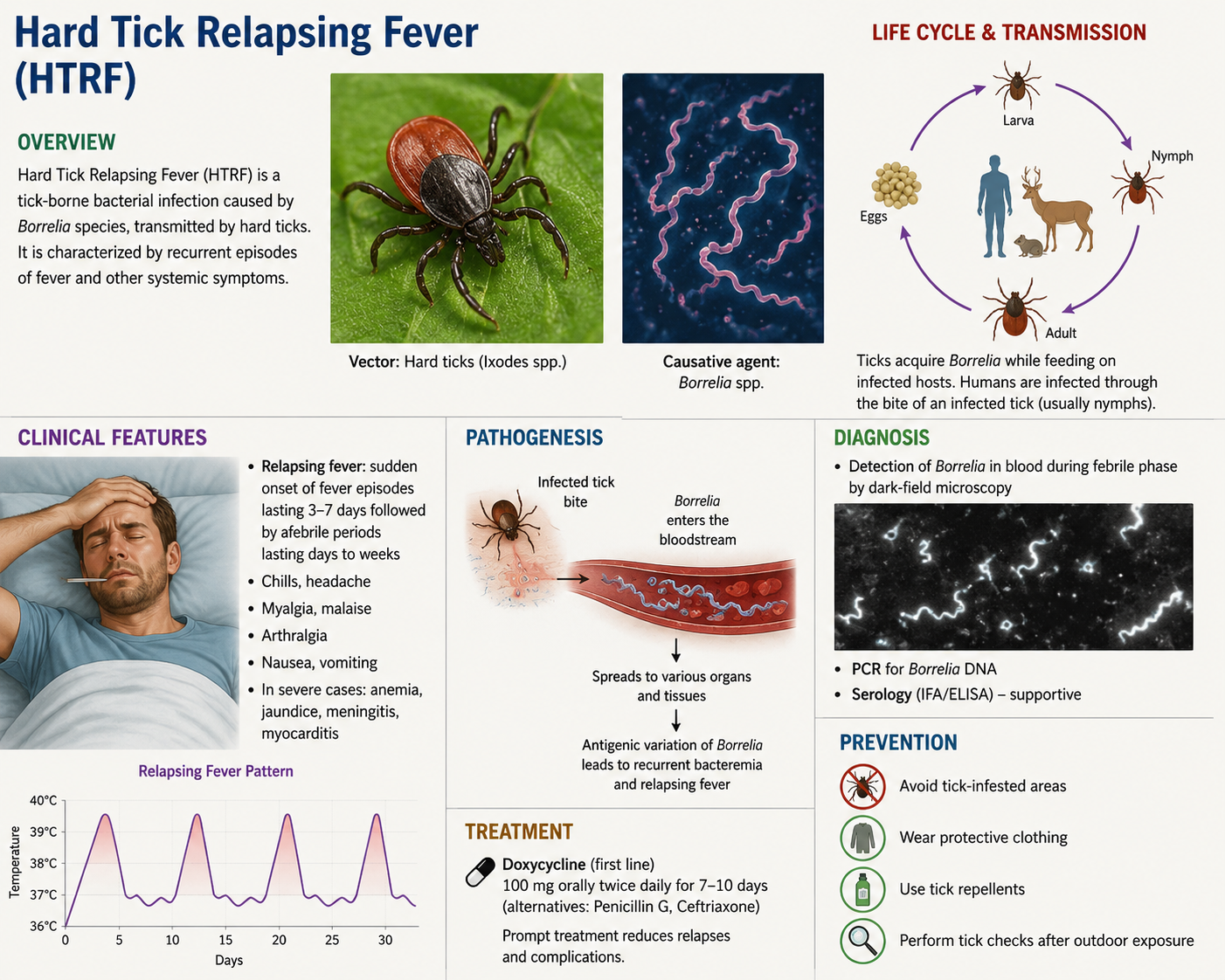
Hard Tick Relapsing Fever (HTRF): An Emerging Tickborne Bacterial Disease
What Is Hard Tick Relapsing Fever?
Hard tick relapsing fever (HTRF) is a tickborne disease caused by Borrelia miyamotoi bacteria. It is transmitted to people through the bites of infected blacklegged ticks (Ixodes scapularis) and western blacklegged ticks (Ixodes pacificus).
The term hard tick relapsing fever helps distinguish infections with relapsing-fever Borrelia transmitted by hard ticks, such as B. miyamotoi, from relapsing-fever infections transmitted by soft ticks and caused by other Borrelia species.
CDC describes HTRF as an emerging infection that is likely underrecognized and underreported because its symptoms can be nonspecific, awareness among healthcare providers may be limited, and diagnosis can be challenging.
Despite the name “relapsing fever,” evidence suggests that HTRF most commonly causes a single episode of fever. Relapsing fever has been documented in approximately 10% of cases.
HTRF is reportable in some states. CDC is working with state health departments to standardize surveillance in states where HTRF is reportable and to improve healthcare provider education and recognition.
Babesiosis is a disease caused by microscopic Babesia parasites that infect red blood cells. In the United States, most infections are transmitted through the bite of an infected blacklegged tick.
Several species of Babesia can infect people, but Babesia microti is the most common cause of human babesiosis in the United States.
Some people infected with Babesia do not develop symptoms. Others may experience a flu-like illness, and certain people can develop serious or potentially life-threatening complications.
In the United States, babesiosis occurs most commonly in the Northeast and upper Midwest, although cases can occur elsewhere. Babesiosis is a nationally notifiable condition. As of CDC’s July 23, 2026 update, 41 states and the District of Columbia notify CDC of cases.
How Do Ticks Spread HTRF?
HTRF is transmitted through the bite of an infected:
- Blacklegged tick (Ixodes scapularis)
- Western blacklegged tick (Ixodes pacificus)
These ticks can also transmit pathogens responsible for several other tickborne diseases. CDC identifies B. miyamotoi as a pathogen transmitted by both the blacklegged tick and western blacklegged tick.
Hard ticks generally feed slowly over several days. According to CDC, the longer an infected tick remains attached, the more likely it is to transmit B. miyamotoi. CDC does not provide a specific minimum attachment time for HTRF transmission in its current HTRF guidance.
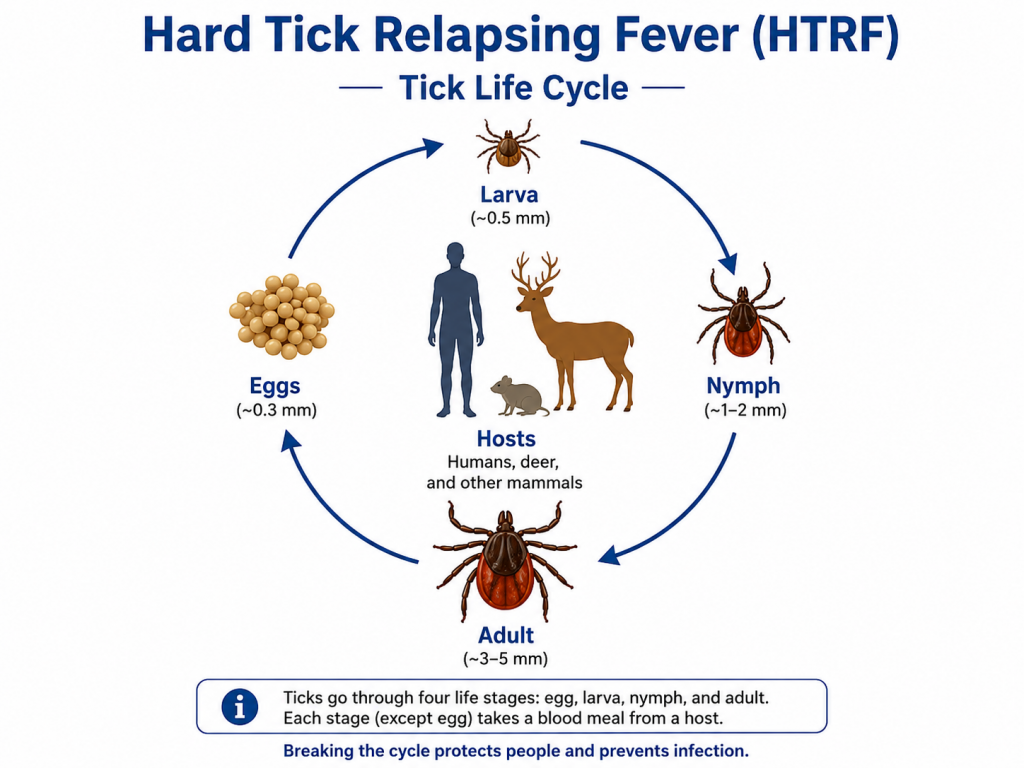
CDC surveillance has identified B. miyamotoi in populations of blacklegged and western blacklegged ticks in the United States, with current surveillance maps showing detections through 2025.
Where Does HTRF Occur?
In the United States, HTRF occurs primarily in:
- Upper Midwestern states
- Northeastern states
- Mid-Atlantic states
- Pacific coastal states
In the upper Midwest, Northeast, and mid-Atlantic regions, HTRF is transmitted by the blacklegged tick. In Pacific coastal states, it is transmitted by the western blacklegged tick.

CDC notes that HTRF appears to be much less common than Lyme disease, and the true burden of human infection is still being evaluated.
HTRF cases peak in August, whereas Lyme disease occurs most commonly in late spring and early summer.
What Are the Symptoms of HTRF?
Signs and symptoms generally appear around two weeks after a tick bite, although they may occur anywhere from approximately 3 days to 6 weeks after exposure.
Symptoms may include:
- Fever
- Chills or shaking
- Fatigue
- Headache
- Muscle aches
- Joint aches
- Nausea
- Vomiting
Evidence suggests that most HTRF cases involve a single episode of fever, although relapsing fever has been documented in approximately 10% of cases.
CDC notes that people with HTRF are thought to often recover without treatment. However, infection can sometimes be more severe and require treatment, particularly in people with immunocompromising conditions. Severe illness, including meningoencephalitis, has been reported.
How Is HTRF Diagnosed?
HTRF can be challenging to diagnose because its symptoms can be nonspecific and may overlap with those of other tickborne and infectious diseases. CDC recommends considering clinical and epidemiologic features, along with travel and exposure history, when interpreting test results.
Polymerase chain reaction (PCR) testing for HTRF is available from some commercial laboratories. CDC identifies whole blood as the preferred specimen for PCR testing.
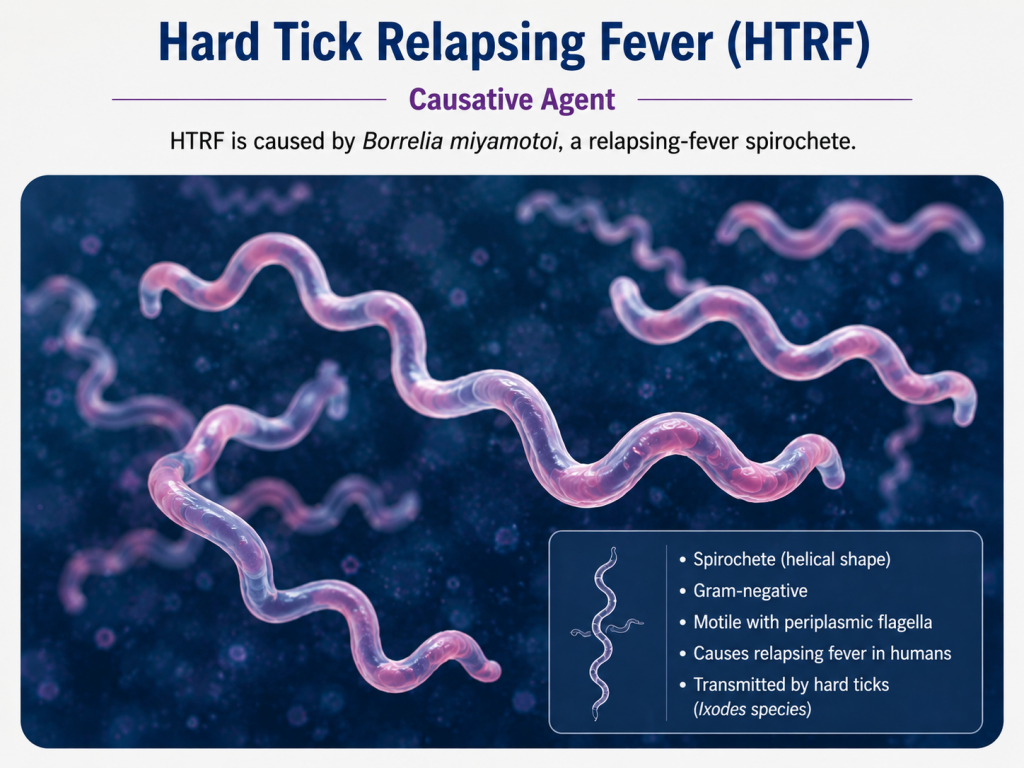
Serologic testing is also available from some laboratories. These tests are most sensitive when specimens are collected at least 14 days after symptoms begin. Serum collected early during infection may produce a negative result.
Some PCR and serologic tests may not distinguish between the agents of HTRF and soft tick relapsing fever. Some serologic and PCR tests can cross-react with other Borrelia species, and patients with relapsing fevers may have false-positive Lyme disease serologic test results.
For these reasons, healthcare providers consider symptoms, possible tick exposure, geography, and travel history when interpreting laboratory results.
How Is HTRF Treated?
HTRF is treated with antibiotics.
CDC notes that randomized controlled trials evaluating specific treatment regimens for HTRF have not been conducted. However, published case series have shown successful treatment with antibiotics that are also effective against Lyme disease.
A two-week course of oral doxycycline or amoxicillin has been found effective for most patients, including young children. People with severe illness requiring hospitalization, such as meningoencephalitis, may initially require an intravenous antibiotic such as ceftriaxone. Treatment decisions should be made by a healthcare professional based on the individual patient.
Symptoms typically improve within 24 to 72 hours after appropriate antibiotic treatment begins. A reaction known as a Jarisch-Herxheimer reaction has been reported in a minority of treated patients.
For patients with an immunocompromising condition and suspected HTRF, CDC recommends consultation with an infectious disease specialist.
How Can HTRF Be Prevented?
Preventing tick bites is the best defense against HTRF and other tickborne diseases. Promptly removing attached ticks can also help reduce the risk of tickborne disease.
To reduce your risk:
- Use an EPA-registered insect repellent according to label directions.
- Avoid wooded and brushy areas with high grass and leaf litter when possible.
- Check your body, clothing, and pets for ticks after spending time outdoors.
- Promptly remove attached ticks.
- Be especially aware of ticks when spending time in grassy, brushy, or wooded environments where blacklegged or western blacklegged ticks occur.
What Should You Do If You Find an Attached Tick?
CDC recommends removing an attached tick as soon as possible.
- Use clean, fine-tipped tweezers to grasp the tick as close to the skin’s surface as possible.
- Pull the tick away from the skin using steady, even pressure.
- Do not twist or jerk the tick.
- After removal, thoroughly clean the bite area and your hands with soap and water, rubbing alcohol, or hand sanitizer.
- Check the rest of your body carefully for additional ticks and promptly remove any you find.
If fine-tipped tweezers are not available, CDC’s current guidance states that regular tweezers or your fingers may also be used to grasp the tick close to the skin’s surface. Avoid squeezing the tick’s body.
CDC advises not to use petroleum jelly, heat, nail polish, or other substances to try to make an attached tick detach.
When Should You Contact a Healthcare Provider?
Seek medical care if you become ill after a tick bite or after spending time in grassy, brushy, or wooded areas where ticks may be present.
Tell your healthcare provider:
- That you had a recent tick bite or possible tick exposure
- When the exposure occurred
- Where you were when the exposure likely occurred
- What symptoms you are experiencing
CDC specifically recommends telling your healthcare provider about the recent tick bite, when it occurred, and where you most likely acquired the tick if you develop a rash or fever within several weeks after removing a tick.
HTRF: Important Facts to Remember
- HTRF is caused by Borrelia miyamotoi.
- It is transmitted by blacklegged ticks and western blacklegged ticks.
- CDC describes HTRF as an emerging infection that is likely underrecognized and underreported.
- HTRF occurs primarily in the upper Midwest, Northeast, mid-Atlantic, and Pacific coastal states.
- U.S. HTRF cases peak in August.
- Symptoms generally appear around two weeks after a tick bite, but may occur from approximately 3 days to 6 weeks after exposure.
- Evidence suggests that HTRF most commonly involves a single episode of fever.
- Relapsing fever has been documented in approximately 10% of cases.
- HTRF appears to be much less common than Lyme disease, and its true burden is still being evaluated.
- Antibiotics can effectively treat HTRF.
- Preventing tick bites and promptly removing attached ticks are important ways to reduce the risk of tickborne disease.
Educational Disclaimer
This information is provided for educational purposes only and is not intended to replace professional medical advice, diagnosis, or treatment.
If you develop a fever, rash, unusual fatigue, headache, body aches, nausea, vomiting, or other concerning symptoms following a known or possible tick exposure, contact a qualified healthcare provider and mention the potential tick exposure.