
Mouse Tick
Ixodes muris
The Mouse Tick is a small hard tick in the genus Ixodes that is strongly associated with rodents and their nests.
- Adult females are typically tan with a darker dorsal shield, or scutum, directly behind the head.
- Adult males are usually reddish-tan and tend to be slightly smaller than females.
- In females, the scutum covers only the front portion of the back.
- ⚫ In males, the scutum covers almost the entire dorsal surface.
- Adults and nymphs have 8 legs.
- Larvae have 6 legs.
- Identification to species can be difficult because I. muris resembles other Ixodes ticks and may require examination of small anatomical or microscopic features.
The primary host is the white-footed mouse, although this tick may also feed on other small mammals, birds, pets, and occasionally humans.
Associated with rodents & host nests
Host activity reported from spring into fall
Very weak vector of Lyme disease
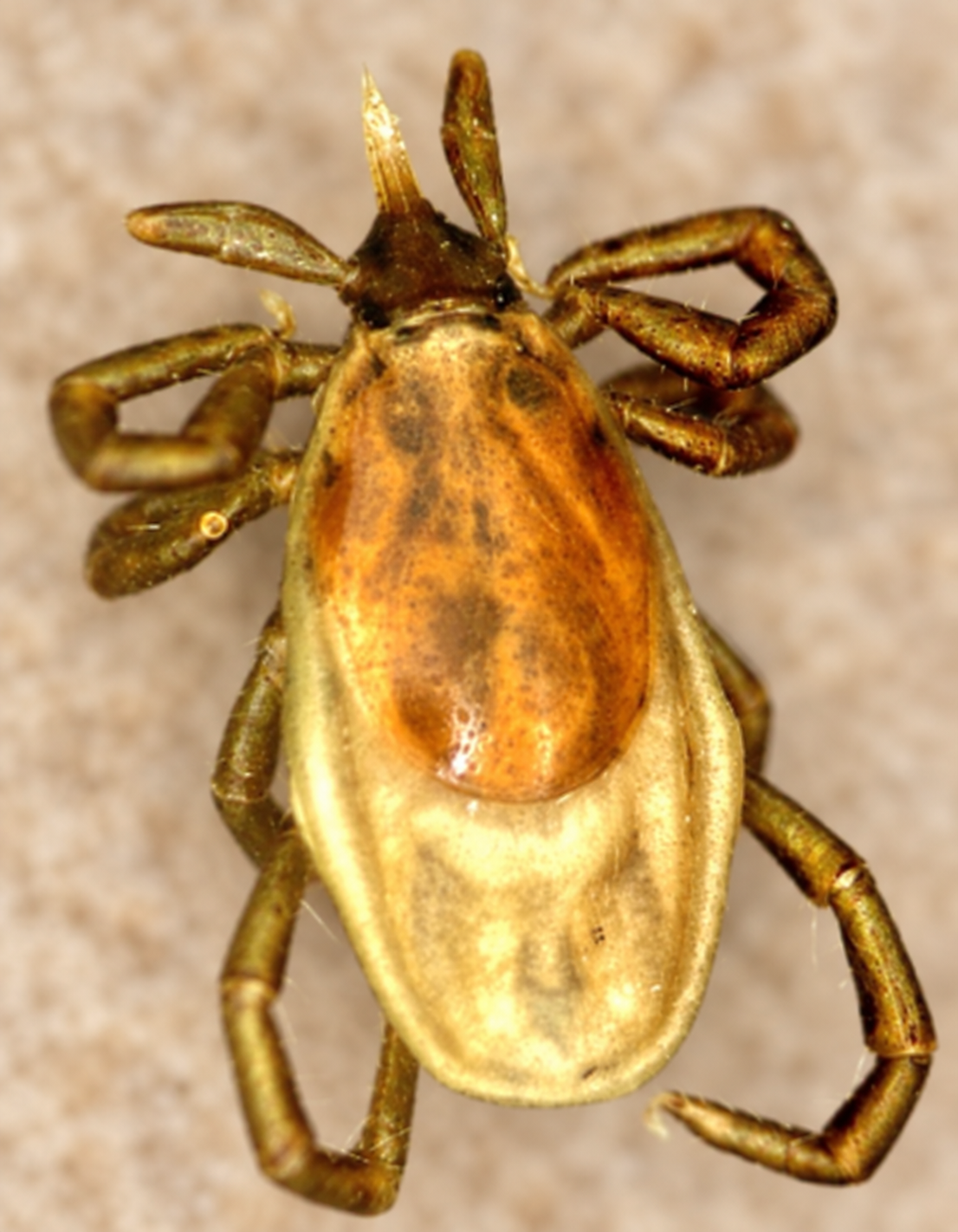
 Identification & Key Features
 Identification & Key Features
 The Mouse Tick is a small hard tick in the genus Ixodes that is strongly associated with rodents.
- Adult females are typically tan with a darker dorsal shield, or scutum, directly behind the head.
- Adult males are usually reddish-tan and slightly smaller than females.
- The female’s scutum covers only the front portion of the back.
- In adult males, the scutum covers essentially the entire dorsal surface.
- Adults and nymphs have 8 legs.
- Larvae have 6 legs.
- Identification to species can be difficult because I. muris resembles other Ixodes ticks and may require examination of small anatomical or microscopic features.
The female and male coloration is documented for I. muris by the University of Maine Tick Lab. The difference in scutum coverage between males and females is characteristic of hard ticks.
Geographic Distribution & Habitat
Geographic Distribution & Habitat The Mouse Tick is found primarily in the northeastern United States and Maritime Canada.
Its reported range extends:
- As far west as South Dakota
- As far south as South Carolina
The Mouse Tick is nidicolous, meaning it is closely associated with the nests or resting areas of its hosts rather than commonly encountered questing on exposed vegetation.
It is particularly associated with rodents and their nests.
Life Cycle & Seasonal Activity
Life Cycle & Seasonal Activity The Mouse Tick is a three-host tick, with the larva, nymph, and adult typically using a different host during each active life stage.
Its primary host is the white-footed mouse, but it has also been found on:
- Other mice
- Rats
- Voles
- Shrews
- Muskrats
- Birds, particularly during immature stages
- Dogs and cats
- Occasionally humans
Mouse Ticks have been reported on hosts from approximately April through October.
In a Maine passive-surveillance study, adult female submissions showed a smaller peak in late June and a larger peak in late August and September.
These Maine observations should not be interpreted as a universal seasonal pattern throughout the species’ entire geographic range.
Diseases & Health Risks
Diseases & Health Risks The Mouse Tick is not considered a major vector of human Lyme disease.
Laboratory research has demonstrated that Ixodes muris can acquire and transmit Borrelia burgdorferi, the bacterium that causes Lyme disease.
However, it is a relatively poor vector compared with the Blacklegged Tick (Ixodes scapularis) and is considered unlikely to play a significant role in Lyme disease transmission to humans.
Mouse Ticks can occasionally bite humans.
In domestic animals, particularly dogs and cats, feeding by I. muris has been associated with reactions including:
- Pain
- Swelling
- Fever
- Reduced appetite
- Lethargy
More severe reactions have been reported with increasingly engorged adult female ticks.
Bite Prevention & Protection
Bite Prevention & Protection Because Mouse Ticks are strongly associated with rodents and their nests, avoiding direct contact with rodent nesting areas can help reduce potential exposure.
- Avoid handling rodent nests with bare hands.
- Reduce rodent shelter and nesting opportunities around buildings.
- Check yourself, children, and pets for ticks after potential exposure.
- Use an EPA-registered insect repellent when appropriate.
- Remove attached ticks as soon as possible.
- Use clean, fine-tipped tweezers to grasp an attached tick close to the skin and pull upward with steady, even pressure.
These removal and prevention recommendations are consistent with current CDC guidance.
Identification Gallery
Identification Gallery Adult Female
- Tan body
- Darker scutum near the front of the back
- 8 legs
Adult Male
- Reddish-tan body
- Slightly smaller than the female
- Scutum covering essentially the entire back
- 8 legs
Engorged Female
- Enlarged body after feeding
- Dark scutum remaining visible near the front
Nymph
- Small body
- 8 legs
- Scutum covering the front portion of the back
Larva
- Extremely small body
- 6 legs

