
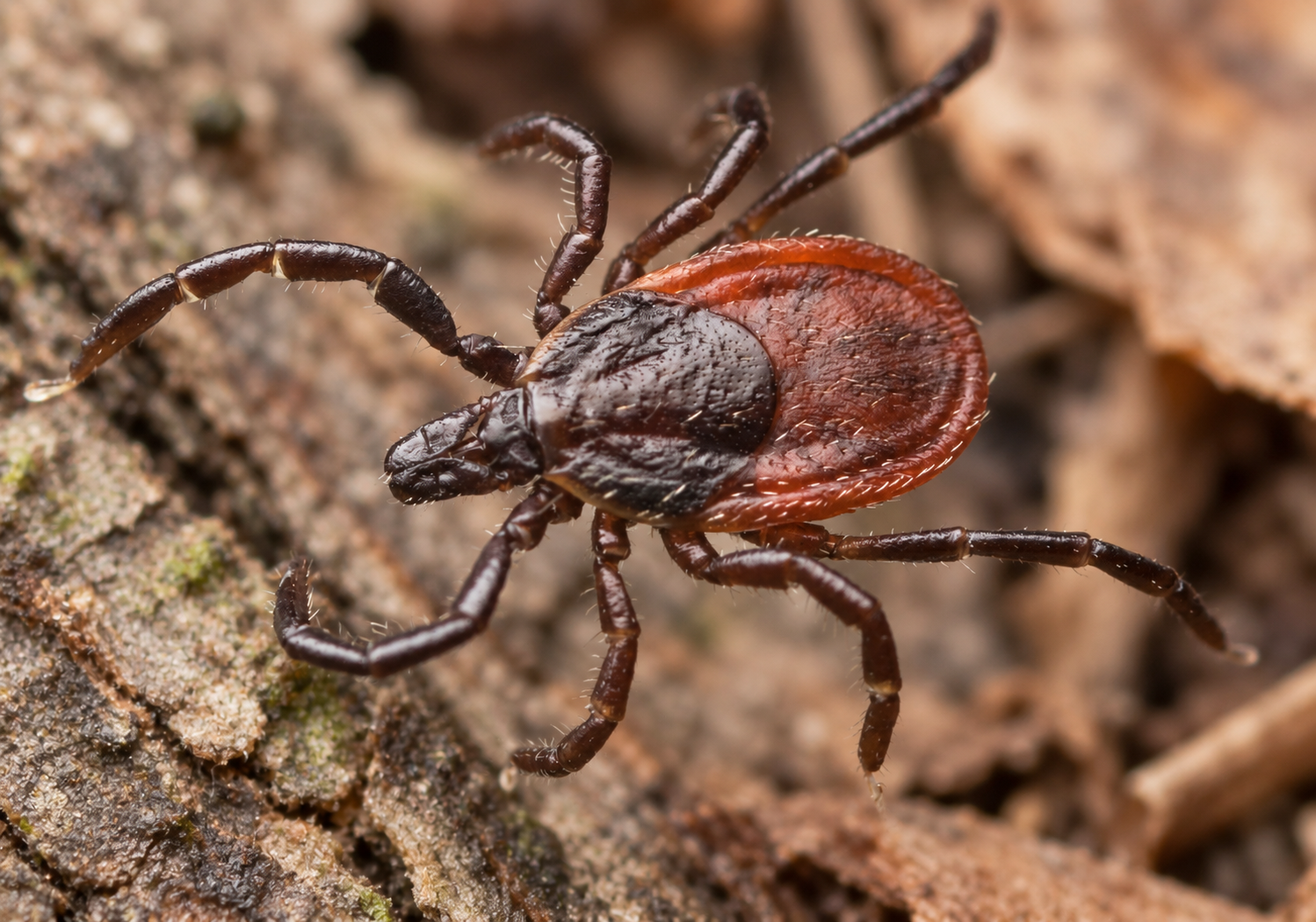

Western Blacklegged Tick

Ixodes pacificus
The western blacklegged tick (Ixodes pacificus) is a small, hard-bodied tick commonly found along the Pacific Coast of the United States, including California, Oregon, and Washington. It can transmit several pathogens that cause human illness, most notably Lyme disease, as well as anaplasmosis, babesiosis, and Powassan virus.

Nymphs and adult females are the stages most often reported biting people, although larvae can also bite humans.

Found in wooded, brushy & grashy areas

Active year-round; peaks vary by life stage

Can transmit serious diseases

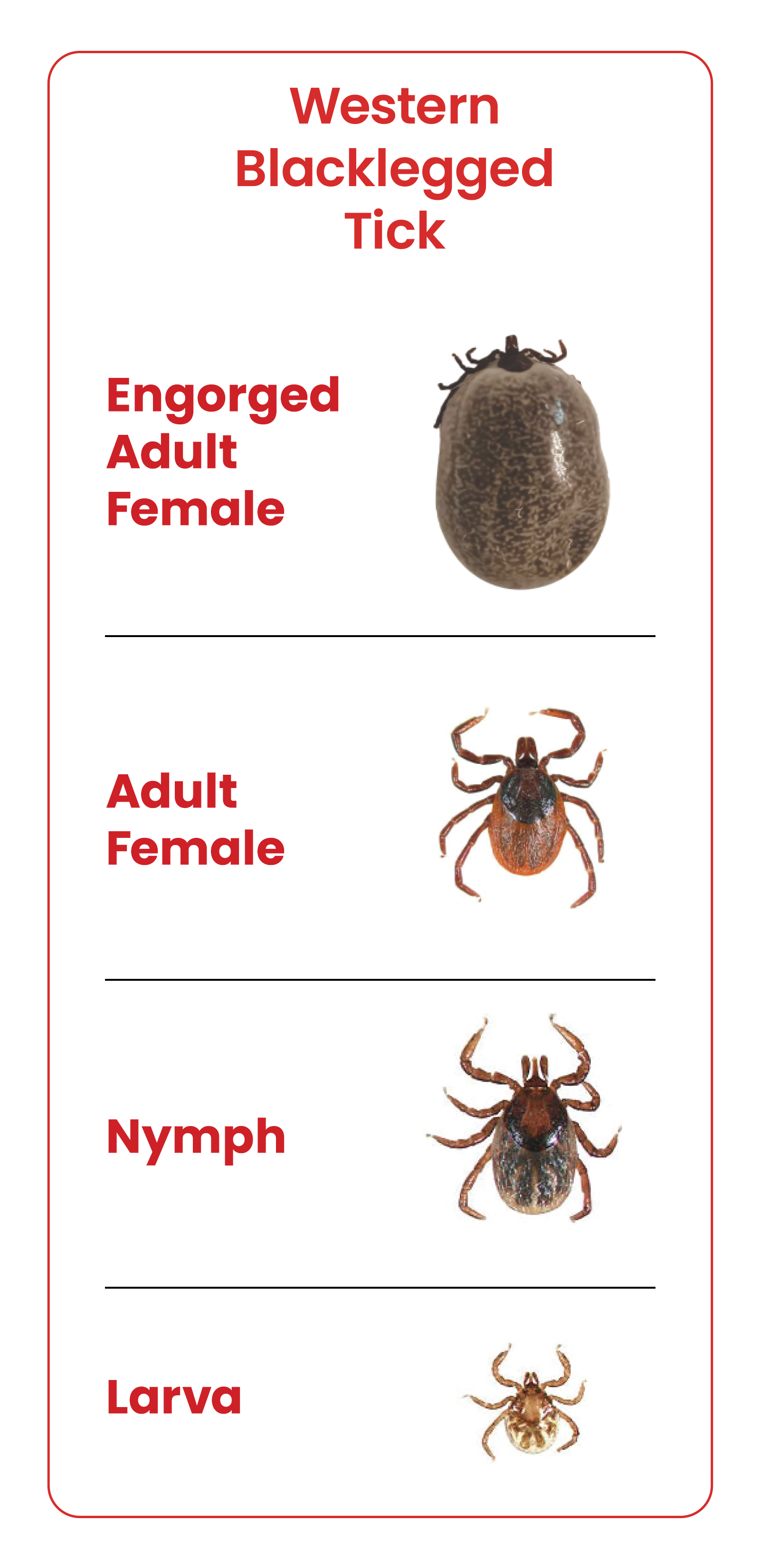
Western blacklegged ticks are relatively small. Their appearance changes depending on life stage, sex, and whether they have fed.

Adult Female

An unfed adult female is approximately 1/8 inch long.

Typical features include:

  • Eight legs
  • Brownish-black legs
  • A dark brownish-black scutum, or hard shield, covering the front portion of the back
  • A reddish-orange abdomen behind the scutum
  • Relatively long, forward-projecting mouthparts

As an adult female feeds, her abdomen expands considerably. A fully engorged female may reach approximately 3/8 inch or longer and becomes much larger and lighter in appearance.

Adult Male

Adult males are:

  • Approximately 1/10 inch long when unfed
  • Smaller than adult females
  • Eight-legged
  • Oval-shaped
  • Generally dark brown to brownish-black
  • Covered dorsally by a scutum extending over essentially the entire back

Adult males attach to people much less frequently than adult females. They take only small quantities of blood and therefore do not expand dramatically during feeding.

Nymph

An unfed nymph is approximately 1/25 inch long — roughly the size of a poppy seed.

Typical features include:

  • Eight legs
  • A dark brownish-black scutum
  • A lighter, somewhat translucent abdomen
  • Extremely small size

Because nymphs are so small, an attached nymph can be difficult to notice.

Larva

Larvae are extremely small and:

  • Have six legs
  • Commonly feed on lizards, birds, rodents, and other small animals
  • Can bite humans, although they are reported on people less often than nymphs and adult females

CDC notes that all life stages of the western blacklegged tick can bite humans, but nymphs and adult females are reported on people more often.

Other Identification Features

Like other ticks in the genus Ixodes, western blacklegged ticks have:

  • Relatively long mouthparts
  • An unornamented scutum
  • No eyes
  • No festoons along the rear edge of the body
  • A characteristic anal groove that arches in front of the anus on the underside of the tick

Some of these features are very small and may require magnification for proper examination.

Using a magnifier can help make the tick’s mouthparts, scutum, legs, and other identification features easier to see.

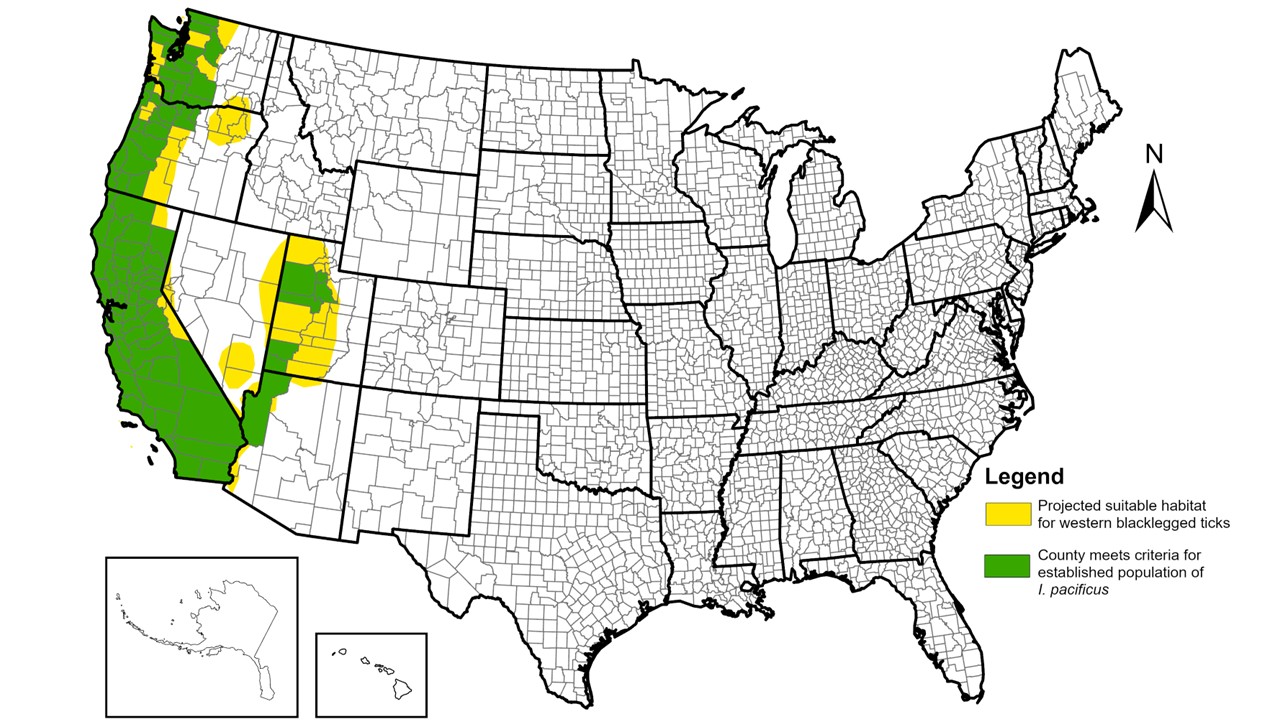
According to CDC’s May 14, 2026 western blacklegged tick surveillance update, Ixodes pacificus occurs primarily in the far western United States.

Its core U.S. distribution includes:

  • California
  • Western Oregon
  • Western Washington

The species is particularly important in northern California.

Outlying populations have also been documented in:

  • Utah
  • Arizona

CDC’s current surveillance map shows projected suitable habitat and counties with established Ixodes pacificus populations using surveillance records through December 31, 2025.

A county without an “established” designation should not automatically be considered tick-free. CDC specifically cautions that the absence of an established designation does not mean the tick is absent, because surveillance and collection efforts vary.

Common Habitats

Western blacklegged ticks occur in several types of natural and semi-developed environments, including:

  • Woodlands and forests
  • Oak woodlands
  • Leaf litter
  • Brush and chaparral
  • Grasslands
  • Woodland and grassland edges
  • Trail margins
  • Parks and wildlands
  • Semi-rural communities
  • Some suburban areas that support deer and other wildlife

The habitat where a person is most likely to encounter a tick differs somewhat by life stage.

Nymph Habitat

Nymphs are especially associated with shaded woodland and forest environments.

They may be encountered:

  • In leaf litter
  • Among fir needles
  • On fallen branches
  • On logs
  • On rocks
  • Near the bases of tree trunks
  • On other low surfaces in shaded natural areas

Unlike adults, nymphs generally do not climb far up grasses or shrubs while seeking hosts.

They are typically more abundant and accessible in suitable woodland habitats than in exposed grasslands.

Adult Habitat

Adult western blacklegged ticks often climb onto low vegetation while waiting for a passing host.

Adults may be encountered:

  • On grasses
  • On shrubs and brush
  • Along trail margins
  • In chaparral
  • In open grasslands
  • At boundaries where grassland meets woodland or brush
  • In parks and wildlands

Western blacklegged ticks do not jump or fly.

They typically get onto people or animals when a host brushes against vegetation or another surface where the tick is waiting.
The western blacklegged tick has four life stages:

Egg → 6-legged Larva → 8-legged Nymph → Adult

The adult stage may be female or male.

Ixodes pacificus follows a three-host life cycle. After hatching, the larval, nymphal, and adult feeding stages generally require a new host for each blood meal.

Larvae

Larvae:

  • Have six legs
  • Commonly feed on lizards, birds, rodents, and other small animals
  • Drop from their host after feeding
  • Later molt into nymphs

Nymphs

Nymphs:

  • Have eight legs
  • Commonly feed on lizards, birds, rodents, and other small animals
  • Can bite humans
  • Drop from their host after feeding
  • Later molt into adults

Adults

Adults:

  • Have eight legs
  • Use medium- and large-sized mammals as important hosts
  • Commonly feed on deer
  • May also encounter humans and other mammals

CDC notes that larvae and nymphs often feed on lizards, birds, and rodents, while adults more commonly feed on deer.

After feeding and mating, an adult female eventually drops from the host and lays her eggs in protected soil or leaf-litter environments.

How Long Does the Life Cycle Take?

CDC states that the life cycle of Ixodes pacificus generally lasts about three years.

During that period, the tick progresses through:

Egg → Larva → Nymph → Adult

Local timing can vary depending on factors such as geography, climate, temperature, moisture, and host availability.

Research from the Hopland area of northwestern California also found an approximately three-year cycle from egg to egg-laying female, while noting that the duration may be shorter or longer elsewhere within the species’ range.

Seasonal Activity

Seasonal activity varies by geographic location, habitat, elevation, temperature, rainfall, and humidity, so timing observed in one region should not automatically be applied to the species’ entire range.

In California:

  • Adult western blacklegged ticks are most active from fall through early spring
  • Adult activity is especially important during fall and winter
  • Nymphs are most active during spring and early summer
  • Tick bites may occur at any time of year in California

In northwestern California, nymphs may be found over a relatively long seasonal period, but their activity generally increases during spring and often peaks in mid-to-late spring.

Adult host-seeking activity generally occurs from late fall through spring.

The exact timing varies with:

  • Temperature
  • Rainfall
  • Humidity
  • Elevation
  • Habitat
  • Geographic location

CDC currently lists the western blacklegged tick as transmitting three established human pathogens:

  • Borrelia burgdorferi — Lyme disease
  • Anaplasma phagocytophilum — anaplasmosis
  • Borrelia miyamotoi — hard tick relapsing fever

Other microorganisms may sometimes be detected during tick surveillance. Detection of a pathogen in a tick does not automatically establish that the tick is an important or proven vector of that pathogen to humans.

For that reason, the main disease list for Ixodes pacificus should remain limited to the transmission associations currently recognized by CDC.

Lyme Disease

Cause associated with Ixodes pacificus transmission: Borrelia burgdorferi

The western blacklegged tick transmits Borrelia burgdorferi, the bacterium responsible for Lyme disease in the I. pacificus transmission cycle in the western United States.

Possible early signs and symptoms of Lyme disease include:

  • Fever
  • Chills
  • Headache
  • Fatigue
  • Muscle and joint aches
  • Swollen lymph nodes
  • Erythema migrans (EM) rash

The EM rash occurs in approximately 70–80% of infected people, meaning some people with Lyme disease do not develop or notice this rash.

If Lyme disease is not treated, infection can sometimes spread to other parts of the body and affect the:

  • Joints
  • Nervous system
  • Heart

Attachment Time and Lyme Disease

For Lyme disease specifically, CDC states that in general, an infected tick must be attached for more than 24 hours to transmit infection.

Prompt tick removal therefore reduces the risk of Lyme disease transmission.

This attachment-time statement should not automatically be applied to other tick-borne pathogens, because transmission dynamics differ among pathogens.

Anaplasmosis

Cause: Anaplasma phagocytophilum

The western blacklegged tick is a recognized vector of Anaplasma phagocytophilum, the bacterium that causes anaplasmosis.

Symptoms typically begin approximately 5–14 days after the bite of an infected tick.

Early symptoms may include:

  • Fever
  • Chills
  • Severe headache
  • Muscle aches
  • Malaise
  • Nausea
  • Vomiting
  • Diarrhea
  • Loss of appetite

Many cases are mild or moderate, but severe illness can occur, particularly when appropriate treatment is delayed.

Hard Tick Relapsing Fever — HTRF

Cause: Borrelia miyamotoi

Western blacklegged ticks can transmit Borrelia miyamotoi, the bacterium responsible for hard tick relapsing fever (HTRF).

Possible symptoms include:

  • Fever
  • Chills or shaking
  • Fatigue
  • Headache
  • Muscle aches
  • Joint aches
  • Nausea or vomiting

Signs and symptoms generally appear around two weeks after a tick bite, but CDC reports that they may occur anywhere from approximately 3 days to 6 weeks after exposure.

Important HTRF Clarification

Despite the name “relapsing fever,” current CDC evidence indicates that HTRF most commonly involves a single episode of fever.

Relapsing fever episodes have been documented in approximately 10% of cases.

CDC’s July 10, 2026 clinical guidance describes HTRF as an emerging infection that is likely underrecognized and underreported, in part because symptoms can be nonspecific, awareness remains limited, and diagnostic testing can be challenging.

Important to Know

Finding an attached western blacklegged tick does not automatically mean that infection occurred.

Risk depends on several factors, including:

  • Tick species
  • Tick life stage
  • Geographic location
  • Whether the tick was infected
  • Local pathogen prevalence
  • Duration of attachment
  • The specific pathogen involved

Promptly removing an attached tick is one of the most important steps a person can take after discovering a tick bite.

Western blacklegged ticks can occur in wooded areas, leaf litter, grasslands, brush, and along trails. Taking precautions can reduce the chance of being bitten.

Before and During Outdoor Activity

  • Avoid direct contact with dense brush, tall grass, and leaf litter when practical
  • Walk near the center of maintained trails
  • Use an EPA-registered insect repellent according to label directions
  • Treat clothing and outdoor gear with products containing 0.5% permethrin, or use commercially pretreated clothing and gear
  • Wear long pants, long sleeves, and closed shoes when practical
  • Wear light-colored clothing when practical to make crawling ticks easier to see

Always follow the product label when using insect repellents or permethrin-treated products.

After Outdoor Activity

Perform a thorough full-body tick check after spending time in tick habitat.

CDC recommends checking especially:

  • Under the arms
  • In and around the ears
  • Inside the belly button
  • Behind the knees
  • In and around the hair
  • Between the legs
  • Around the waist

Also examine:

  • Children
  • Pets
  • Clothing
  • Coats
  • Backpacks and daypacks
  • Outdoor equipment and gear

CDC recommends showering within two hours after coming indoors.

Showering may help wash off unattached ticks, provides a good opportunity to perform a careful body check, and has been shown to reduce the risk of Lyme disease and may help reduce the risk of other tick-borne diseases.

Check pets for ticks after outdoor activity and talk with a veterinarian about appropriate tick-prevention products.

If You Find an Attached Tick

Remove the tick as soon as possible.

CDC’s current tick-removal guidance was updated June 9, 2026.

Do not delay removing an attached tick while waiting to see a healthcare provider.

How to Remove a Tick

  1. Use clean fine-tipped tweezers and grasp the tick as close to the skin’s surface as possible.
  2. If fine-tipped tweezers are not available, CDC says regular tweezers or your fingers may be used. When doing so, grasp the tick close to the skin and avoid squeezing its body.
  3. Pull the tick away from the skin with steady, even pressure.
  4. Do not twist or jerk the tick, which may cause the mouthparts to break off and remain in the skin.
  5. If mouthparts remain in the skin, they may be removed with tweezers if they come out easily. If they cannot be removed easily, leave them alone and allow the skin to heal. The body will generally push the remaining mouthparts out over time.
  6. Dispose of a live tick by:
    • Placing it in a sealed container
    • Wrapping it tightly in tape
    • Putting it in alcohol
    • Flushing it down the toilet

Do not crush a tick with your fingers.

  1. Thoroughly clean the bite area and your hands using:
    • Soap and water
    • Rubbing alcohol
    • Hand sanitizer
  2. Perform another careful body check for additional ticks.

Do Not Use

Do not use:

  • Petroleum jelly
  • Heat
  • Nail polish
  • Other substances intended to make an attached tick detach

CDC warns that these methods may agitate the tick and force infected fluid from the tick into the skin.

Prompt mechanical removal is recommended.

Tick Testing

CDC generally does not recommend commercial testing of a removed tick to guide treatment decisions.

Reasons include:

  • A positive test showing that the tick contains a pathogen does not prove that the person was infected
  • A negative test can provide false reassurance
  • A person may have been bitten by another infected tick that was never noticed
  • Tick-testing results should not be used by themselves to make treatment decisions

If a rash or fever develops within several weeks after removing a tick, contact a healthcare provider.

Tell the healthcare provider:

  • That you had a recent tick bite
  • When the bite occurred
  • Where you most likely encountered the tick

Adult Female

  • Reddish-orange abdomen
  • Dark scutum at the front
  • Dark legs
  • Long mouthparts
  • Eight legs

Adult Male

  • Smaller, dark body
  • Scutum covers nearly the entire back
  • Eight legs

Nymph

  • Very small
  • Eight legs
  • Dark scutum
  • Lighter abdomen

Larva

  • Extremely small
  • Six legs

Engorged Adult Female

  • Enlarged abdomen after feeding
  • Lighter body color
  • Dark scutum remains visible at the front

Life Stages
Egg → 6-legged Larva → 8-legged Nymph → Adult

Show adult sexes separately:

Adult Female | Adult Male

Note: Adult female and adult male are different sexes, not separate developmental stages.
Need Help OR

Have a question?

Email us anytime at
sales@ticktweezers.com
and we will be happy to help.

While you're here, check out our
Resources and Product pages to
learn more.

Be Tick free