
Seabird Tick
Ixodes uriae
The Seabird Tick is a hard tick in the genus Ixodes that is primarily associated with seabirds, particularly auks, gulls, and other colonial seabirds, in coastal and island environments.
- Adult females are typically grayish-tan to brown with a darker dorsal shield, or scutum, directly behind the head.
- Adult males are usually darker brown and slightly smaller than females.
- The female’s scutum covers only the front portion of the back.
- In adult males, the scutum covers essentially the entire dorsal surface.
- Adults and nymphs have 8 legs.
- Larvae have 6 legs.
- Identification to species can be difficult because I. uriae resembles other Ixodes ticks and may require examination of small anatomical or microscopic features.
Seabird ticks are most commonly found on seabirds and in their nests, but they can occasionally be found on other birds or mammals near coastal nesting areas. Human exposure is uncommon, and there is currently no evidence that I. uriae is an important vector of human disease in the United States.
Associated with seabirds, nests & coastal habitats
Life cycle usually takes about 2-4 years
Potential disease vector; human transmission is unlikely
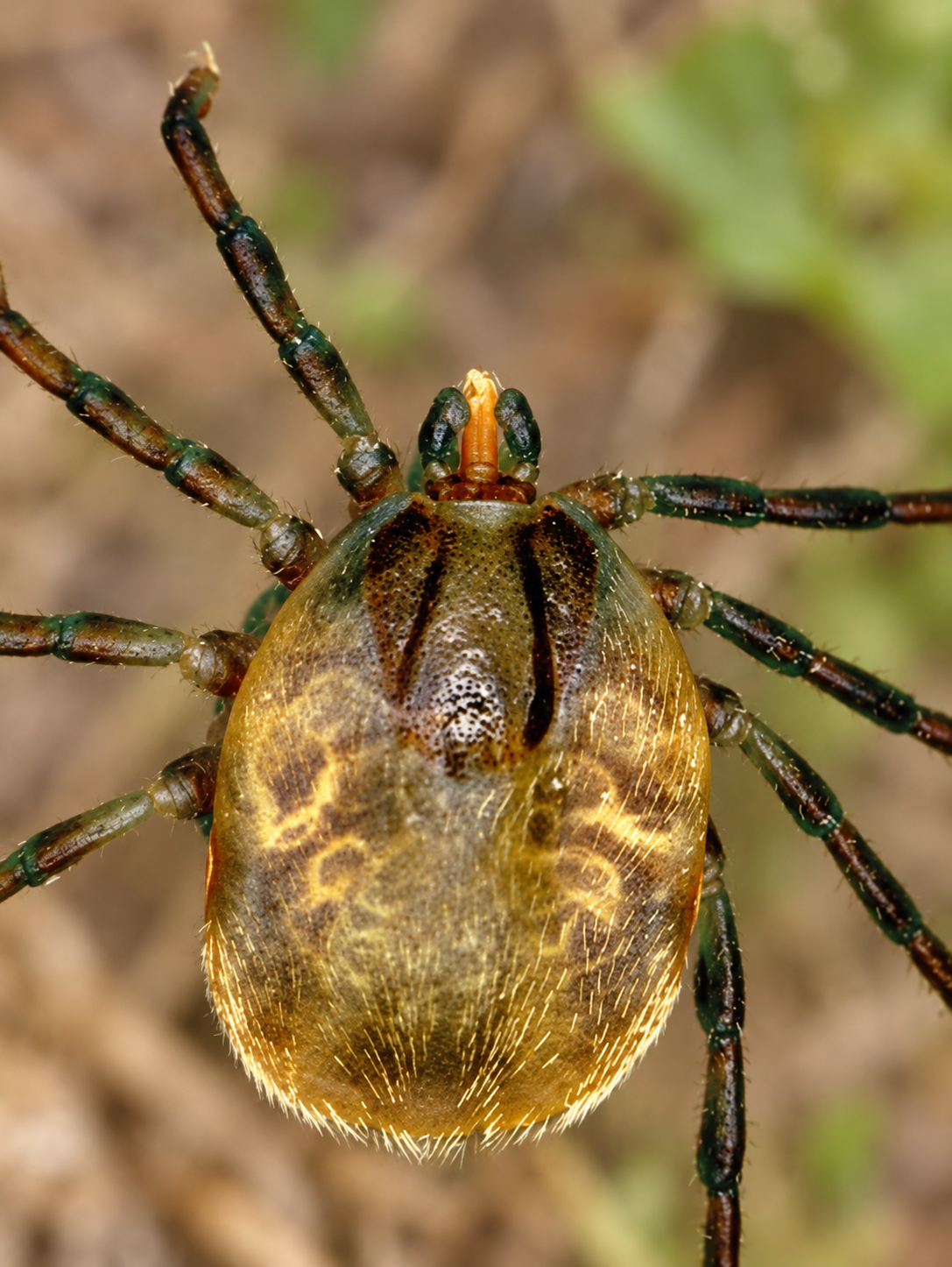
 Identification & Key Features
 Identification & Key Features
 The Seabird Tick is a hard tick strongly associated with seabirds and their nesting colonies.
- Adult females are generally brown to tan-brown
- Females have a darker, unornamented scutum covering the front portion of the back
- Unfed adult females are approximately 3.3–4.0 mm long
- Fully engorged females can reach approximately 12 mm
- Adults and nymphs have 8 legs
- Larvae have 6 legs
- Eyes are absent
- Adult males have festoons and distinctive brushes of setae associated with the posterior festoons
- Species-level identification may require examination of microscopic characteristics
Unfed females measuring 3.3–4.0 mm and engorged females reaching about 12 mm are specifically documented; males measure approximately 3.3–4.2 mm.
Geographic Distribution & Habitat
Geographic Distribution & Habitat The Seabird Tick has an exceptionally broad worldwide distribution and occurs in seabird colonies in both the Northern and Southern Hemispheres.
A major scientific review describes Ixodes uriae as having the most extensive geographic distribution of any tick species, spanning the Afrotropical, Australasian, Nearctic, Neotropical, and Palearctic regions.
It has been documented in coastal, island, polar, and subpolar regions including:
- North America
- Europe
- Arctic regions
- Southern South America
- Southern Africa
- The Australasian region and associated islands
- Subantarctic islands
- The Antarctic Peninsula
Its occurrence on the Antarctic Peninsula is directly documented.
In the United States, I. uriae has been documented in:
- Maine
- Oregon
- Alaska
A large review of ticks found infesting humans in the United States lists I. uriae from these three states.
Typical habitat includes:
- Seabird nests and burrows
- Rock crevices
- Areas beneath stones
- Nesting substrate and debris
- Moist, protected microhabitats around seabird colonies
The tick is nidicolous, meaning it spends most of its life in or around the host’s nesting environment rather than continuously on the bird.
Life Cycle & Seasonal Activity
Life Cycle & Seasonal Activity The Seabird Tick has a three-host life cycle.
Larvae, nymphs, and adult females typically take one blood meal during each active stage and then drop from the host into the nesting environment.
- Larvae feed and then molt into nymphs
- Nymphs feed and then molt into adults
- Adult females feed, drop from the host, lay eggs, and then die
- Adult males do not take a blood meal
Common hosts include:
- Puffins
- Murres and guillemots
- Razorbills
- Gannets
- Cormorants and shags
- Gulls and kittiwakes
- Penguins
- Other colonial seabirds
- uriae parasitizes a very broad range of seabird species worldwide.
Humans are incidental and uncommon hosts, although bites and human infestations have been documented.
The complete life cycle generally takes several years and varies substantially with climate, locality, and the seasonal availability of seabird hosts.
Studies have documented considerable variation:
- Approximately 2 years in some subantarctic Macaroni Penguin colonies
- Approximately 3 years in King Penguin colonies
- Typically 3 years, with a range of 2–4 years, on Scotland’s Isle of May
- Up to approximately 7 years in colder Arctic or subarctic environments
Activity is closely synchronized with the breeding cycles of local seabirds. Therefore, there is no single set of active months that accurately applies to I. uriae throughout its worldwide range.
Diseases & Health Risks
Diseases & Health Risks The Seabird Tick can harbor and participate in natural transmission cycles involving multiple bacterial and viral agents associated with seabirds. Its importance varies considerably depending on the microorganism.
One of the best-studied bacteria is:
- Borrelia garinii — a member of the Borrelia burgdorferi sensu lato complex and an established cause of Lyme borreliosis in Eurasia
Borrelia garinii is maintained in a well-documented seabird–Ixodes uriae enzootic cycle.
In North America, B. garinii has been detected in I. uriae associated with seabird colonies, including populations in Atlantic Canada and Alaska. Alaska surveillance documented Borrelia identified as B. garinii in I. uriae collected from seabirds.
However, an important distinction is necessary:
The Seabird Tick is not recognized as a vector of human Lyme disease in the United States.
CDC identifies the Blacklegged Tick (Ixodes scapularis) and Western Blacklegged Tick (Ixodes pacificus) as the ticks responsible for transmitting Lyme disease to people in the United States. U.S. human Lyme disease is caused primarily by Borrelia burgdorferi and, rarely, B. mayonii.
Research from the Faroe Islands found serologic evidence suggesting that transmission of B. garinii or exposure to its antigens may occur in people regularly exposed to I. uriae. However, the seropositive individuals in that study did not have symptoms of Lyme disease, and the epidemiologic and clinical importance of this transmission route remains uncertain.
The pathogenic potential of seabird-associated B. garinii strains in North America is also not established.
Therefore, the Seabird Tick should not be described as routinely transmitting Lyme disease to humans.
Bite Prevention & Protection
Bite Prevention & Protection Human exposure is uncommon, but people working in or visiting seabird colonies should still take standard tick precautions.
- Avoid unnecessary contact with seabird nests and nesting material
- Wear protective clothing when working around seabird colonies
- Use an EPA-registered insect repellent when appropriate
- Check clothing and skin after spending time around nesting sites
- Remove attached ticks as soon as possible
CDC recommends EPA-registered repellents and regular tick checks for people exposed to tick habitat.
If a tick is attached:
- Grasp it as close to the skin’s surface as possible with clean, fine-tipped tweezers
- Pull it away from the skin with steady, even pressure
- Do not twist or jerk the tick
Clean the bite area and your hands afterward
Identification Gallery
Identification Gallery Adult Female
- Brown to tan-brown body
- Dark, unornamented scutum on the front portion of the back
- 8 legs
- Show an unfed specimen
Adult Male
- Brown body
- 8 legs
- Festoons present
- Distinctive brushes of setae associated with the posterior festoons
Engorged Female
- Greatly enlarged body after feeding
- Dark scutum remaining visible near the front
- Show an unfed vs. engorged comparison
Nymph
- Small body
- 8 legs
- Plain, unornamented appearance
- Show size comparison with an adult when possible
Larva
- Extremely small body
- 6 legs
- Show size comparison with a nymph
Habitat Image
Show a representative environment such as:
- Seabird nest
- Burrow
- Rocky nesting colony
- Rock crevice
Offshore or polar seabird nesting island

