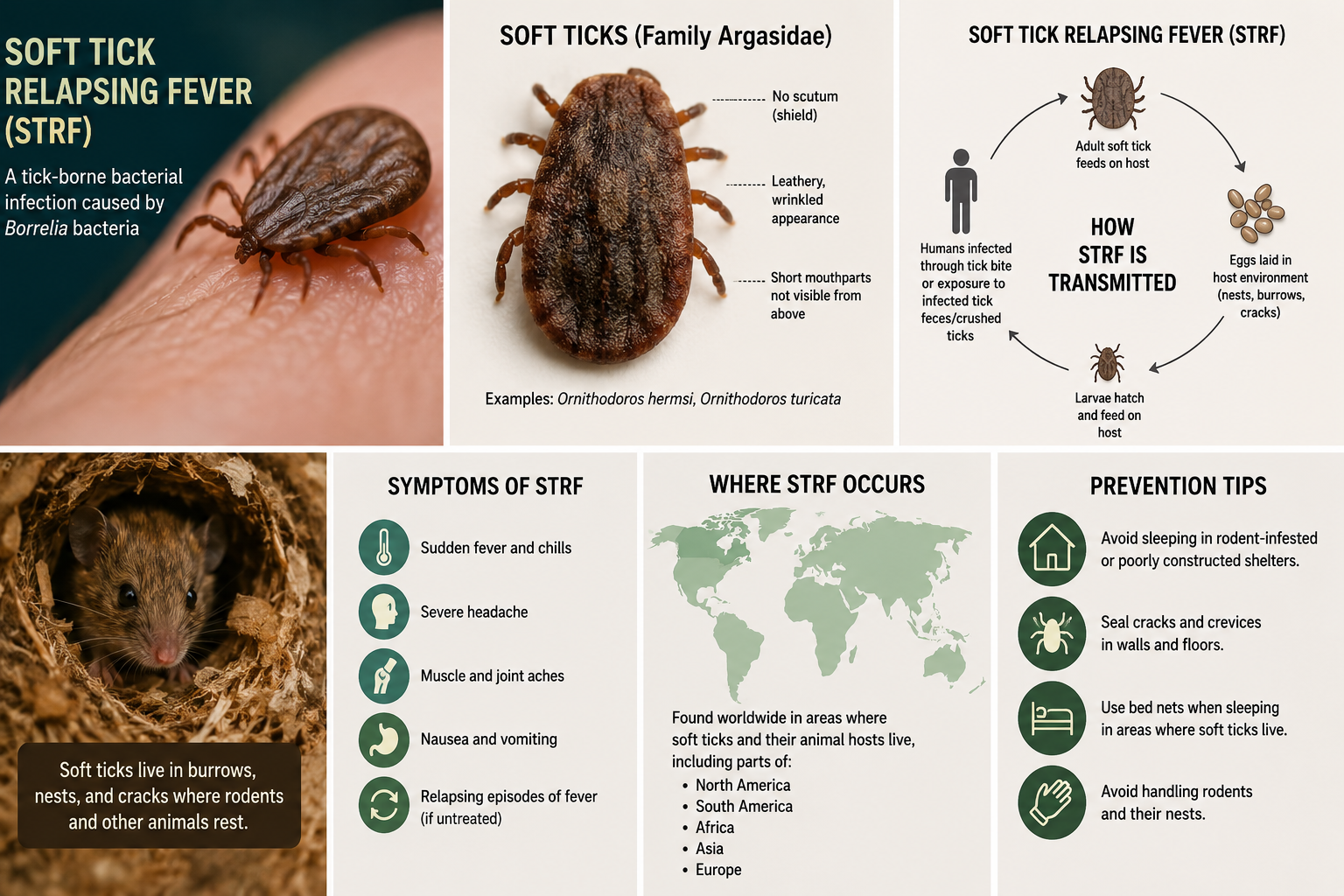
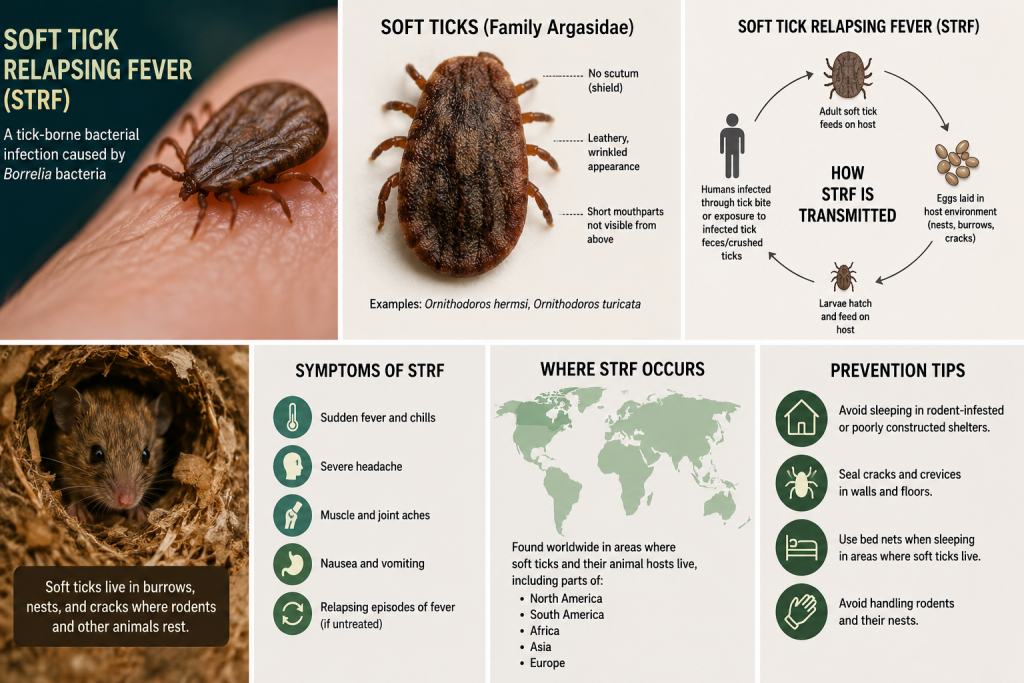
Soft Tick Relapsing Fever (STRF): A Tick-Borne Bacterial Disease
What Is Soft Tick Relapsing Fever?
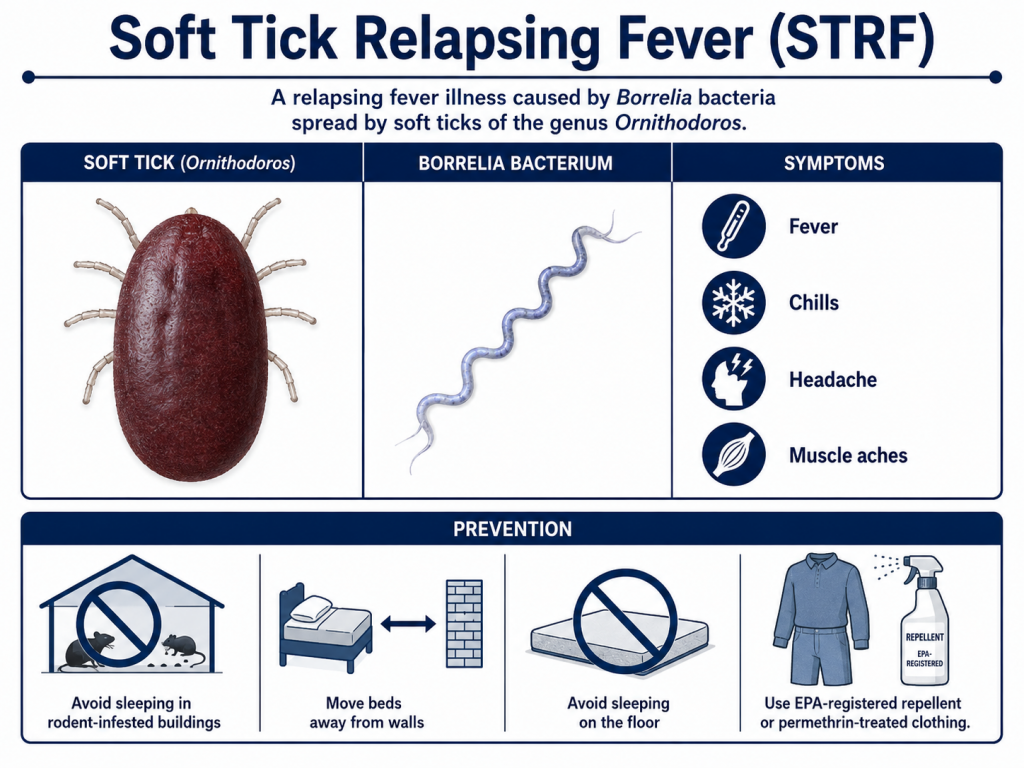
Soft tick relapsing fever (STRF) is a tick-borne bacterial disease caused by certain Borrelia bacteria, including Borrelia hermsii, Borrelia turicatae, and other Borrelia species.
STRF is transmitted to people through the bites of infected soft-bodied ticks in the genus Ornithodoros.
STRF is also known as tickborne relapsing fever (TBRF). The term soft tick relapsing fever helps distinguish it from hard tick relapsing fever (HTRF), which is caused by Borrelia miyamotoi and possibly other species transmitted by hard ticks.
STRF is uncommon in the United States but can cause serious illness. A characteristic feature is repeated episodes of fever separated by periods without fever.
How Is Soft Tick Relapsing Fever Spread?
People become infected when an infected Ornithodoros soft tick bites and feeds on them.
Unlike many hard ticks, soft ticks feed very quickly. Their bites usually last less than 30 minutes, are painless, and frequently go unnoticed. Many people with STRF never see the tick or realize they were bitten.
In the United States, people most often become infected after staying overnight in rodent-infested cabins. In these settings, O. hermsi ticks can emerge at night, feed briefly while a person is sleeping, and then retreat into walls, woodwork, rodent nests, or other hiding places.
Less commonly, people may become infected while exploring caves or through other exposures to environments where infected soft ticks and their rodent hosts occur.
Which Ticks Spread Soft Tick Relapsing Fever?
In the United States, STRF is transmitted by infected soft ticks belonging to the genus Ornithodoros.
Important tick-bacteria associations include:
- Ornithodoros hermsi — transmits Borrelia hermsii
- Ornithodoros turicata — transmits Borrelia turicatae
hermsi is typically found in rodent nests in mountainous areas above approximately 1,500 feet (450 meters) in elevation, particularly where chipmunks or squirrels are present.
turicata occurs in caves and in the nests and burrows of prairie dogs and ground squirrels in the plains regions of the southwestern United States.
Soft ticks behave differently from many hard ticks. Rather than remaining attached for hours or days, they generally emerge from their hiding places, feed rapidly, and then retreat
Where Does Soft Tick Relapsing Fever Occur?
In the United States, STRF usually occurs in mountainous areas of western states and in parts of Texas.
CDC’s 2026 surveillance case definition identifies STRF as occurring most commonly in:
- Arizona
- California
- Colorado
- Idaho
- Montana
- New Mexico
- Oregon
- Texas
- Utah
- Washington
In mountainous western areas, disease is commonly associated with B. hermsii transmitted by O. hermsi ticks.
In parts of Texas, STRF is associated with B. turicatae transmitted by O. turicata ticks.
Exposure is most common during the summer, but infections can also occur during the winter. Heating a previously unoccupied cabin can cause O. hermsi ticks resting in walls or woodwork to become active.
How Soon Do Symptoms Appear?
Symptoms may begin approximately 4–21 days after exposure.
The average incubation period is about one week.
Because soft tick bites are brief, painless, and often unnoticed, a person may develop symptoms without ever realizing that a tick bite occurred.
What Are the Symptoms of Soft Tick Relapsing Fever?
The most common symptoms include:
- Fever
- Headache
- Muscle aches
- Chills
Symptoms during fever episodes can sometimes be severe and may include:
- Shaking or rigors
- Drenching sweats
- Low blood pressure
Other possible symptoms include:
- Dizziness
- Joint pain
- Nausea
- Vomiting
- Loss of appetite
Rarely, people may develop:
- Facial paralysis
- Eye pain or redness
- Vision changes
Symptoms can improve and then return, producing the characteristic relapsing fever pattern associated with STRF.
Why Is It Called “Relapsing” Fever?
A distinctive feature of STRF is that fever can go away and then return.
CDC’s general patient guidance describes a typical pattern of:
- Fever lasting around 3 days
- Approximately 7 days without fever
- Fever returning again
Without antibiotic treatment, this cycle may repeat multiple times.
CDC’s 2026 surveillance case definition describes fever episodes that may last approximately 2–7 days, alternating with fever-free periods of approximately 4–14 days.
The recurring fever is related to a process called antigenic variation. Relapsing-fever Borrelia bacteria can alter certain surface proteins, helping them evade the body’s immune response and allowing another episode of illness to develop.
Can Soft Tick Relapsing Fever Become Serious?
Yes. STRF can sometimes cause serious illness and, rarely, can be fatal.
Rare complications include:
- Neurologic disease
- Eye involvement
- Myocarditis
- Acute respiratory distress syndrome (ARDS)
Severe fever episodes may also be accompanied by low blood pressure.
During CDC surveillance of U.S. STRF cases from 2012–2021, 251 cases were identified. Among the 211 patients for whom hospitalization information was available, 115 (55%) were hospitalized. No deaths were reported in that surveillance series.
Prompt diagnosis and appropriate treatment are important.
STRF and Pregnancy
STRF can be particularly serious during pregnancy.
Infection during pregnancy has been associated with serious complications, including:
- Pregnancy loss
- Premature birth
- Transmission of infection to the fetus
- Severe infection in newborns
- Neonatal death
Anyone who is pregnant and develops symptoms after a possible exposure should seek medical care promptly and tell their healthcare provider about the potential tick or environmental exposure.
How Is Soft Tick Relapsing Fever Diagnosed?
Healthcare providers may consider a combination of:
- Symptoms
- Medical history
- Recent travel
- Possible tick exposure
- Staying in rodent-infested cabins or other structures
- Camping
- Cave exposure
- Exposure to rodent habitats
- Laboratory testing
Because many people do not remember being bitten by a soft tick, information about recent travel and environmental exposures can be especially important.
Laboratory Testing
Several laboratory methods may be used to help diagnose STRF.
Blood smear microscopy:
During febrile episodes, Borrelia spirochetes may be present in high concentrations in the blood. They are most readily detected by microscopy in symptomatic, untreated patients early in the course of infection. Dark-field microscopy or stained peripheral blood smears may be used.
PCR testing:
Polymerase chain reaction (PCR) testing can detect Borrelia DNA. PCR is more sensitive than microscopy and may also be useful during periods without symptoms or soon after treatment begins.
Whole blood is the preferred specimen for PCR testing.
Some PCR methods do not distinguish between the organisms that cause STRF and those that cause hard tick relapsing fever (HTRF).
Serologic testing:
Serologic testing can provide evidence of infection with relapsing-fever Borrelia.
Currently available serologic assays may not distinguish STRF from HTRF. People with relapsing fever may also have false-positive serologic tests for Lyme disease.
Because some PCR and serologic tests can cross-react with other Borrelia species, laboratory results should be interpreted together with symptoms, travel history, geographic location, and possible exposures.
How Is Soft Tick Relapsing Fever Treated?
STRF is treated with antibiotics.
For patients who are not pregnant and do not have neurologic complications, CDC lists doxycycline as the preferred treatment.
Depending on the patient’s circumstances, other antibiotics may include:
- Azithromycin
- Penicillin G
- Ceftriaxone
For people who are pregnant or when neurologic involvement is present, CDC advises initial parenteral therapy with a beta-lactam antibiotic.
Treatment decisions should be made by a qualified healthcare provider based on the individual patient’s circumstances.
What Is a Jarisch-Herxheimer Reaction?
People being treated for STRF can develop a Jarisch-Herxheimer reaction after antibiotic treatment begins.
The reaction is a temporary worsening of symptoms that may include:
- High fever
- Rigors or severe shaking
- Low blood pressure
CDC reports that a Jarisch-Herxheimer reaction occurs in up to 50% of STRF cases.
Because the reaction can be significant, CDC recommends observing patients during the first 4 hours of antibiotic therapy.
Rarely, acute respiratory distress syndrome (ARDS) has been reported after treatment begins.
How Can Soft Tick Relapsing Fever Be Prevented?
Preventing STRF primarily involves reducing exposure to infected soft ticks and rodent-infested environments.
When Staying in Cabins or Similar Buildings
- Avoid sleeping in rodent-infested buildings whenever possible.
- Look for signs of rodent activity, such as droppings, nesting material, chewing or gnawing, or a stale odor.
- Move beds away from walls.
- Keep sheets and bedding from touching the floor.
- Avoid sleeping directly on the floor.
- If you notice evidence of rodents in a rental cabin or similar building, alert the owner.
Reduce Rodent Infestations
Cabin and property owners should take steps to keep rodents—especially chipmunks and squirrels—out of buildings.
CDC recommends consulting a licensed pest-control professional who can safely:
- Identify and remove rodent nests
- Treat appropriate cracks and crevices
- Establish a pest-control plan to keep rodents out
Do not remove rodent nests yourself. Rodents can carry diseases that may spread to people, and contact with rodent urine, droppings, saliva, or nesting materials can create additional health risks.
When Exploring Caves or Areas With Rodent Burrows
- Wear long-sleeved shirts and long pants.
- Avoid direct skin contact with cave floors or rodent burrows.
- Use an EPA-registered insect repellent according to label directions.
Clothing and gear can be treated with products containing 0.5% permethrin, following product instructions.
Who May Be at Risk?
Exposure may be more likely among people who:
- Stay overnight in rustic or rodent-infested cabins
- Camp in areas where infected soft ticks occur
- Explore caves
- Enter rodent-infested buildings or structures
- Spend time near rodent nests or burrows
- Handle firewood in areas where soft ticks occur
- Spend time in areas where Ornithodoros soft ticks and STRF are known to occur
Because soft tick bites are often brief, painless, and unnoticed, a person does not need to remember being bitten by a tick to have been exposed.
What Should You Do If You Find a Tick?
Soft ticks that transmit STRF usually feed briefly and then detach, so people often never find the tick responsible for an exposure.
If you do find an attached tick:
- Use clean, fine-tipped tweezers to grasp the tick as close to the skin’s surface as possible.
- Pull the tick away from the skin using steady, even pressure.
- Do not twist or jerk the tick.
- After removing the tick, thoroughly clean the bite area and your hands with soap and water, rubbing alcohol, or hand sanitizer.
- Check your body carefully for additional ticks.
- Monitor yourself for symptoms.
Do not use petroleum jelly, heat, nail polish, or other substances to try to make an attached tick detach.
If you develop fever, rash, or other concerning symptoms after a known or possible tick exposure, contact a healthcare provider and mention the exposure.
Is Soft Tick Relapsing Fever Nationally Notifiable?
No.
According to CDC’s 2026 surveillance case definition, STRF is not nationally notifiable through the National Notifiable Diseases Surveillance System (NNDSS).
However, STRF is reportable in some jurisdictions, and healthcare providers should follow applicable state and local reporting requirements.
The standardized 2026 surveillance case definition is intended to help public health jurisdictions classify STRF cases consistently where the disease is reportable.
When Should You Contact a Healthcare Provider?
Contact a healthcare provider if you develop fever, headache, chills, muscle or joint aches, nausea, vomiting, or other concerning symptoms after a known or possible tick exposure.
Be sure to mention recent activities or exposures such as:
- Staying in a rustic or rodent-infested cabin
- Camping
- Exploring caves
- Spending time around rodent nests or burrows
- Handling firewood in an area where soft ticks may occur
- Traveling to an area where STRF occurs
Because soft tick bites can be painless, brief, and unnoticed, symptoms may develop even when no tick was ever seen.
Prompt medical evaluation is important if STRF is suspected.
Key Facts About Soft Tick Relapsing Fever
- Soft tick relapsing fever (STRF) is a bacterial disease caused by certain Borrelia bacteria.
- Important causes include Borrelia hermsii and Borrelia turicatae.
- STRF is transmitted by infected Ornithodoros soft ticks.
- Soft tick bites are brief, usually lasting less than 30 minutes, painless, and often unnoticed.
- In the United States, exposure is commonly associated with rodent-infested cabins.
- Cave exposure can also occur.
- U.S. STRF usually occurs in mountainous areas of western states and in parts of Texas.
- Symptoms may begin approximately 4–21 days after exposure, with an average incubation period of about one week.
- Common symptoms include fever, headache, muscle aches, and chills.
- Repeated episodes of fever separated by fever-free periods are a characteristic feature.
- STRF can cause serious complications and can be particularly dangerous during pregnancy.
- STRF is treated with antibiotics.
- A Jarisch-Herxheimer reaction can occur shortly after antibiotic treatment begins.
- Prevention focuses on avoiding rodent-infested environments and reducing exposure to infected soft ticks.
- STRF is not nationally notifiable, although it is reportable in some jurisdictions.
Educational Disclaimer
This information is provided for educational purposes only and is not a substitute for professional medical advice, diagnosis, or treatment.
If you develop fever, headache, chills, muscle or joint aches, nausea, vomiting, or other concerning symptoms after a known or possible tick exposure—or after staying in a rodent-infested cabin, camping, exploring caves, or spending time around rodent habitats—contact a qualified healthcare provider and mention the possible exposure.