

Gulf Coast Tick

Amblyomma maculatum

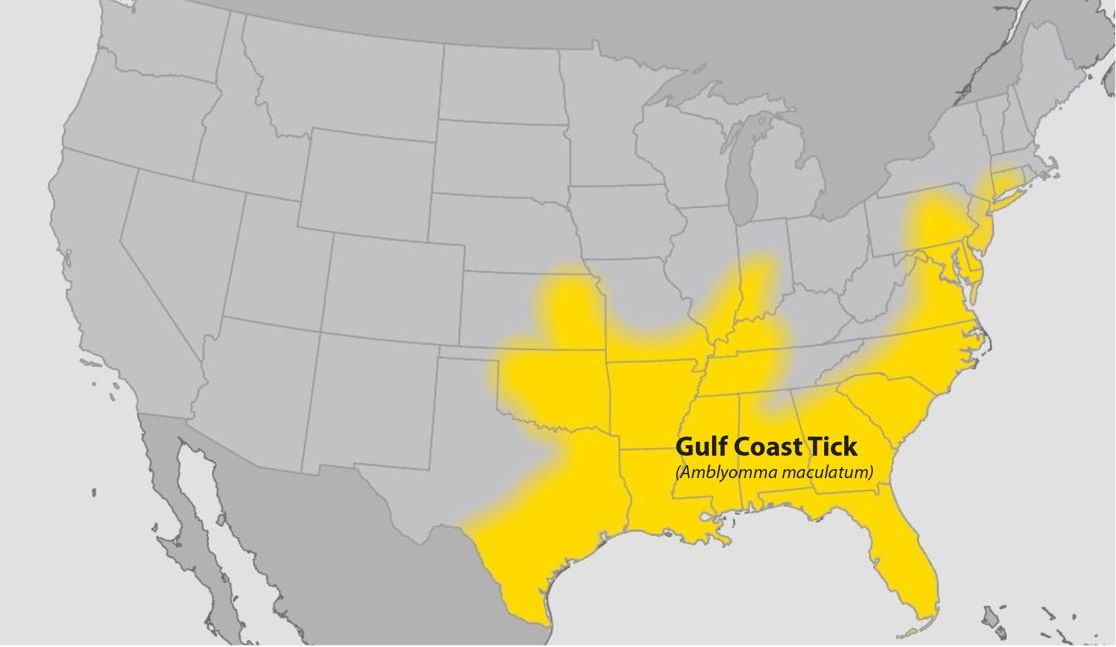
The Gulf Coast tick (Amblyomma maculatum) is an ornate hard tick found primarily in the southeastern United States, with additional focal populations in parts of the Northeast, Midwest, and Southwest. Historically associated with the Gulf and southern Atlantic coasts, its U.S. range has expanded substantially inland and northward.

The Gulf Coast tick is medically important because adult ticks can transmit Rickettsia parkeri, the bacterium that causes Rickettsia parkeri rickettsiosis, a type of spotted fever rickettsiosis.

Common around dogs, kennels & infested homes

Can remain active year-round, especially indoors

Can transmit Rickettsia parkeri rickettsiosis disease

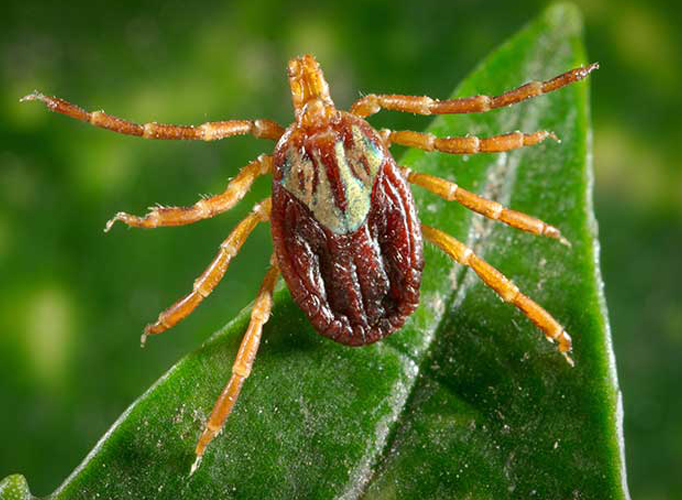
Adult Gulf Coast ticks are relatively large, ornate ticks. Unfed adults are approximately 6 mm, or about 1/4 inch, long and have distinctive silvery-white or cream-colored markings on a dark reddish-brown background.

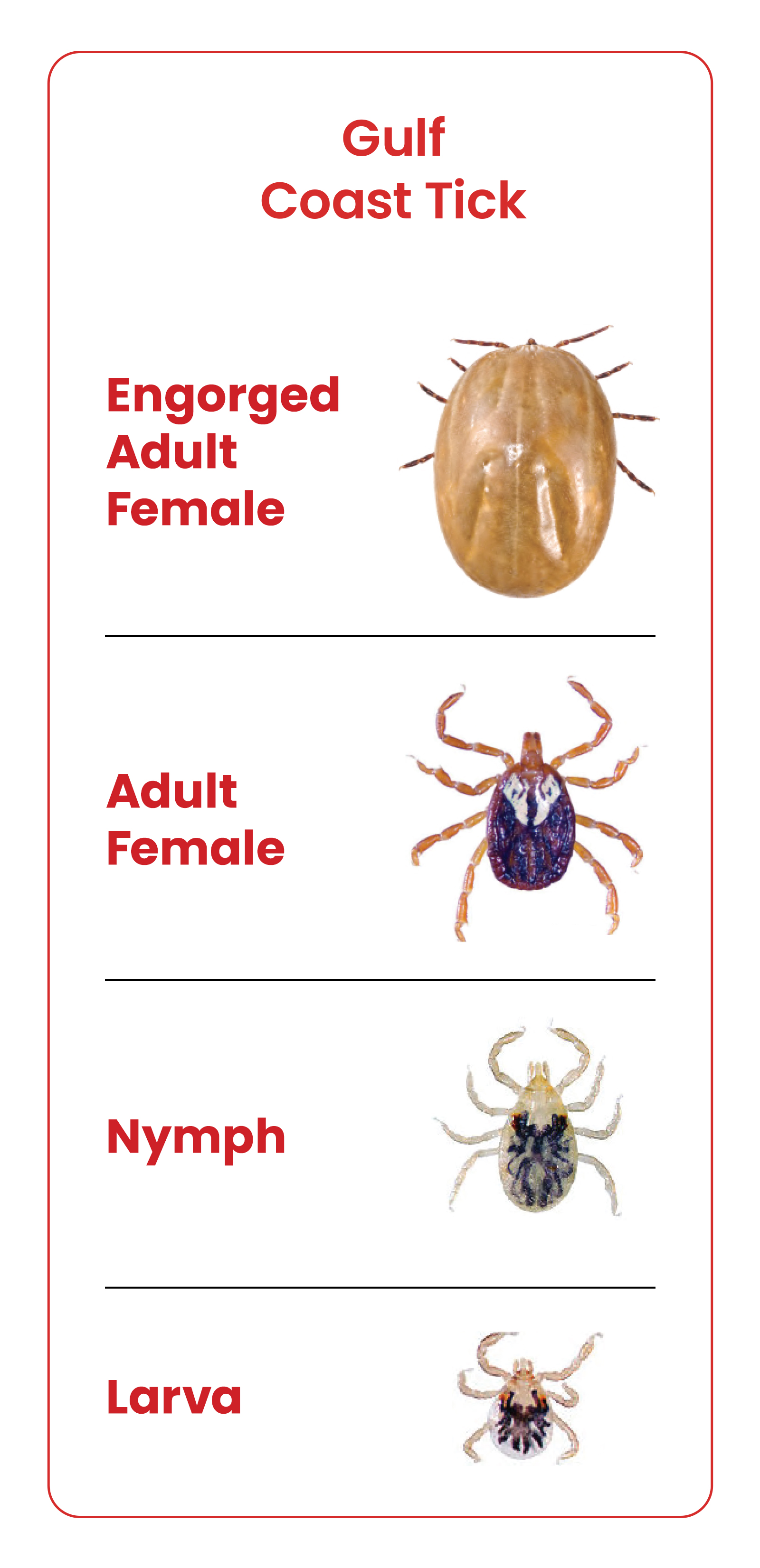
Adult Female

Typical features include:

  • 8 legs
  • Reddish-brown body
  • A dark-brown scutum near the front of the body
  • Distinctive silvery-white ornamentation on the scutum
  • Scutum covering only the front portion of the back
  • Relatively long mouthparts
  • Abdomen capable of expanding dramatically during feeding

The female’s smaller scutum allows the abdomen behind it to enlarge substantially as she becomes engorged.

Adult Male

Adult males:

  • Have 8 legs
  • Are reddish brown to dark brown
  • Have a scutum covering essentially the entire dorsal surface
  • Display interconnected silvery-white markings across much of the back
  • Have relatively long mouthparts
  • Do not enlarge as dramatically as adult females while feeding

Nymph

Nymphs:

  • Have 8 legs
  • Are much smaller than adults
  • Lack the conspicuous ornate pattern seen in adults
  • Are approximately 1.3 mm long when unfed
  • May become several times larger after feeding
  • Can be difficult to identify accurately without magnification

Larva

Larvae:

  • Have 6 legs
  • Are extremely small—approximately 0.5 mm
  • Lack the prominent adult ornamentation
  • Feed on a host before dropping off and molting into nymphs

Distinguishing It From Similar Ticks

The Gulf Coast tick can be confused with the American dog tick (Dermacentor variabilis).

One of the most useful differences is the mouthparts:

Gulf Coast Tick

  • Relatively long mouthparts

American Dog Tick

  • Shorter, broader mouthparts

Male Gulf Coast ticks may also resemble male lone star ticks. However, male Gulf Coast ticks typically have interconnected pale ornamentation across much of the scutum, whereas male lone star ticks generally have more separated pale markings concentrated toward the outer edges of the body.

Using a magnifier can help make the tick’s mouthparts, scutum, markings, legs, and other identification features easier to see.

CDC describes the Gulf Coast tick as occurring primarily in the southeastern United States, with focal populations in the northeastern, midwestern, and southwestern United States.

Its range has expanded considerably beyond its historical coastal distribution. Established populations have been documented hundreds of miles inland and northward, including populations in states such as Arkansas, Missouri, Kentucky, Illinois, Indiana, Connecticut, New York, New Jersey, and Ohio, among other areas.

Important 2026 Range Update

A September 2026 report in CDC’s Emerging Infectious Diseases documented established Gulf Coast tick populations in Hamilton and Butler Counties, Ohio, based on field collections conducted in 2020.

Researchers collected 30 adult Gulf Coast ticks in Hamilton County and 7 adults in Butler County, meeting the study’s criteria for established populations. Gulf Coast ticks were also detected in Madison County, although the collection there did not meet the study’s establishment criteria.

Researchers tested 29 Gulf Coast ticks from the Hamilton County site and detected Rickettsia parkeri in 15 of them.

This finding demonstrates that both the Gulf Coast tick and its principal human pathogen are present well beyond the tick’s historical southeastern range.

It does not mean that all Gulf Coast ticks in Ohio—or elsewhere—carry R. parkeri.

Common Habitats

Gulf Coast ticks are particularly associated with relatively open, grassy, and drier environments, including:

  • Grasslands
  • Prairies
  • Pastures
  • Coastal uplands
  • Coastal grass and dune habitats
  • Tall grassy areas
  • Open or brushy fields
  • Grassy woodland edges
  • Similar open habitats used by wildlife and livestock

They are generally more characteristic of open grassy environments than dense, shaded forest interiors.

Gulf Coast ticks find hosts through a behavior called questing, in which they climb vegetation and wait for a passing animal or person.

Ticks do not jump or fly.
The Gulf Coast tick has four developmental stages:

Egg → Larva → Nymph → Adult

It is a three-host tick, meaning that each active life stage—larva, nymph, and adult—typically feeds on a host. After feeding, larvae and nymphs drop into the environment and molt to the next stage. After feeding and mating, an adult female eventually drops from the host and lays eggs.

Larvae

Larvae:

  • Have 6 legs
  • Primarily feed on small animals
  • Commonly use birds, rodents, and other small vertebrates as hosts
  • Drop from the host after feeding
  • Molt into nymphs

Nymphs

Nymphs:

  • Have 8 legs
  • Commonly feed on birds, rodents, rabbits, and other small animals
  • Drop from the host after feeding
  • Molt into adults

Adults

Adults:

  • Have 8 legs
  • Feed primarily on larger mammals
  • Commonly infest wildlife, livestock, dogs, and other large mammals
  • Will also bite humans

Adult Gulf Coast ticks frequently concentrate around the ears of large animal hosts.

After feeding and mating, an engorged adult female leaves the host and lays a large clutch of eggs in a protected environmental location.

Life-Cycle Timing

There is no single fixed duration for the Gulf Coast tick’s entire life cycle.

Development, activity, and survival depend on factors including:

  • Temperature
  • Humidity
  • Geography
  • Host availability
  • Local environmental conditions

Under favorable laboratory conditions, unfed adult Gulf Coast ticks have survived for up to approximately 16 months, demonstrating how long some stages may persist while waiting for a host.

Seasonal Activity

Seasonal activity varies substantially by geographic location and life stage, so Gulf Coast ticks should not simply be described as a “spring through fall” species.

Published regional observations have found:

  • Coastal Texas: activity approximately May through March, with adult activity peaking around August
  • Oklahoma and Kansas: activity approximately February through October, with adult activity peaking around April
  • Mississippi: ticks collected approximately March through November, with adults peaking in late July to early August
  • Northern Florida: activity reported approximately February through September

These are regional patterns, not universal dates.

For a national audience, the most accurate summary is:

Gulf Coast ticks can be active for extended portions of the year. Exact activity periods and peak months vary by region, climate, and life stage.

Rickettsia parkeri Rickettsiosis

Cause: Rickettsia parkeri

The Gulf Coast tick is the principal U.S. vector of Rickettsia parkeri, which causes Rickettsia parkeri rickettsiosis.

CDC specifically associates adult Gulf Coast ticks with transmission of R. parkeri to humans.

Possible Symptoms

Symptoms generally develop 2–10 days after the bite of an infected tick.

A characteristic feature of R. parkeri rickettsiosis is an inoculation eschar at or near the site where the infected tick was attached.

An eschar is generally an ulcerated or necrotic skin lesion that may have:

  • A dark or black scab
  • A shallow ulcer underneath
  • An area of redness surrounding the lesion

Additional symptoms can include:

  • Fever
  • Headache
  • Muscle aches
  • Rash
  • Swollen regional lymph nodes in some patients

The rash is often described as a sparse maculopapular or vesicular/papulovesicular eruption involving the trunk and extremities.

  1. parkeri Rickettsiosis vs. RMSF

Rickettsia parkeri rickettsiosis is not Rocky Mountain spotted fever (RMSF).

They are caused by different bacteria:

  • R. parkeri rickettsiosis: Rickettsia parkeri
  • Rocky Mountain spotted fever: Rickettsia rickettsii
  1. parkeri rickettsiosis is characteristically less severe than RMSF, and an eschar is much more typical of R. parkeri infection.

However, the illnesses can be difficult to distinguish during the early stages of disease.

It is therefore more accurate to describe R. parkeri rickettsiosis as a distinct spotted fever rickettsiosis, rather than as a “mild form of RMSF.”

Important Disease Clarification

For a U.S.-focused human-health page, Rickettsia parkeri rickettsiosis is the principal established infectious disease associated with transmission by the Gulf Coast tick.

Other microorganisms have been detected in Gulf Coast ticks or studied experimentally, but detecting an organism in a tick—or demonstrating transmission under laboratory conditions—does not necessarily establish that the tick naturally transmits human disease in the United States.

Finding a Gulf Coast tick does not mean that the tick is infected or that disease transmission has occurred.

Tick Paralysis

The Gulf Coast tick has been implicated in uncommon cases of tick paralysis in humans and animals, including dogs.

Tick paralysis is not an infectious disease. It is caused by toxins released in the saliva of certain feeding ticks that affect the nervous system and can cause progressive muscle weakness or paralysis.

Reports involving Gulf Coast ticks are uncommon, so tick paralysis should be described as a rare association rather than a primary health risk.

Important Veterinary Health Risks

American Canine Hepatozoonosis

The Gulf Coast tick is the principal vector of Hepatozoon americanum, the protozoan parasite that causes American canine hepatozoonosis.

Unlike many tick-borne infections, dogs generally become infected by swallowing an infected Gulf Coast tick, rather than through the tick’s bite.

Dogs may also acquire infection by consuming certain infected prey animals that serve as paratenic hosts.

American canine hepatozoonosis is a veterinary disease and is not known to pose a zoonotic risk to people.

Livestock Injury

Adult Gulf Coast ticks often attach around the ears of cattle and other livestock.

Heavy infestations may result in:

  • Severe local inflammation
  • Abscesses
  • Tissue damage
  • Lethargy or debilitation
  • Drooping or damaged ears

The characteristic ear damage associated with heavy Gulf Coast tick infestation has historically been referred to as “gotch ear” or “gotched ears.”

Other Organisms Studied in Gulf Coast Ticks

Gulf Coast ticks have demonstrated experimental ability to transmit certain additional organisms, including the agent of heartwater, and laboratory studies have examined their possible involvement with other pathogens.

However, experimental vector competence is not the same as established natural disease transmission.

Heartwater is not established as an endemic disease in the United States, and Gulf Coast ticks should not be presented as an established U.S. vector of heartwater or leptospirosis in a public-facing human-health disease list.

When Outdoors

To reduce the chance of tick bites:

  • Avoid brushing directly against tall grass, brush, and other tick habitat when practical
  • Walk near the center of maintained trails
  • Use an EPA-registered insect repellent according to label instructions
  • Treat clothing and outdoor gear with products containing 0.5% permethrin, or use commercially pretreated clothing and gear
  • Wear long pants, long sleeves, and closed shoes when practical
  • Light-colored clothing can make crawling ticks easier to see

Permethrin products intended for treating clothing and gear should be used according to the product label and should not be applied directly to skin.

After Outdoor Activity

Perform a thorough tick check after spending time in areas where ticks may be present.

Pay particular attention to:

  • In and around the hair
  • In and around the ears
  • Under the arms
  • Around the waist
  • Inside the belly button
  • Behind the knees
  • Between the legs

Also check:

  • Children
  • Pets
  • Clothing
  • Backpacks
  • Outdoor equipment

CDC recommends showering soon after being outdoors. Showering within two hours of coming indoors may help wash off unattached ticks and provides a good opportunity to perform a complete body check.

If You Find an Attached Tick

Remove the tick as soon as possible.

CDC’s current tick-removal guidance was updated on June 9, 2026.

How to Remove a Tick

  1. Use clean fine-tipped tweezers to grasp the tick as close to the skin’s surface as possible.
  2. If fine-tipped tweezers are not available, CDC says regular tweezers or your fingers can be used. Grasp the tick close to the skin and avoid squeezing its body.
  3. Pull the tick away from the skin with steady, even pressure.
  4. Do not twist or jerk the tick.
  5. If mouthparts break off and remain in the skin, they may be removed with tweezers if they come out easily. If they cannot be removed easily, leave them alone and allow the skin to heal.
  6. Dispose of the live tick safely by placing it in a sealed container, wrapping it tightly in tape, flushing it down the toilet, or placing it in alcohol.
  7. Do not crush a live tick with your fingers.
  8. Thoroughly clean the bite area and your hands with soap and water, rubbing alcohol, or hand sanitizer.
  9. Check the rest of your body for additional ticks.

Do Not Use

CDC advises against using substances or methods intended to make an attached tick detach, including:

  • Petroleum jelly
  • Heat
  • Nail polish
  • Other substances intended to force the tick to release

Prompt mechanical removal is recommended.

Tick Testing

CDC generally does not recommend commercial testing of removed ticks to guide treatment decisions.

A positive test showing that a tick contains a disease-causing organism does not prove that infection was transmitted to the person.

A negative result can also provide false reassurance because:

  • The tested tick may not have been the only tick involved
  • Testing methods and quality standards may vary
  • A person who becomes infected may develop symptoms before tick-testing results are available

Tick-testing results should therefore not be used to make treatment decisions.

When to Contact a Healthcare Provider

If you develop a rash, fever, eschar, headache, muscle aches, or other concerning symptoms during the days or weeks after a tick bite, contact a healthcare provider.

Tell the healthcare provider:

  • That you had a recent tick bite
  • When the bite occurred
  • Where you most likely encountered the tick

Prompt medical evaluation is particularly important if symptoms suggest a spotted fever rickettsiosis.

Adult Female

  • Reddish-brown body
  • Silvery-white markings on the front scutum
  • Long mouthparts
  • 8 legs

Adult Male

  • Silvery-white markings across most of the back
  • Scutum covers nearly the entire back
  • Long mouthparts
  • 8 legs

Engorged Female

  • Greatly enlarged after feeding
  • Ornate scutum remains visible at the front
  • Much larger than an unfed female

Nymph

  • Small body
  • 8 legs

Larva

  • Very small
  • 6 legs

Life Stages
Egg → 6-legged Larva → 8-legged Nymph → Adult

Show adults separately as:

Adult Female | Adult Male

Note: Adult males and females are different sexes, not separate developmental stages.
Need Help OR

Have a question?

Email us anytime at
sales@ticktweezers.com
and we will be happy to help.

While you're here, check out our
Resources and Product pages to
learn more.

Be Tick free