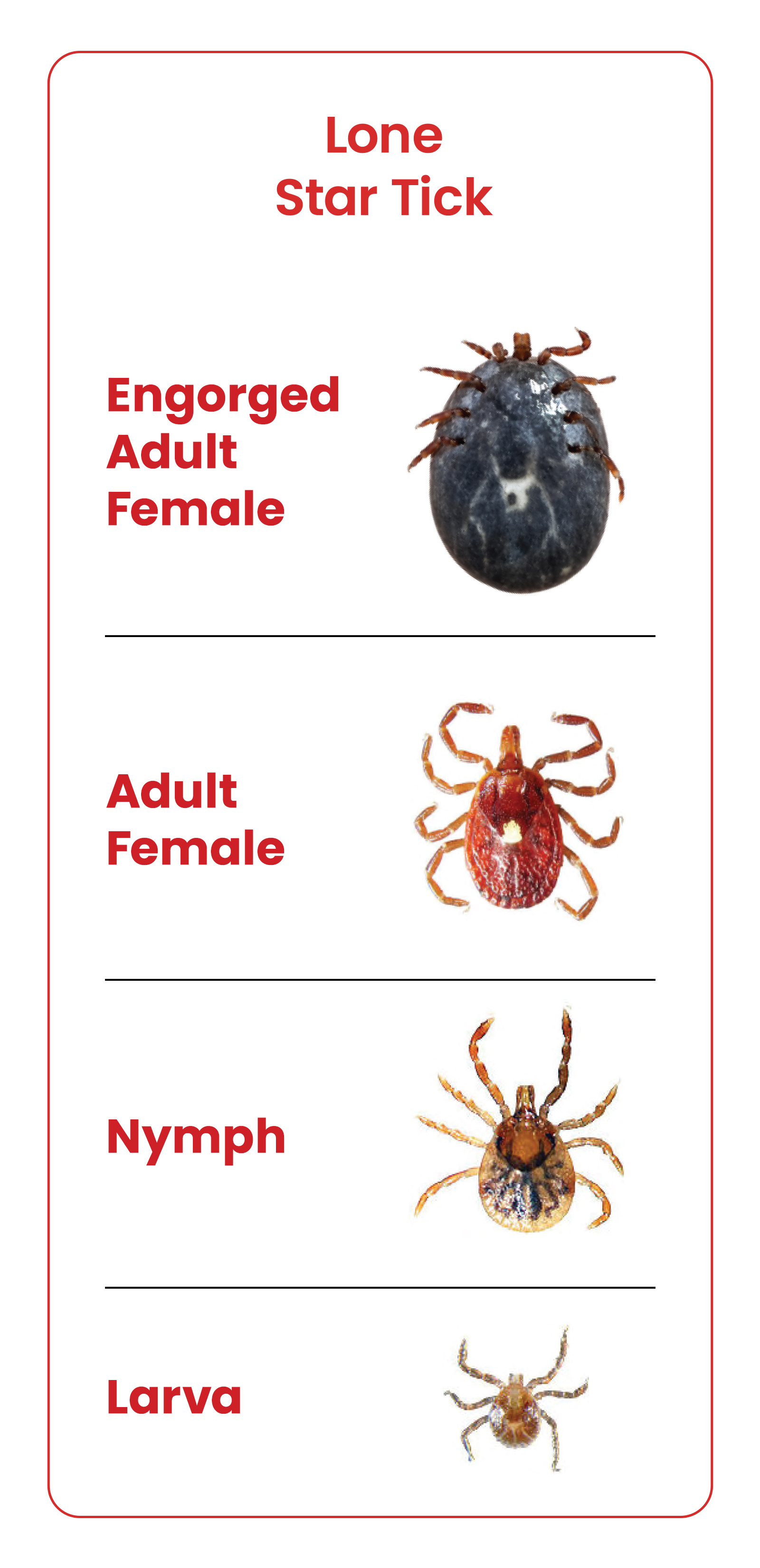

Lone Star Tick
Amblyomma americanum
Common in wooded, brushy & grassy areas
Most active from spring through fall
Aggressive biter that can transmit disease
Identification & Key Features
Identification & Key Features Lone star ticks are generally reddish-brown and have relatively long mouthparts. The species gets its common name from the distinctive pale spot found on the back of the adult female.
All active stages—larva, nymph, and adult—can bite humans, although nymphs and adult females are most frequently reported on people.
Adult Female
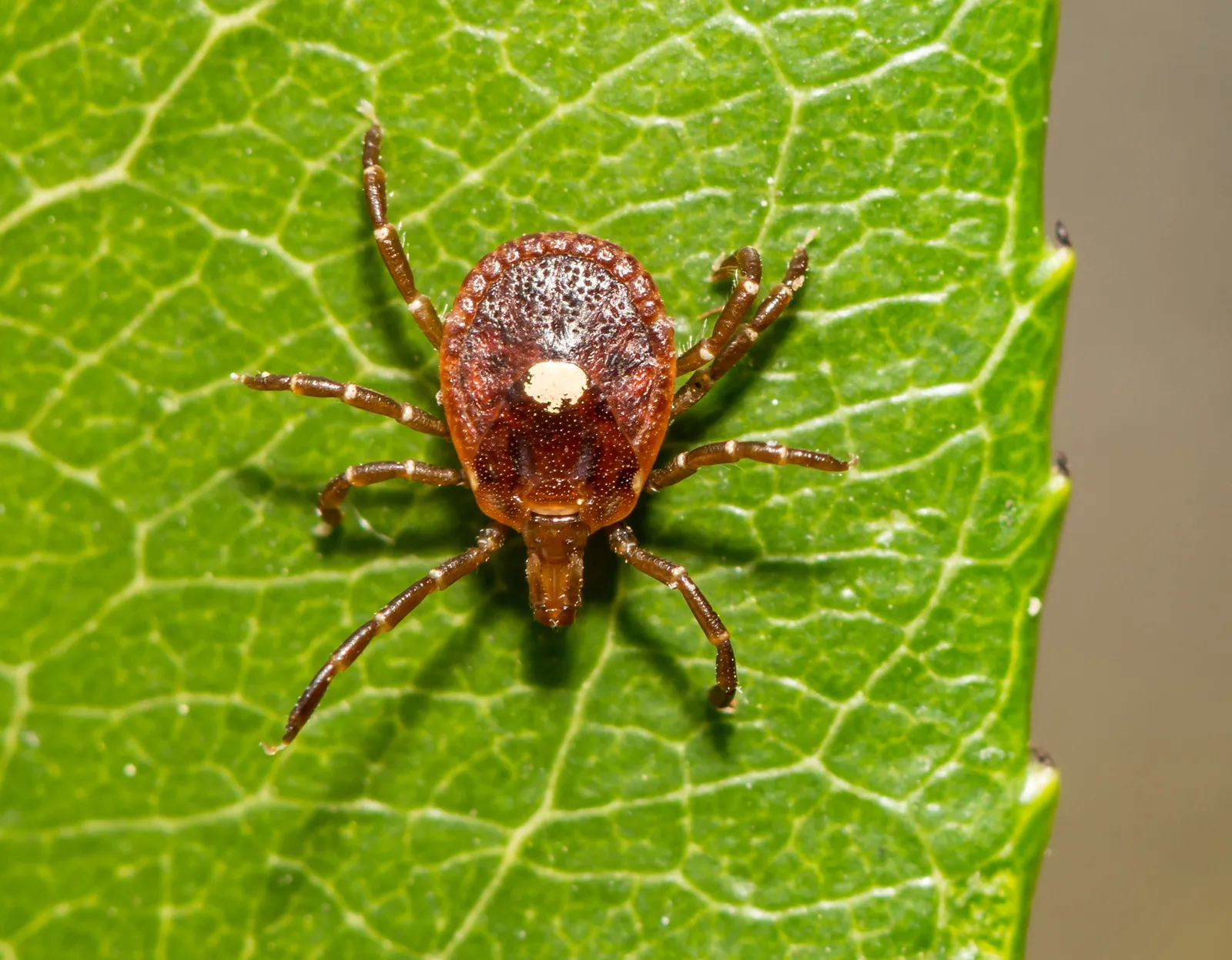
The adult female is the easiest life stage to recognize.
Typical features include:
- Reddish-brown body
- Eight legs
- Relatively long mouthparts
- A single prominent white, cream, or pale spot on the scutum
- Festoons along the rear edge of the body
The single pale spot is the “lone star” that gives the species its common name.
Adult Male
Adult males do not have the female’s single central white spot.
Instead, males are generally:
- Dark reddish-brown
- Eight-legged
- Equipped with relatively long mouthparts
- Marked with variable pale or whitish streaks or spots around portions of the dorsal margins
- Equipped with festoons along the rear edge
The pale markings on adult males may be faint or sometimes difficult to see, so some males may appear almost entirely dark reddish-brown.
Nymph
Lone star tick nymphs:
- Have eight legs
- Are much smaller than adults
- Are generally brown to reddish-brown
- Do not have the adult female’s distinctive white spot
- Can be difficult to notice on the skin
- Readily bite humans
Larva
Lone star tick larvae:
- Have six legs
- Are extremely small
- Lack the adult female’s white spot
- Can bite humans and animals
- May occur in large groups
Because many larvae can hatch within the same small area, people or animals passing through infested vegetation may sometimes encounter many tiny larvae at once.
Additional Identification Features
Lone star ticks have several useful characteristics that can help distinguish them from other ticks:
- Relatively long mouthparts
- Eyes
- Festoons along the rear body margin
- Reddish-brown coloration
- A distinctive single pale spot on adult females
- Variable pale markings on adult males
Festoons can be especially helpful when distinguishing lone star ticks from blacklegged ticks, which do not have festoons.
Identification Tip
Look for:
✓ Single pale “lone star” spot on the adult female
✓ Reddish-brown body
✓ Long mouthparts
✓ Festoons along the rear edge
✓ Variable pale markings on adult males
✓ No “lone star” spot on larvae or nymphs
✓ Very small larvae and nymphs
Geographic Distribution & Habitat
Geographic Distribution & Habitat Geographic Distribution
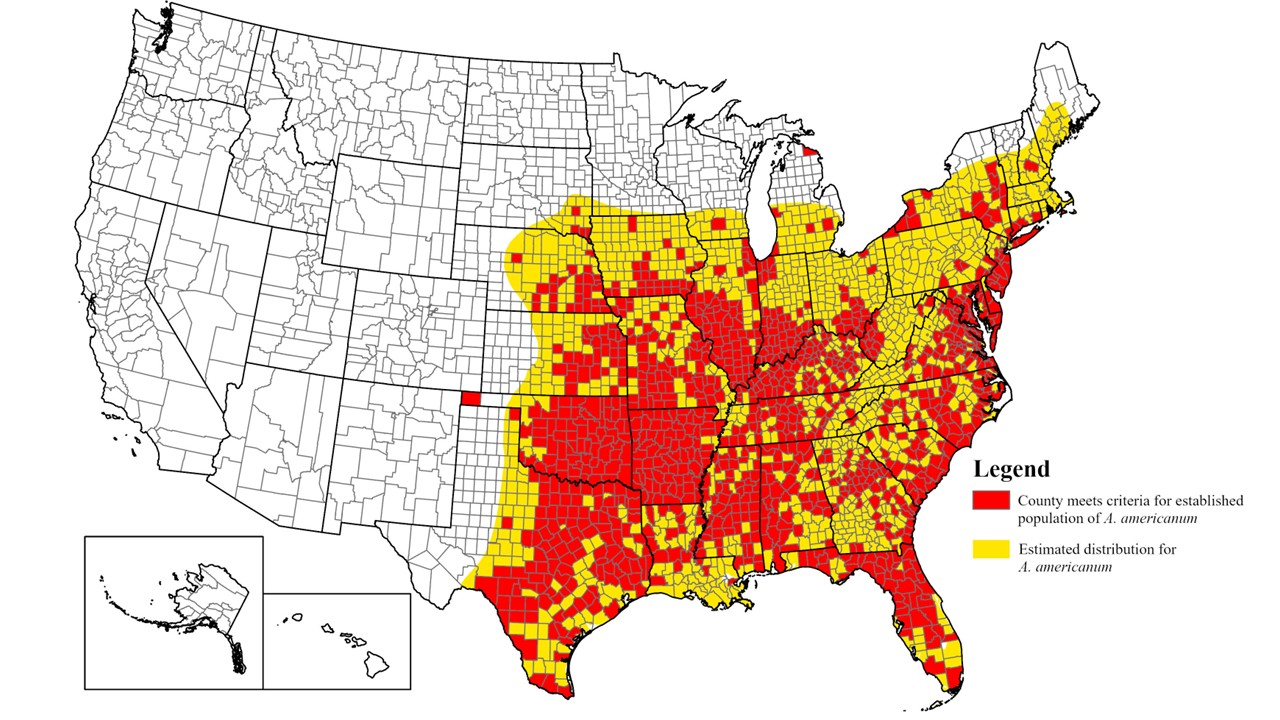
The lone star tick is widely distributed throughout the Northeast, South, and Midwest United States. It is especially common across many southern and southeastern areas but also occurs well into the Midwest and Northeast.
CDC’s current surveillance map shows the estimated distribution of Amblyomma americanum and counties with established populations through 2025 (see below under Distribution Map)
A county that is not labeled as having an established population does not necessarily mean lone star ticks are absent. Surveillance and sampling vary, and ticks may occur in an area without meeting CDC’s criteria for an established population.
Preferred Habitat
Lone star ticks are commonly encountered in:
- Wooded and forested areas
- Brush and shrubs
- Tall or dense vegetation
- Leaf litter
- Woodland edges
- Trails and pathways
- Areas frequently used by deer and other wildlife
- Suburban properties bordering suitable tick habitat
They are often associated with places where potential hosts travel, feed, or rest.
Hosts
Lone star ticks have a broad host range.
They can feed on:
- White-tailed deer
- Other wild mammals
- Birds
- Livestock
- Dogs and other companion animals
- Humans
White-tailed deer are particularly important hosts for lone star ticks and play an important role in supporting their populations and geographic distribution. All three active life stages may feed on deer.
Distribution Map
Life Cycle & Seasonal Activity
Life Cycle & Seasonal Activity The lone star tick progresses through four life stages:
Egg → Larva → Nymph → Adult
Lone star ticks are three-host ticks, meaning the larva, nymph, and adult generally feed on different hosts during their development.
In nature, the life cycle commonly takes around two years, although development varies depending on temperature, humidity, host availability, and other environmental conditions.
Egg
After feeding, an engorged adult female drops from her host and seeks a protected location where environmental conditions are suitable for egg development.
She may lay several thousand eggs before dying. Documented egg masses can sometimes exceed 10,000 eggs, although the number varies considerably among individual females and environmental conditions.
Larva
Eggs hatch into tiny six-legged larvae.
Larvae:
- Seek their first host
- Feed on animals
- Can bite humans
- May be encountered in large groups
After feeding, the larva detaches from its host and eventually molts into an eight-legged nymph.
Nymph
Nymphs have eight legs and seek a second host.
They readily feed on:
- Wildlife
- Domestic animals
- Humans
After feeding, the nymph drops from the host and eventually molts into an adult.
Adult
Adults seek another host for feeding and reproduction.
They commonly feed on medium- and large-sized mammals, particularly white-tailed deer, as well as livestock, pets, and humans.
After an adult female feeds, she drops from the host, lays her eggs, and the life cycle begins again.
Seasonal Activity
The timing of lone star tick activity varies by region, temperature, weather, and climate, so the same calendar should not be applied rigidly across the entire United States.
A useful general pattern is:
Spring
Adult ticks become increasingly active, and nymphs may also be encountered.
Summer
Nymphs remain active, adults may continue to be encountered, and larval activity increases.
Late Summer–Fall
Larvae are often particularly abundant, while nymphs may continue to be encountered.
Studies in parts of the Southeast and Midwest have generally found adults peaking during spring to early summer, nymphs during spring and summer, and larvae during summer into early fall.
Important Seasonal Note
Seasonal activity varies by region and weather.
In warmer parts of the lone star tick’s range, active ticks may be encountered outside these general seasonal windows. Tick-bite prevention should therefore not be limited to only one short period of the year.
Diseases & Health Risks
Diseases & Health Risks Southern Tick-Associated Rash Illness — STARI
Southern tick-associated rash illness (STARI) is associated with bites of the lone star tick.
The main feature is a red, expanding rash that develops around the site of a tick bite.
Other reported symptoms may include:
- Fatigue
- Headache
- Fever
- Muscle pain
- Joint pain
The exact cause of STARI remains unknown.
STARI Is Not Lyme Disease
The rash caused by STARI can resemble the erythema migrans (EM) rash associated with Lyme disease.
However:
Lone star ticks have not been shown to transmit the bacteria that cause Lyme disease, and STARI is not caused by the same bacteria responsible for Lyme disease.
This distinction is important because the two rashes can appear similar.
Bite Prevention & Protection
Bite Prevention & Protection Before Going Outdoors
Use additional caution in:
- Wooded areas
- Brushy vegetation
- Tall grass
- Leaf litter
- Woodland edges
- Trails and pathways
- Areas frequently used by deer and other wildlife
Stay near the center of cleared trails whenever practical and avoid unnecessary contact with brush and vegetation.
Use Insect Repellent
Use an EPA-registered insect repellent containing an active ingredient such as:
- DEET
- Picaridin
- IR3535
- Oil of Lemon Eucalyptus (OLE)
- para-menthane-diol (PMD)
- 2-undecanone
Always follow product-label directions.
Products containing OLE or PMD should not be used on children younger than 3 years.
Protect Clothing & Gear
Products containing 0.5% permethrin may be used on approved clothing and outdoor gear according to product-label directions.
Items may include:
- Pants
- Socks
- Boots
- Jackets
- Tents
- Other outdoor equipment
Pre-treated clothing and gear are also available.
Do not apply permethrin products intended for treating clothing or gear directly to the skin.
After Spending Time Outdoors
Perform a thorough full-body tick check.
Pay particular attention to:
- Under the arms
- In and around the ears
- In and around the hair
- Inside the belly button
- Around the waist
- Between the legs
- Behind the knees
Because lone star tick larvae and nymphs can be extremely small, a mirror and magnifier can help when checking for ticks.
Also inspect:
- Clothing
- Shoes
- Coats
- Backpacks
- Outdoor gear
- Dogs and other pets
Ticks can be carried indoors on clothing, pets, or gear before attaching to a person.
Shower
Shower within two hours of coming indoors.
Showering may help wash off unattached ticks and provides another opportunity to perform a thorough tick check.
Clothing
For dry clothing:
Tumble dry on high heat for 10 minutes after coming indoors to kill ticks.
Damp clothing may require additional drying time.
If clothing needs to be washed first, hot water is recommended because cold and medium-temperature water may not kill ticks.
If You Find an Attached Tick
Remove the tick as soon as possible. Do not delay removal while waiting to see a healthcare professional.
- Use clean fine-tipped tweezers whenever available.
- Grasp the tick as close to the skin’s surface as possible, avoiding squeezing the tick’s body.
- Pull the tick away from the skin using steady, even pressure.
- Do not twist or jerk the tick.
- If fine-tipped tweezers are unavailable, regular tweezers may be used. If necessary, the tick can also be grasped carefully with the fingers close to the skin while avoiding squeezing its body.
- If mouthparts break off and remain in the skin, remove them with tweezers if they can be grasped easily. If they cannot be removed easily, leave them alone and allow the skin to heal.
- Do not crush the tick with your fingers.
- Clean the bite area and your hands afterward.
- Perform another careful tick check for additional ticks.
Do Not Use
Do not try to make an attached tick detach using:
- Petroleum jelly
- Heat
- Nail polish
- Other substances
These methods can delay proper removal. The goal is to remove an attached tick promptly and correctly.
Tick Disposal
After removal, dispose of the tick safely.
Options include:
- Placing it in a sealed container
- Wrapping it tightly in tape
- Placing it in alcohol
- Flushing it down the toilet
Avoid crushing a tick with bare fingers.
After Removal
Monitor how you feel during the following days and weeks.
If you develop a rash, fever, or other concerning symptoms, contact a healthcare professional and mention:
- The recent tick bite
- When the bite occurred
- Where you most likely encountered the tick
If you experience symptoms of a severe allergic reaction, such as difficulty breathing, throat or tongue swelling, faintness, or other signs of anaphylaxis, seek immediate emergency medical care.
Around Your Home
To help reduce tick exposure around residential properties:
- Remove accumulated leaf litter
- Keep grass mowed
- Clear tall grass and brush
- Trim vegetation around frequently used areas
- Keep wood stacked neatly in dry locations
- Keep playground and recreation areas away from wooded edges when practical
- Create a wood-chip or gravel barrier between lawns and wooded areas
- Reduce habitat that attracts unwanted wildlife
- Check pets regularly for ticks
Identification Gallery
Identification Gallery Adult Female
Adult Female Lone Star Tick
Reddish-brown with a distinctive single pale “lone star” spot on the back.
Adult Male
Adult Male Lone Star Tick
Reddish-brown to dark brown with pale markings near the edges of the back rather than one central spot.
Nymph
Lone Star Tick Nymph
A small, eight-legged stage that does not have the adult female’s lone star spot.
Larva
Lone Star Tick Larva
An extremely small, six-legged stage that also lacks the adult female’s distinctive spot.
Engorged Female
Engorged Adult Female Lone Star Tick
After feeding, the female becomes much larger and may look very different from an unfed tick.
Quick Identification
Female: Single pale “lone star” spot on the back.
Male: Pale markings around portions of the outer back.
Nymph: Very small, eight legs, no lone star spot.
Larva: Extremely small, six legs.
Life Stages:
Larva → Nymph → Adult