
Rabbit Tick
Haemaphysalis leporispalustris
The Rabbit Tick is a hard tick in the genus Haemaphysalis that primarily parasitizes rabbits and hares, and can also feed on other small to medium-sized mammals.
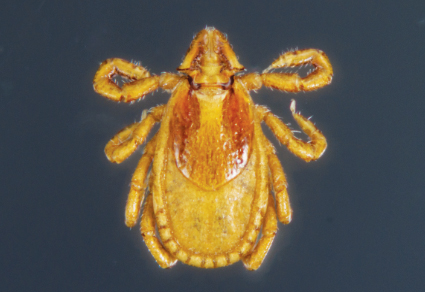
- Adult females are typically tan to reddish-brown with a darker dorsal shield, or scutum, behind the head.
- Adult males are usually darker brown and slightly smaller than females.
- The female’s scutum covers only the front portion of the back.
- In adult males, the scutum covers essentially the entire dorsal surface.
- Adults and nymphs have 8 legs.
- Larvae have 6 legs.
- The body is oval and often has slightly pointed posterior corners, a feature common in Haemaphysalis ticks.
- Identification to species can be difficult and may require examination of small anatomical features.
Rabbit ticks are most commonly found on cottontail rabbits, snowshoe hares, and other lagomorphs in woodlands, brushy areas, fields, and edge habitats. They may occasionally feed on other mammals and rarely on humans. While they can carry some tick-borne pathogens, they are not considered major vectors of human disease in the United States.
Associated with rabbits, hares & other mammals
Life cycle usually takes about 2-3 years
Can carry some pathogens, but human transmission is rare
 Identification & Key Features
 Identification & Key Features
 The Rabbit Tick is a small hard tick associated primarily with rabbits and hares. Adults feed mainly on lagomorphs, while larvae and nymphs also commonly feed on ground-dwelling birds and small mammals.
- Adults are generally tan to reddish-tan
- Adult females have a darker, unornamented scutum behind the head
- The female’s scutum covers only the front portion of the back
- In adult males, the conscutum (dorsal shield) covers essentially the entire back
- Adults and nymphs have 8 legs
- Larvae have 6 legs
- Eyes are absent
- Festoons are present along the rear edge
- The palps are relatively short, and palpal segment II has a distinctive pointed lateral projection
- Unfed adults are small, generally less than 1/8 inch long
The absence of eyes, presence of festoons, inornate female scutum, and laterally projecting second palpal segment are useful identification characteristics. Modern taxonomic work shows that reliable species-level identification may require examination of detailed palpal, scutal, coxal, setal, and other microscopic features.
Rabbit Ticks may resemble the Asian Longhorned Tick (Haemaphysalis longicornis) and other Haemaphysalis species, so visual appearance alone may not always provide a reliable species identification.
Geographic Distribution & Habitat
Geographic Distribution & Habitat The Rabbit Tick has historically been reported across a broad portion of the Americas, including:
- The United States
- Canada
- Mexico
- Regions extending into South America
In Maine, for example, it occurs in a variety of forested habitats, including deciduous, coniferous, and mixed forests. More generally, it occurs in habitats supporting suitable hosts such as rabbits, hares, birds, and small mammals.
Important Taxonomic Note: The precise modern distribution of H. leporispalustris is still being refined.
In 2024, researchers described Haemaphysalis mariae from rabbit- and hare-associated specimens in Texas, Oklahoma, and Colorado that had historically been misidentified as H. leporispalustris.
In 2025, researchers described Haemaphysalis vespertina from specimens collected in California and Oregon that had also previously been identified as H. leporispalustris. That study identified additional unresolved genetic lineages within the broader H. leporispalustris complex.
Therefore, older distribution records for H. leporispalustris should be interpreted with some caution, particularly in western and parts of central North America.
Life Cycle & Seasonal Activity
Life Cycle & Seasonal Activity The Rabbit Tick is a three-host tick, meaning the larva, nymph, and adult typically feed on different individual hosts during development.
Larvae and nymphs commonly feed on:
- Ground-dwelling birds
- Rodents and other small mammals
- Rabbits and hares
Adults feed primarily on:
- Rabbits
- Hares
Adults are commonly found on or around the ears and head of rabbits.
Seasonal activity varies considerably by geographic region and life stage.
In Maine, Rabbit Ticks are most commonly encountered from spring through summer, with numbers declining significantly during fall.
A Virginia study found larvae and nymphs on rabbit hosts from February through November, while adults were detected from February through October.
In southeastern Missouri, a three-year study found H. leporispalustris active throughout the year.
Because activity differs with geography, climate, host availability, and life stage, a single nationwide set of activity months should not be applied to this species.
Diseases & Health Risks
Diseases & Health Risks The Rabbit Tick is primarily important in wildlife disease cycles and rarely feeds on humans.
It has been associated with the maintenance or transmission of:
- Francisella tularensis — the bacterium that causes tularemia
- Rickettsia rickettsii — the bacterium that causes Rocky Mountain spotted fever (RMSF)
- Other spotted-fever-group rickettsiae
Rabbit Ticks can participate in wildlife cycles involving rabbits, rodents, and other animals, but they are not considered important human vectors of tularemia or RMSF in the United States. The Québec public-health identification guide recognizes H. leporispalustris as a reservoir of F. tularensis but not as a human tularemia vector.
For RMSF, CDC identifies the American Dog Tick (Dermacentor variabilis), Rocky Mountain Wood Tick (Dermacentor andersoni), and Brown Dog Tick (Rhipicephalus sanguineus) as the principal recognized U.S. vectors to humans.
For tularemia, CDC identifies the American Dog Tick, Rocky Mountain Wood Tick, and Lone Star Tick (Amblyomma americanum) as recognized U.S. tick vectors to humans.
Rickettsia lanei
Rickettsia lanei is a newly recognized spotted-fever-group rickettsial pathogen that can cause illness in humans. Published studies have detected R. lanei in ticks identified as H. leporispalustris, and research suggests that rabbit-associated Haemaphysalis ticks may play an important role in maintaining the bacterium in nature.
However, H. leporispalustris has not been established as a confirmed vector of R. lanei to humans.
A 2026 California investigation detected R. lanei in both Rabbit Ticks identified as H. leporispalustris and Pacific Coast Ticks (Dermacentor occidentalis). The R. lanei genome recovered from a Pacific Coast Tick at a likely exposure site was identical to the genome recovered from the human patient, strongly implicating the Pacific Coast Tick as the source of that infection.
Researchers concluded that direct human transmission by H. leporispalustris is unlikely because this tick strongly prefers lagomorph hosts and rarely infests humans. However, it may serve as an important vector or reservoir in the natural maintenance cycle of R. lanei. Additional studies are needed to establish vector competence.
Taxonomic caution: Because H. vespertina was only recently separated from western populations formerly identified as H. leporispalustris, some older western records involving “H. leporispalustris” may require taxonomic re-evaluation.
Heavy Rabbit Tick infestations can also weaken and potentially kill small animal hosts.
Bite Prevention & Protection
Bite Prevention & Protection Although Rabbit Ticks rarely bite humans, standard tick precautions remain appropriate.
- Avoid unnecessary contact with wild rabbits and hares
- Wear gloves when handling sick or dead wildlife
- Check yourself, children, clothing, gear, and pets for ticks after outdoor activities
- Use an EPA-registered insect repellent when appropriate
- Reduce tall grass, brush, and dense vegetation around frequently used areas
- Remove attached ticks as soon as possible
- Use clean fine-tipped tweezers, grasping the tick as close to the skin as possible and pulling with steady, even pressure
CDC recommends EPA-registered repellents, post-outdoor tick checks, and prompt tick removal with fine-tipped tweezers.
Extra care is important when handling sick or dead rabbits because tularemia can also spread through direct contact with infected animal tissue, independently of tick bites. CDC specifically recommends gloves when handling potentially infected rabbits and other wildlife.
Identification Gallery
Identification Gallery Adult Female
- Tan to reddish-tan body
- Darker, unornamented scutum
- Scutum covering only the front portion of the back
- 8 legs
- No eyes
- Festoons along the rear edge
Adult Male
- Tan to reddish-brown body
- Conscutum (dorsal shield) covering essentially the entire back
- 8 legs
- No eyes
- Festoons present
Engorged Female
- Enlarged body after feeding
- Dark scutum remaining visible near the front
- Show comparison with an unfed female
Nymph
- Very small body
- 8 legs
- Plain, unornamented appearance
- Show size comparison with an adult
Larva
- Extremely small body
- 6 legs
- Show size comparison with a nymph
Important: Rabbit Ticks may resemble the Asian Longhorned Tick (Haemaphysalis longicornis), H. mariae, H. vespertina, and other Haemaphysalis ticks. Reliable species identification may require examination of palpal shape and setae, scutal punctation, coxal spurs, body measurements, and other microscopic characteristics.

