Groundhog Tick (Woodchuck Tick)
Ixodes cookei
Common in wooded areas, forest edges, fields & brushy habitats
Most active from spring through fall (peak in spring/early summer)
Can transmit several disease-causing pathogens
 Identification & Key Features
 Identification & Key Features
 Groundhog ticks are relatively small and have a plain, unornamented appearance. They lack the conspicuous white or silvery markings seen on ticks such as American dog ticks and Gulf Coast ticks.
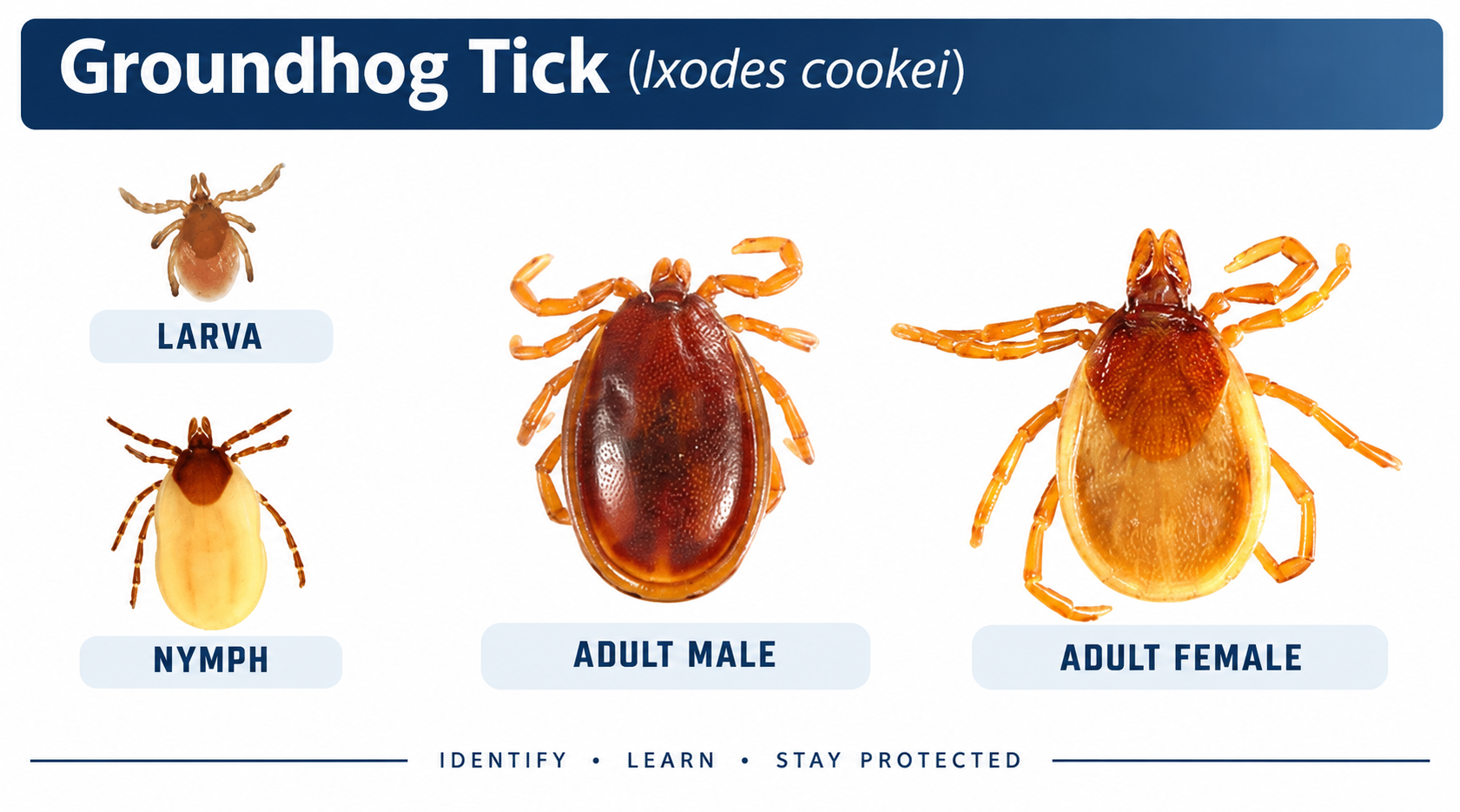
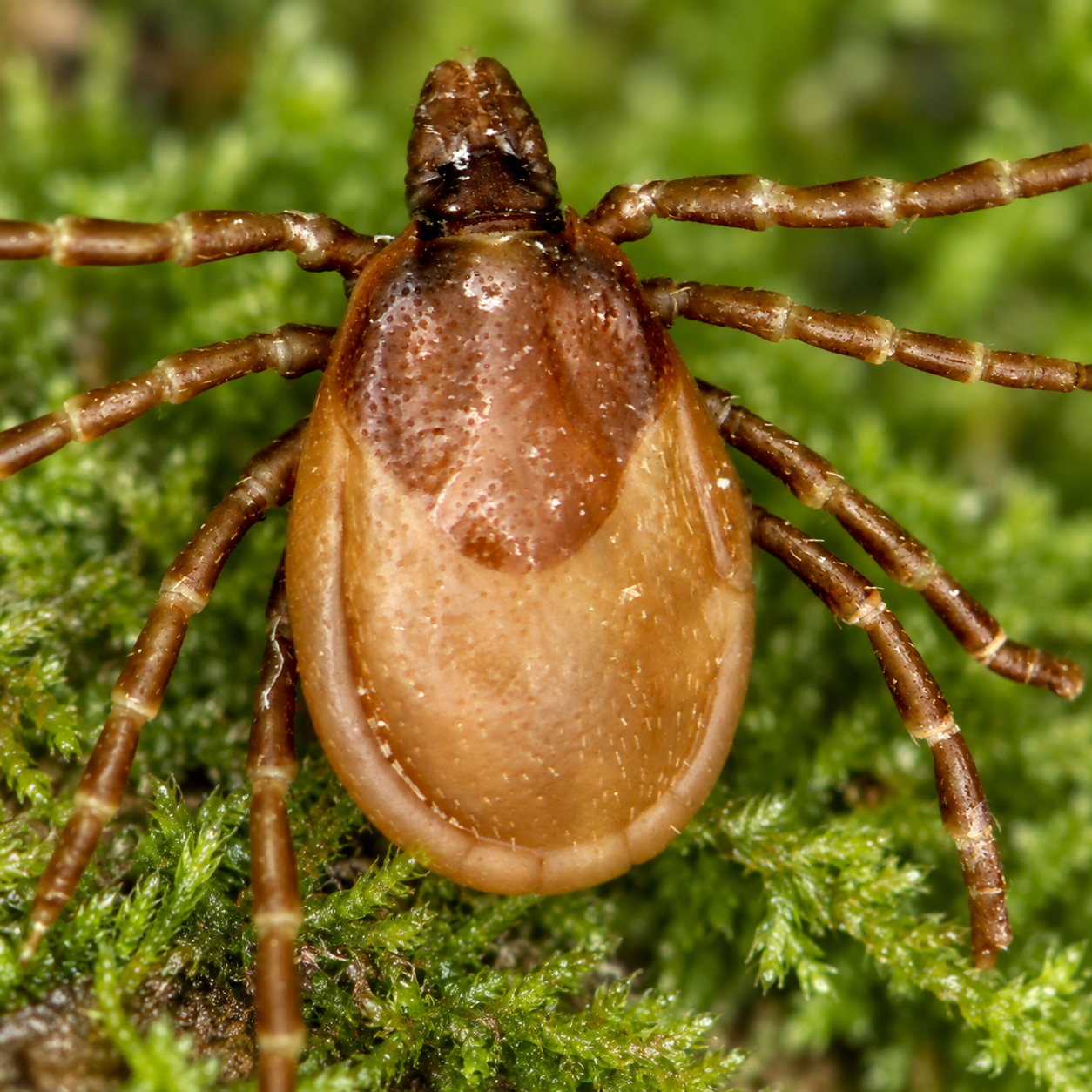
Adult female woodchuck ticks are approximately 1/8 inch long when unfed, roughly the size of a sesame seed. They are generally tan to reddish tan, with a darker dorsal shield, or scutum, near the front of the body. Males are somewhat smaller.
Adult Female
Typical features include:
- 8 legs
- Tan to reddish-tan body
- Darker, inornate scutum
- Scutum covering only the front portion of the back
- Relatively short, stout palps
- Rectangular basis capituli
- No eyes
- No festoons
- Anal groove located in front of the anus
- Abdomen capable of expanding considerably during feeding
One particularly useful identification feature is the shape of the female’s scutum.
In Ixodes cookei, the scutum is generally angular or lozenge-shaped, whereas the scutum of the female blacklegged tick (Ixodes scapularis) is more oval.
Adult Male
Adult males:
- Have 8 legs
- Are generally reddish tan to brown
- Have a plain, inornate appearance
- Have a scutum covering essentially the entire dorsal surface
- Have relatively short, stout palps
- Have a rectangular basis capituli
- Lack eyes
- Lack festoons
- Have an anal groove in front of the anus
Because the male’s scutum covers essentially the entire back, males cannot expand to the same degree as adult females.
Nymph
Nymphs:
- Have 8 legs
- Are considerably smaller than adults
- Have an inornate partial scutum
- Typically have a lozenge-shaped scutum
- Have short, stout palps
- Have a rectangular basis capituli
- Lack eyes
- Lack festoons
- Lack the genital opening present in adult ticks
- Feed primarily on animal hosts
- Can occasionally bite people
Nymphs can be difficult to distinguish from other immature Ixodes ticks without magnification.
Larva
Larvae:
- Have 6 legs
- Are extremely small
- Are generally lighter in coloration than adults
- Feed on animal hosts
- Drop from the host after feeding
- Later molt into eight-legged nymphs
Other Identification Features
Useful characteristics of Ixodes cookei include:
- Inornate scutum
- No eyes
- No festoons
- Rectangular basis capituli in adults and nymphs
- Relatively short, stout palps
- Anal groove positioned in front of the anus
- Characteristically lozenge-shaped scutum in females and nymphs
Several of these features are very small and require magnification or microscopic examination.
Using a magnifier can help make the tick’s scutum, mouthparts, legs, body shape, and other identification features easier to see.
Distinguishing It From Similar Ticks
The groundhog tick can be confused with the:
Blacklegged Tick / Deer Tick
Ixodes scapularis
Both species:
- Are relatively small
- Have an inornate scutum
- Have no eyes
- Have no festoons
- Have an anal groove in front of the anus
- Occur in overlapping parts of eastern North America
Useful differences include:
Groundhog Tick — Ixodes cookei
- More angular or lozenge-shaped female scutum
- Relatively short, stout palps
- Strong association with mammal dens and nests
- Rarely bites people
Blacklegged Tick — Ixodes scapularis
- More oval-shaped female scutum
- Relatively longer palps
- Frequently encountered in wooded and brushy habitats
- Nymphs and adult females commonly bite people
Color should not be used as the sole identification feature, because individuals of both species can vary in coloration. Reliable species-level identification may require microscopic examination.
Geographic Distribution & Habitat
Geographic Distribution & Habitat The groundhog tick occurs broadly across eastern and central North America.
In the United States, it is found through much of the eastern half of the country, including areas of the:
- Northeast
- Mid-Atlantic
- Great Lakes region
- Midwest
- Southeast
Its range also extends into southern Canada.
Common Habitats
Groundhog ticks differ ecologically from many other common human-biting ticks because they are strongly nidicolous, meaning they tend to live in or near the nests, dens, and burrows of their hosts.
Typical locations include:
- Groundhog or woodchuck burrows
- Wildlife dens
- Mammal nests
- Areas immediately around den and burrow entrances
- Sheltered areas occupied by medium-sized mammals
- Properties where groundhogs or other wildlife have established dens
Why Human Encounters Are Less Common
The groundhog tick’s burrow-associated lifestyle helps explain why human bites are uncommon.
Unlike highly exposed host-seeking ticks, I. cookei tends to remain closely associated with its animal hosts and their shelters rather than widely dispersing through vegetation.
CDC identifies the groundhog tick as a species that rarely bites people.
People may be more likely to encounter groundhog ticks when:
- Working near wildlife burrows
- Handling wildlife
- Disturbing mammal dens or nests
- Spending time where groundhogs or similar mammals live
- Pets investigate wildlife burrows and carry ticks into nearby areas
Life Cycle & Seasonal Activity
Life Cycle & Seasonal Activity The groundhog tick has four developmental stages:
Egg → Larva → Nymph → Adult
Ixodes cookei is a three-host tick. The larva, nymph, and adult each take a blood meal and normally detach before continuing to the next stage of development.
Because groundhog ticks remain closely associated with dens and burrows, different life stages may repeatedly feed on the same types of mammalian hosts.
Larvae
Larvae:
- Have 6 legs
- Feed on mammalian hosts
- Remain closely associated with host nests and burrows
- Drop after feeding
- Later molt into nymphs
Nymphs
Nymphs:
- Have 8 legs
- Feed primarily on wildlife
- Commonly use medium-sized mammals
- Can occasionally feed on domestic animals
- Can occasionally bite people
- Drop from the host after feeding
- Later molt into adults
Adults
Adults:
- Have 8 legs
- Feed primarily on mammals
- Commonly infest groundhogs and other medium-sized wildlife
- May occasionally be found on dogs and cats
- Rarely bite humans
After feeding, an adult female drops from the host and lays eggs.
Common Hosts
Despite its common name, the groundhog tick is not restricted to groundhogs.
Reported hosts include:
- Groundhogs / woodchucks
- Skunks
- Raccoons
- Foxes
- Weasels and other mustelids
- Porcupines
- Dogs
- Cats
- Other mammals
- Occasionally birds
- Humans, rarely
Groundhogs and striped skunks are particularly important hosts in the natural ecology of Powassan virus Lineage 1.
Seasonal Activity
Seasonal activity varies according to geography, climate, host activity, weather, and life stage.
In northern portions of its range, adult groundhog ticks are particularly associated with the summer months, and studies in the Northeast have documented peak activity during late spring and summer.
However, Ixodes cookei can be encountered outside this period, and seasonal patterns may differ in more southern parts of its range.
For a national website, the most accurate summary is:
Groundhog tick activity varies geographically, but adults are often most active during the warmer months in northern regions. The species may be encountered at other times of year depending on location, weather, host activity, and life stage.
Diseases & Health Risks
Diseases & Health Risks The principal established human-health concern associated with the groundhog tick is:
Powassan Virus Disease
Cause: Powassan virus
CDC identifies three Ixodes tick species capable of spreading Powassan virus in the United States:
- Ixodes cookei — Groundhog Tick
- Ixodes marxi — Squirrel Tick
- Ixodes scapularis — Blacklegged Tick
CDC also makes an important distinction in human exposure:
Groundhog Tick — rarely bites people
Squirrel Tick — rarely bites people
Blacklegged Tick — often bites people
Powassan Virus Lineage 1
Powassan virus has two closely related genetic lineages:
Lineage 1 — Powassan virus
and
Lineage 2 — Deer tick virus
The groundhog tick is particularly associated with the Lineage 1 enzootic transmission cycle.
One important Lineage 1 cycle involves:
Groundhog Tick — Ixodes cookei
and
Groundhogs / Woodchucks and Striped Skunks
The squirrel tick (Ixodes marxi) also participates in Lineage 1 transmission cycles involving squirrels.
By comparison, Lineage 2, often called deer tick virus, is primarily associated with:
Blacklegged Tick — Ixodes scapularis
and small mammals, including the white-footed mouse.
Both Powassan virus lineages can cause human disease.
Human Risk
Although I. cookei is an important natural vector of Powassan virus, human bites from this species are uncommon.
The groundhog tick is therefore important in the natural wildlife transmission cycle, but its strong association with animal dens and its relatively low tendency to bite people reduce opportunities for human exposure compared with the blacklegged tick.
Nevertheless, an infected groundhog tick can transmit Powassan virus if it bites a person.
Possible Symptoms of Powassan Virus Disease
Many people infected with Powassan virus do not develop symptoms.
For people who become ill, symptoms generally begin approximately:
1 week to 1 month after the bite of an infected tick.
Initial Symptoms
Symptoms can include:
- Fever
- Headache
- Vomiting
- Weakness
Severe Neurologic Disease
Powassan virus can cause serious infection of the central nervous system, including:
Encephalitis
Inflammation of the brain
and
Meningitis
Inflammation of the membranes surrounding the brain and spinal cord
Symptoms of severe illness may include:
- Confusion
- Loss of coordination
- Difficulty speaking
- Seizures
Severity
Among people who develop severe Powassan virus disease:
- Approximately 1 in 10 die
- Approximately half of survivors experience long-term health problems
Long-term effects can include:
- Recurring headaches
- Loss of muscle mass or strength
- Muscle weakness
- Memory problems
- Other neurologic complications
Treatment
There is currently:
- No specific antiviral treatment for Powassan virus disease
- No vaccine available to prevent Powassan virus disease
Treatment is supportive.
People with severe illness may require hospitalization for:
- Respiratory support
- Hydration
- Management of seizures
- Management of brain swelling or other neurologic complications
Important Lyme Disease Clarification
The groundhog tick should not be listed as one of the principal ticks that transmit Lyme disease to people in the United States.
Research has shown that Ixodes cookei can acquire Borrelia burgdorferi, and experimental or field evidence has raised questions about its potential vector competence. However, it is far less important epidemiologically than the blacklegged tick and is not recognized by CDC as a primary U.S. vector of human Lyme disease.
For a U.S.-focused public-health page:
Powassan virus—not Lyme disease—is the primary established human disease association that should be emphasized for the groundhog tick.
The recognized U.S. Lyme disease vectors are:
- Ixodes scapularis — Blacklegged Tick
- Ixodes pacificus — Western Blacklegged Tick
Important to Know
Finding a groundhog tick does not automatically mean that it carries Powassan virus or that infection occurred.
Disease risk depends on factors including:
- Whether the tick was infected
- Whether it attached and fed
- Geographic location
- Local Powassan virus activity
- Exposure to infected wildlife transmission cycles
Powassan virus disease remains uncommon, although reported U.S. cases have increased in recent years. Most U.S. cases occur in the Northeast and Great Lakes regions, particularly during the warmer months when ticks are active.
Bite Prevention & Protection
Bite Prevention & Protection Because groundhog ticks are strongly associated with wildlife dens and nests, prevention should include general tick precautions as well as avoiding unnecessary contact with animal burrows.
When Outdoors
To reduce the chance of tick bites:
- Avoid reaching into or disturbing groundhog, skunk, raccoon, or other wildlife dens and burrows.
- Avoid unnecessary contact with wildlife nests.
- Avoid direct contact with tall grass, brush, and dense vegetation when practical.
- Walk near the center of maintained trails.
- Use an EPA-registered insect repellent according to label instructions.
- Treat clothing and outdoor gear with products containing 0.5% permethrin, or use commercially pretreated clothing.
- Wear long pants, long sleeves, socks, and closed shoes when practical.
After Outdoor Activity
Perform a thorough tick check.
Pay particular attention to:
- In and around the hair
- In and around the ears
- Under the arms
- Around the waist
- Inside the belly button
- Behind the knees
- Between the legs
Also inspect:
- Children
- Pets
- Clothing
- Backpacks
- Outdoor equipment
CDC recommends showering within two hours after coming indoors. Showering may help wash away unattached ticks and provides a good opportunity to perform a complete body check.
Protect Pets
Dogs and cats can occasionally encounter groundhog ticks, especially if they investigate wildlife burrows or dens.
- Check pets carefully after outdoor activity.
- Pay attention around the ears, head, neck, legs, toes, and beneath collars.
- Prevent pets from entering wildlife dens and burrows when practical.
- Ask a veterinarian about appropriate tick-prevention products.
If You Find an Attached Tick
Remove it as soon as possible.
Do not delay tick removal while waiting to see a healthcare provider.
How to Remove a Tick
- Use clean fine-tipped tweezers.
- Grasp the tick as close to the skin’s surface as possible.
- Pull the tick away from the skin with steady, even pressure.
- Do not twist or jerk the tick.
- If mouthparts remain and can be removed easily with tweezers, remove them. If they cannot be removed easily, leave them alone and allow the skin to heal.
- Dispose of the tick safely.
- Thoroughly clean the bite area and your hands.
- Check the rest of your body for additional ticks.
Do not attempt to make the tick detach using:
- Petroleum jelly
- Nail polish
- Heat
- Other substances or chemicals
These methods should not replace prompt mechanical removal.
Tick Testing
CDC generally does not recommend commercial testing of removed ticks to guide medical treatment decisions.
A positive tick test does not prove that infection was transmitted.
A negative result can provide false reassurance.
After Removal
Monitor for symptoms during the following days and weeks.
Contact a healthcare provider if concerning symptoms develop, particularly:
- Fever
- Headache
- Vomiting
- Unusual weakness
- Confusion
- Difficulty speaking
- Loss of coordination
- Seizures
Because Powassan virus can cause serious neurologic disease, confusion, seizures, significant coordination problems, difficulty speaking, or other sudden neurologic symptoms require prompt medical evaluation.
Tell the healthcare provider:
- That a tick bite occurred
- When it occurred
Where the tick exposure most likely occurred
Identification Gallery
Identification Gallery Adult Female
- Tan to reddish-tan body
- Dark, plain scutum on the front of the back
- Distinctive lozenge-shaped scutum
- Short, stout mouthparts
- 8 legs
Adult Male
- Reddish-tan to brown body
- Plain appearance
- Scutum covers nearly the entire back
- 8 legs
Engorged Female
- Greatly enlarged after feeding
- Small scutum remains visible at the front
- Show comparison with an unfed female
Nymph
- Very small
- 8 legs
- Plain, partial scutum
Larva
- Extremely small
- 6 legs
Groundhog Tick vs. Blacklegged Tick
Groundhog Tick (Ixodes cookei)
- Lozenge-shaped female scutum
- Short, stout mouthparts
- Common around wildlife dens and nests
- Rarely bites humans
Blacklegged Tick (Ixodes scapularis)
- More oval female scutum
- Longer mouthparts
- Common in wooded and brushy areas
- Frequently bites humans
Life Stages
Egg → 6-legged Larva → 8-legged Nymph → Adult
Show adults separately as:
Adult Female | Adult Male