Pacific Coast Tick
Dermacentor occidentalis
Common in coastal areas, grasslands, chaparral & woodlands
Most active from spring through fall
Can transmit several disease-causing pathogens
 Identification & Key Features
 Identification & Key Features
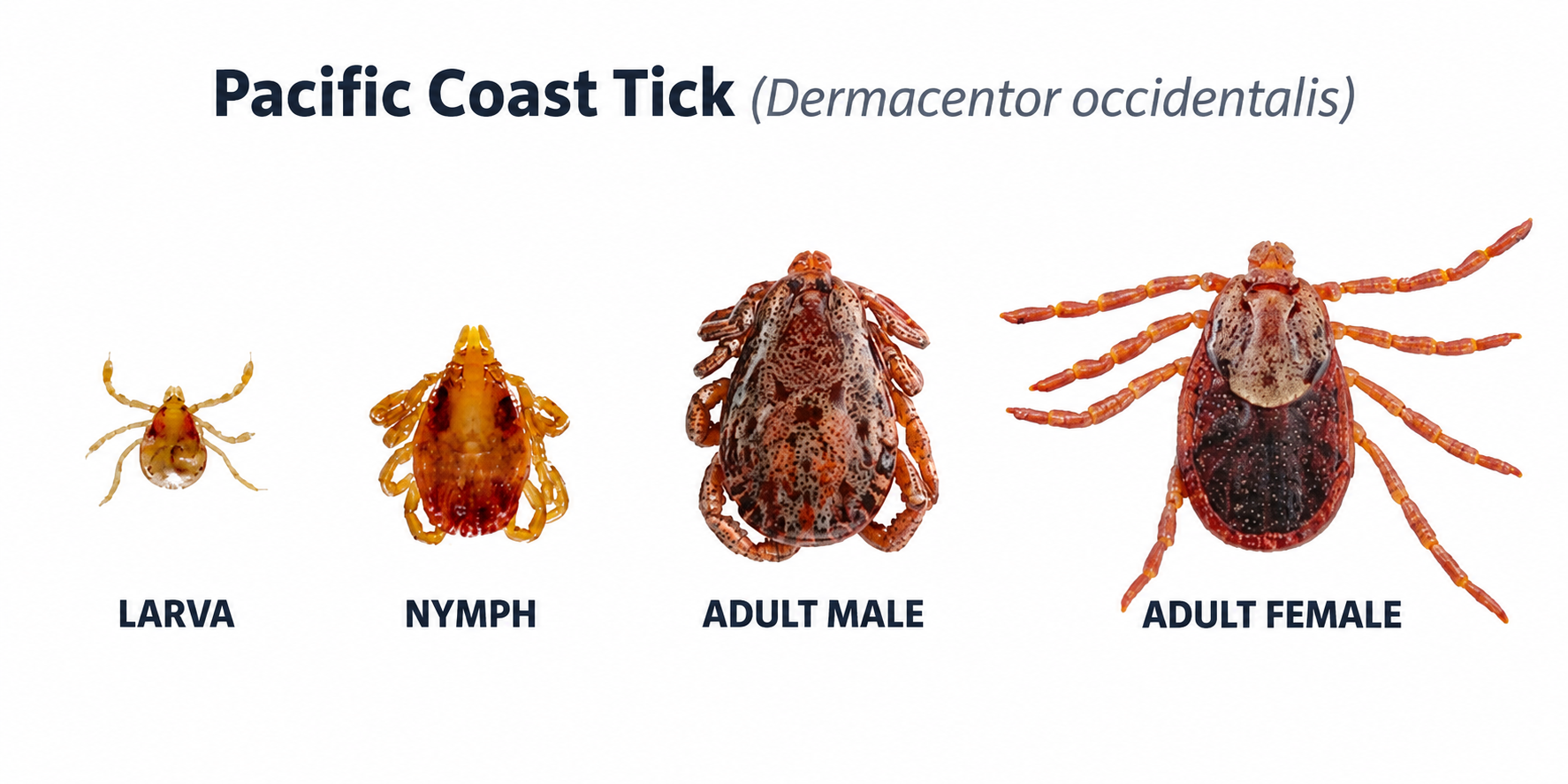
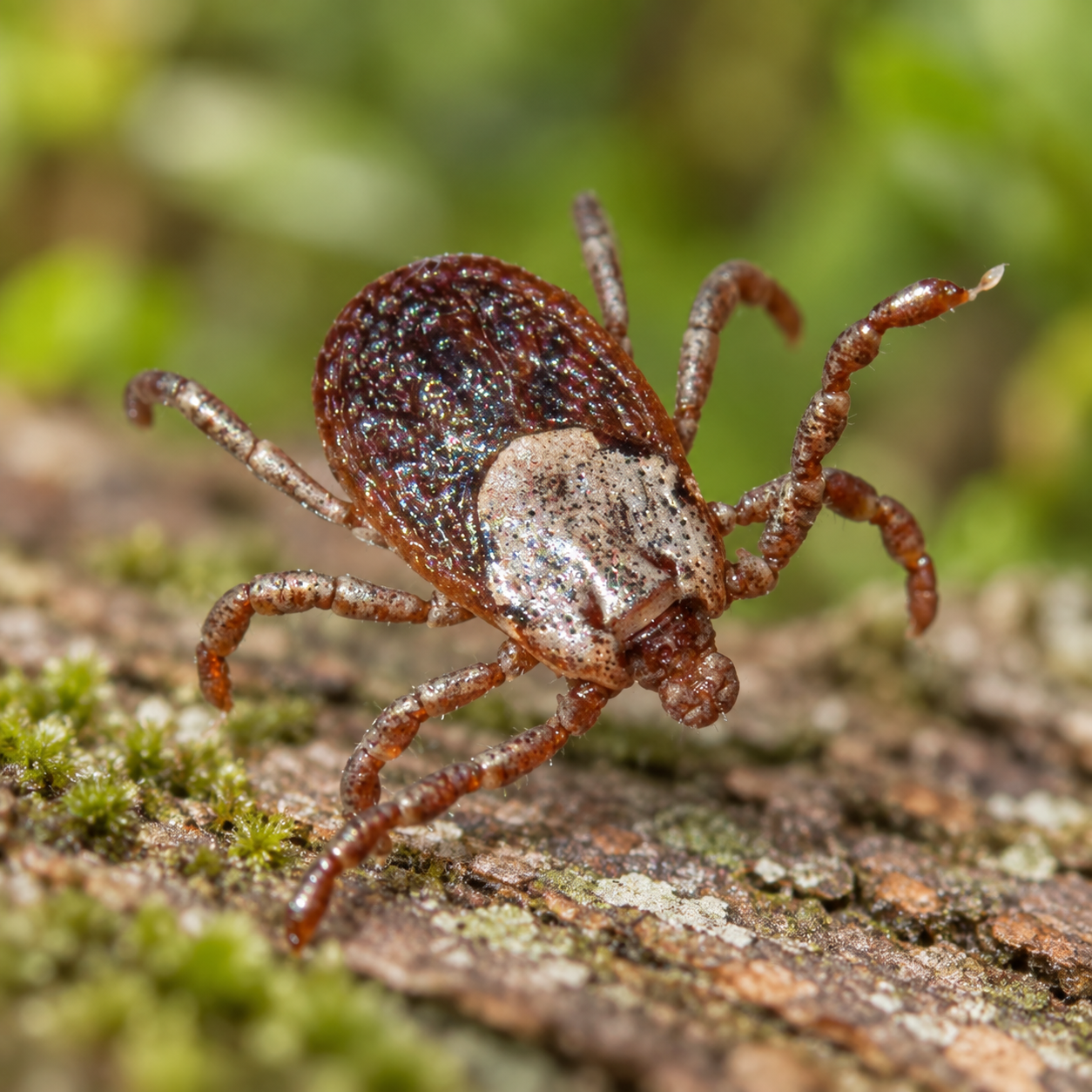
 Adult Pacific Coast ticks are generally brown with grayish, cream-colored, or pale ornamentation on the hard dorsal shield, called the scutum.
California Department of Public Health identification materials describe the adult:
- Female: Brown abdomen with a grayish scutum
- Male: Grayish patterned scutum
Like other adult Dermacentor ticks, Pacific Coast ticks have relatively short mouthparts, eyes, festoons, and an ornate scutum.
Adult Female
Typical features include:
- 8 legs
- Brown to reddish-brown abdomen
- Grayish, cream, or pale-patterned scutum
- Scutum covering only the front portion of the back
- Relatively short mouthparts
- Eyes
- Festoons along the rear edge of the body
- Abdomen capable of expanding substantially during feeding
Because the female’s scutum covers only the front portion of the back, the abdomen behind it can expand considerably as she takes a blood meal.
An engorged female can therefore look very different from an unfed female.
Adult Male
Adult males:
- Have 8 legs
- Have grayish, cream, or pale ornamentation
- Have a scutum covering essentially the entire dorsal surface
- Have relatively short mouthparts
- Have eyes
- Have festoons
- Do not enlarge as dramatically as females during feeding
Because the scutum covers essentially the entire back, the male generally has a more extensively patterned dorsal appearance.
Nymph
Nymphs:
- Have 8 legs
- Are much smaller than adults
- Lack the conspicuous ornate appearance of adults
- Commonly feed on small mammals
- Can readily bite people
- Can be difficult to identify accurately without magnification
Nymphs are particularly important for this species because Pacific Coast tick nymphs are significant human-biters.
Among 171 D. occidentalis ticks removed from people and submitted to CDPH for identification from 1971–2011:
- 117 were nymphs — 68.2%
- 46 were adults — 26.9%
- 8 were larvae — 4.7%
This is an important difference from several other Dermacentor species, for which adults account for most reported human bites.
Larva
Larvae:
- Have 6 legs
- Are extremely small
- Feed primarily on small mammals
- Commonly use rodents as hosts
- Can occasionally bite people
- Drop from the host after feeding
- Later molt into eight-legged nymphs
California studies have found larvae particularly associated with mice, while nymphs commonly feed on larger rodents.
Other Identification Features
Adult Pacific Coast ticks characteristically have:
- An ornate scutum
- Relatively short mouthparts
- Eyes
- Festoons along the rear edge of the body
- Grayish or pale dorsal ornamentation
Some characteristics required for reliable species identification are very small and may require microscopic examination.
Using a magnifier can help make the tick’s markings, mouthparts, scutum, legs, festoons, and other identification features easier to see.
Distinguishing It From Similar Ticks
The Pacific Coast tick may be confused with other ornate Dermacentor ticks, particularly:
Western American Dog Tick
Dermacentor similis
and
Rocky Mountain Wood Tick
Dermacentor andersoni
These species may share:
- Brown coloration
- Pale or grayish ornamentation
- Relatively short mouthparts
- Eyes
- Festoons
- Similar overall body shape
Because these Dermacentor ticks can look very similar, color and dorsal markings alone should not always be used for definitive species-level identification.
Geographic location, sex, life stage, and detailed morphology should also be considered. In difficult cases, microscopic examination may be needed.
Geographic Distribution & Habitat
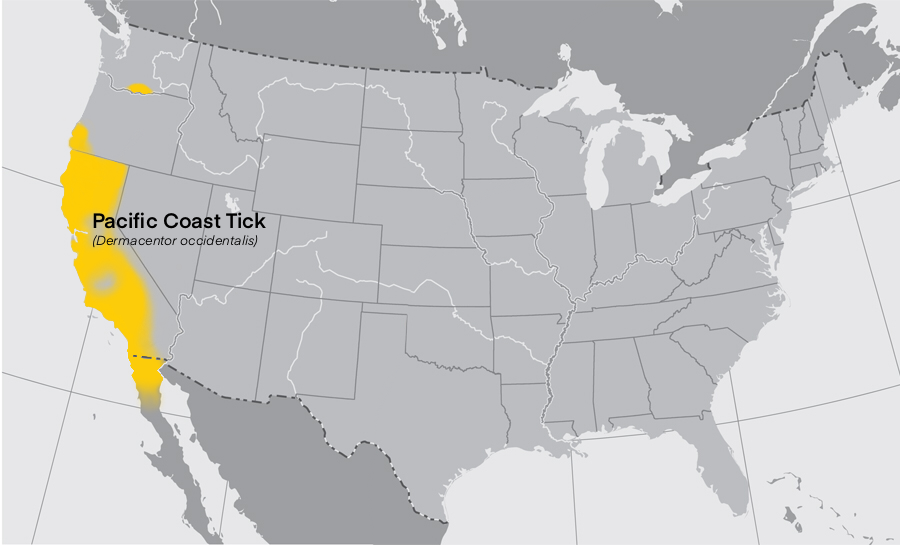
Geographic Distribution & Habitat The recognized range of the Pacific Coast tick is concentrated in far-western North America.
Recent research describes its known distribution as:
- Most of California
- Parts of southwestern Oregon
- Parts of south-central Washington
- Northwestern Mexico
CDC also describes Pacific Coast ticks as occurring along the western coastline in California, Oregon, and Washington.
California
California represents the core of the species’ distribution.
The Pacific Coast tick is one of the most widely distributed ticks in California and occurs across most of the state, although it is less characteristic of the very dry portions of the Central Valley and southeastern desert regions.
Common Habitats
Pacific Coast ticks can occur in environments including:
- Chaparral
- Shrublands
- Coastal scrub
- Grasslands
- Brushy areas
- Woodland
- Woodland edges
- Foothill environments
- Areas with shrubs and leaf litter
- Trails and recreational areas
- Areas frequented by deer and other mammals
California studies have found D. occidentalis particularly associated with chaparral, shrubland, and relatively open habitats.
Pacific Coast ticks reach passing hosts primarily by questing—waiting on vegetation or other suitable surfaces for an animal or person to pass close enough for the tick to attach.
They do not jump or fly.
Life Cycle & Seasonal Activity
Life Cycle & Seasonal Activity The Pacific Coast tick has four developmental stages:
Egg → Larva → Nymph → Adult
It is a three-host tick, meaning its larval, nymphal, and adult stages generally take blood meals from different individual hosts.
Larvae
Larvae:
- Have 6 legs
- Feed primarily on small mammals
- Frequently feed on rodents
- Drop from the host after feeding
- Later molt into nymphs
Studies in California have found mice to be particularly important larval hosts.
Nymphs
Nymphs:
- Have 8 legs
- Feed primarily on small mammals
- Commonly feed on rodents
- Can readily attach to humans
- Drop after feeding
- Later molt into adults
California observations found nymphs especially associated with larger rodents, including woodrats.
Adults
Adults:
- Have 8 legs
- Feed primarily on larger mammals
- Common hosts include cattle, horses, deer, and humans
- Can also occur on other medium and large mammals
UC Davis identifies rodents—especially squirrels—as common hosts of immature Pacific Coast ticks and cattle, horses, deer, and humans as common adult hosts.
After feeding and mating, an engorged female drops from the host and lays eggs in the environment.
Human-Biting Activity by Life Stage
Human exposure varies substantially by life stage.
Historical California records of Pacific Coast ticks removed from people found:
Adults
- Human bites recorded from March through July
- Peak month: May
Nymphs
- Human bites recorded from June through October
- Peak month: August
Larvae
- Human bites recorded from May through August
- Peak month: June
These represent historical California observations and should not be interpreted as fixed activity dates for every location or every year.
Seasonal Activity
Seasonal activity varies with geography, habitat, weather, and life stage.
Current California Department of Public Health guidance indicates that the adult and nymphal stages of the Pacific Coast tick are generally most active from early spring through mid-summer, although ticks can be encountered outside these periods.
Local studies demonstrate geographic variation.
At Crystal Cove State Park in Orange County, adult D. occidentalis were collected during most of the year, with activity peaking in March.
Other California research has similarly found substantial adult activity during spring, including peaks during approximately March–May.
Historical records of ticks removed from people also show that nymphal bites can extend into early fall, with reported nymphal bites occurring through October.
For a national website, the clearest summary is:
Pacific Coast ticks can be encountered during multiple seasons, and activity varies by location, habitat, weather, and life stage. In California, adult and nymphal Pacific Coast ticks are generally most active from early spring through mid-summer, although human exposure—particularly to nymphs—can extend later in the year.
Diseases & Health Risks
Diseases & Health Risks The most important established or emerging human-health associations of the Pacific Coast tick include:
- Pacific Coast tick fever
- Rocky Mountain spotted fever
- Tularemia
- Rickettsia lanei rickettsiosis — emerging association
Pacific Coast Tick Fever
Cause: Rickettsia rickettsii subsp. californica
The Pacific Coast tick is the established vector of the bacterium responsible for Pacific Coast tick fever (PCTF).
Important Updated Scientific Name
The current name of the bacterium responsible for Pacific Coast tick fever is:
Rickettsia rickettsii subsp. californica
Older publications may refer to the same organism as:
- Rickettsia species 364D
- Rickettsia 364D
- Rickettsia philipii
Modern genomic and taxonomic research established the organism as a distinct subspecies of R. rickettsii, and current CDC and CDPH materials use Rickettsia rickettsii subsp. californica.
Geographic Risk
Human Pacific Coast tick fever cases recognized by CDPH have had exposure in California.
Most reported cases have occurred in northern California, but infected Pacific Coast ticks have been found in both northern and southern California.
The tick itself also occurs in Oregon, Washington, and northwestern Mexico, so the tick’s geographic range is broader than the locations where confirmed human PCTF cases have historically been recognized.
Role of Immature Ticks
An important feature of PCTF is the apparent role of immature Pacific Coast ticks.
Research examining human cases and tick activity has implicated nymphal and larval D. occidentalis in transmission of PCTF to people, with nymphs considered particularly important.
This helps explain why recognized human PCTF cases have historically clustered during late summer, when immature Pacific Coast ticks can be active.
Possible Symptoms
A particularly characteristic feature of PCTF is an eschar.
An eschar is an ulcerated or necrotic lesion that develops a dark crust or scab, often at the location of the infected tick bite.
Eschars generally develop a few days to approximately one week after the bite.
Other symptoms may include:
- Fever
- Headache
- Muscle aches
- Fatigue
- Regional swollen lymph nodes
- Rash, although rash is less common
CDC describes PCTF as typically involving an eschar followed by fever, regional lymphadenopathy, headache, myalgia, and fatigue.
Severity
Pacific Coast tick fever is generally less severe than Rocky Mountain spotted fever, although illness can still be significant and hospitalization has occurred.
Treatment
Doxycycline is the treatment of choice for spotted fever rickettsioses, including Pacific Coast tick fever.
CDC recommends doxycycline for suspected spotted fever rickettsial infections in people of all ages.
Rocky Mountain Spotted Fever
Cause: Rickettsia rickettsii subsp. rickettsii
The California Department of Public Health recognizes the Pacific Coast tick as one of the California tick species capable of transmitting the bacterium responsible for Rocky Mountain spotted fever (RMSF).
Important Risk Context
Although D. occidentalis is recognized as a potential RMSF vector, R. rickettsii subsp. rickettsii appears to be very uncommon in California Pacific Coast tick populations.
For example, a large 2024 surveillance effort tested:
2,872 Pacific Coast ticks
and detected:
0 R. rickettsii subsp. rickettsii.
This does not mean transmission is impossible. It demonstrates that the RMSF pathogen can be extremely uncommon in surveyed Pacific Coast tick populations.
Possible Symptoms
RMSF may cause:
- Fever
- Severe headache
- Muscle aches
- Nausea
- Vomiting
- Abdominal pain
- Rash
RMSF can progress rapidly and become life-threatening.
Treatment should not be delayed while waiting for a rash or laboratory confirmation when RMSF is clinically suspected.
Tularemia
Cause: Francisella tularensis
The Pacific Coast tick is recognized in California as a tick capable of transmitting the bacterium that causes tularemia.
Current California Department of Public Health guidance specifically identifies:
Pacific Coast Tick
Dermacentor occidentalis
and
Western American Dog Tick
Dermacentor similis
as California ticks that can transmit tularemia.
Francisella tularensis has been detected in Pacific Coast ticks in California.
For example, surveillance conducted in coastal southwestern San Mateo County from 2017–2021 detected F. tularensis in multiple pools of D. occidentalis.
Detection can vary considerably by location and year. In CDPH’s 2024 statewide surveillance, 201 adult Pacific Coast ticks were tested and none were positive for F. tularensis.
Possible Symptoms
Tick-associated tularemia may cause:
- Sudden fever
- Chills
- Headache
- Fatigue
- Swollen and painful lymph nodes
- A skin ulcer at or near the infection site
Tick-bite transmission commonly results in ulceroglandular or glandular tularemia.
Tularemia can also be acquired in other ways, particularly through contact with infected wild animals such as rabbits.
Finding a Pacific Coast tick does not mean that the tick carries F. tularensis.
Rickettsia lanei Rickettsiosis — Emerging Association
Rickettsia lanei is a newly recognized spotted fever group bacterium capable of causing severe RMSF-like illness.
The first two recognized human infections involved patients in northern California with illness beginning in:
- 2004
- 2023
The organism was initially identified as a novel genotype and was subsequently classified as Rickettsia lanei.
Important 2026 Pacific Coast Tick Finding
A January 2026 CDC Emerging Infectious Diseases study investigated ticks from areas associated with the two California patients.
Researchers tested 2,872 Pacific Coast ticks collected in California during 2024.
They detected R. lanei in:
1 adult female Pacific Coast tick from Contra Costa County.
The bacterium’s genome from that tick had zero single-nucleotide differences from the genome recovered from the 2023 human infection.
The positive tick was collected at one of the locations visited by the patient during the likely exposure period.
Researchers concluded that the geographic connection and identical genome strongly implicated Dermacentor occidentalis as the likely source of infection in that case.
Current Vector Status
Current California Department of Public Health guidance identifies the Pacific Coast tick (Dermacentor occidentalis) as a potential vector of Rickettsia lanei.
The 2026 genomic and geographic evidence strongly supports its involvement in transmission. However, formal laboratory studies demonstrating the tick’s vector competence for R. lanei have not yet been reported.
Therefore, the most accurate wording is:
The Pacific Coast tick is a potential vector of Rickettsia lanei and has been strongly implicated as the likely source of at least one human infection, but additional transmission studies are still needed.
Additional 2026 Update
A third recognized human R. lanei infection occurred in Oregon in 2025 and was published online in March 2026 in the April 2026 issue of CDC’s Emerging Infectious Diseases.
The patient recalled a tick crawling on his body after outdoor activity in eastern Oregon, but the tick was not collected or identified.
Therefore, the Oregon case confirms human R. lanei infection in Oregon but does not establish which tick species transmitted the infection.
Possible Symptoms
The currently recognized cases show that R. lanei rickettsiosis can cause symptoms and complications including:
- Fever
- Headache
- Muscle aches
- Rash
- Altered mental status
- Respiratory distress or respiratory failure
- Nausea or vomiting
- Other serious systemic manifestations
Because only a few human infections have been recognized, the full clinical spectrum, geographic distribution, and transmission ecology remain under investigation.
Colorado Tick Fever Clarification
Older publications have associated the Pacific Coast tick with Colorado tick fever virus, and the virus has historically been detected in or discussed in connection with D. occidentalis.
However, current CDC guidance identifies the tick responsible for transmitting Colorado tick fever virus to people as:
Dermacentor andersoni — Rocky Mountain Wood Tick.
For a current public-facing website, Colorado tick fever should therefore not be listed as an established human disease transmitted by the Pacific Coast tick.
This avoids overstating historical or experimental associations that are not part of CDC’s current description of human Colorado tick fever transmission.
Important Lyme Disease Clarification
The Pacific Coast tick is not a recognized vector of Lyme disease.
In the western United States, the recognized Lyme disease vector is:
Ixodes pacificus — Western Blacklegged Tick.
Pacific Coast ticks and western blacklegged ticks can occur in some of the same geographic areas, but they are different species with different disease associations.
Finding a Pacific Coast tick attached to a person does not mean that person was exposed to Lyme disease bacteria.
Important to Know
Finding a Pacific Coast tick does not automatically mean that it is infected or that disease transmission occurred.
Risk depends on several factors, including:
- Tick species
- Geographic location
- Whether the tick was infected
- Local pathogen prevalence
- Life stage
- Feeding and attachment
- The specific pathogen involved
It is also important to distinguish between detecting a microorganism inside a tick and demonstrating that the tick is capable of naturally transmitting that microorganism to people.
Bite Prevention & Protection
Bite Prevention & Protection When Outdoors
To reduce the chance of tick bites:
- Avoid direct contact with tall grass, brush, shrubs, and dense vegetation when practical.
- Walk near the center of maintained trails.
- Use an EPA-registered insect repellent according to label instructions.
- Treat clothing and outdoor gear with products containing 0.5% permethrin, or wear commercially pretreated clothing.
- Wear long pants, long sleeves, socks, and closed shoes when practical.
- Light-colored clothing may make crawling ticks easier to see.
CDC recommends EPA-registered repellents containing appropriate ingredients such as DEET, picaridin, IR3535, oil of lemon eucalyptus/PMD, or 2-undecanone, used according to label instructions.
After Outdoor Activity
Perform a thorough tick check.
Pay particular attention to:
- In and around the hair
- Around the ears
- Under the arms
- Around the waist and belt line
- Inside the belly button
- Behind the knees
- Between the legs
- Around the groin
Also inspect:
- Children
- Pets
- Clothing
- Backpacks
- Outdoor equipment
CDC recommends showering within two hours after coming indoors to help remove unattached ticks and provide an opportunity for a complete body check.
California public-health guidance also recommends checking pets and gear, because ticks may be carried indoors and attach later.
If You Find an Attached Tick
Remove the tick as soon as possible.
Current CDC guidance states that tick removal should not be delayed while waiting to see a healthcare provider.
How to Remove a Tick
- Use clean fine-tipped tweezers.
- Grasp the tick as close to the skin’s surface as possible.
- Pull the tick away from the skin with steady, even pressure.
- Do not twist or jerk the tick.
- If mouthparts remain and can be removed easily with tweezers, remove them. If they cannot be removed easily, leave them alone and allow the skin to heal.
- Dispose of the live tick safely.
- Thoroughly clean the bite area and your hands.
- Check the rest of your body for additional ticks.
Do not attempt to force the tick to detach using:
- Petroleum jelly
- Nail polish
- Heat
- Other substances or chemicals
These methods should not replace prompt mechanical removal with fine-tipped tweezers.
Tick Testing
CDC generally does not recommend commercial testing of removed ticks to guide medical treatment decisions.
A positive result does not prove that infection was transmitted.
A negative result can provide false reassurance.
After Removal
Monitor for illness during the following days and weeks.
Contact a healthcare provider if you develop:
- Fever
- Rash
- Headache
- Muscle aches
- Unusual fatigue
- Swollen lymph nodes
- An eschar, ulcer, or dark scab at or near the bite site
- Other concerning symptoms
An eschar is particularly important to mention because it is a characteristic feature of Pacific Coast tick fever.
Tell the healthcare provider:
- That a tick bite occurred
- When it occurred
- Where the tick exposure most likely occurred
Identification Gallery
Identification Gallery Adult Female
- Brown abdomen
- Grayish or pale-patterned scutum
- Scutum covers the front portion of the back
- Short mouthparts
- 8 legs
Adult Male
- Grayish patterned back
- Scutum covers nearly the entire back
- Short mouthparts
- 8 legs
Engorged Female
- Greatly enlarged after feeding
- Small scutum remains visible at the front
- Show comparison with an unfed female
Nymph
- Small body
- 8 legs
- Less distinctive than adults
Larva
- Very small
- 6 legs
Male vs. Female
- Female: patterned scutum only at the front
- Male: patterned scutum covers nearly the entire back
Life Stages
Egg → 6-legged Larva → 8-legged Nymph → Adult
Show adults separately as:
Adult Female | Adult Male
Similar Species
Compare with:
- Western American Dog Tick
- Rocky Mountain Wood Tick
Note: These Dermacentor ticks can look very similar, so location and microscopic features may be needed for reliable identification.