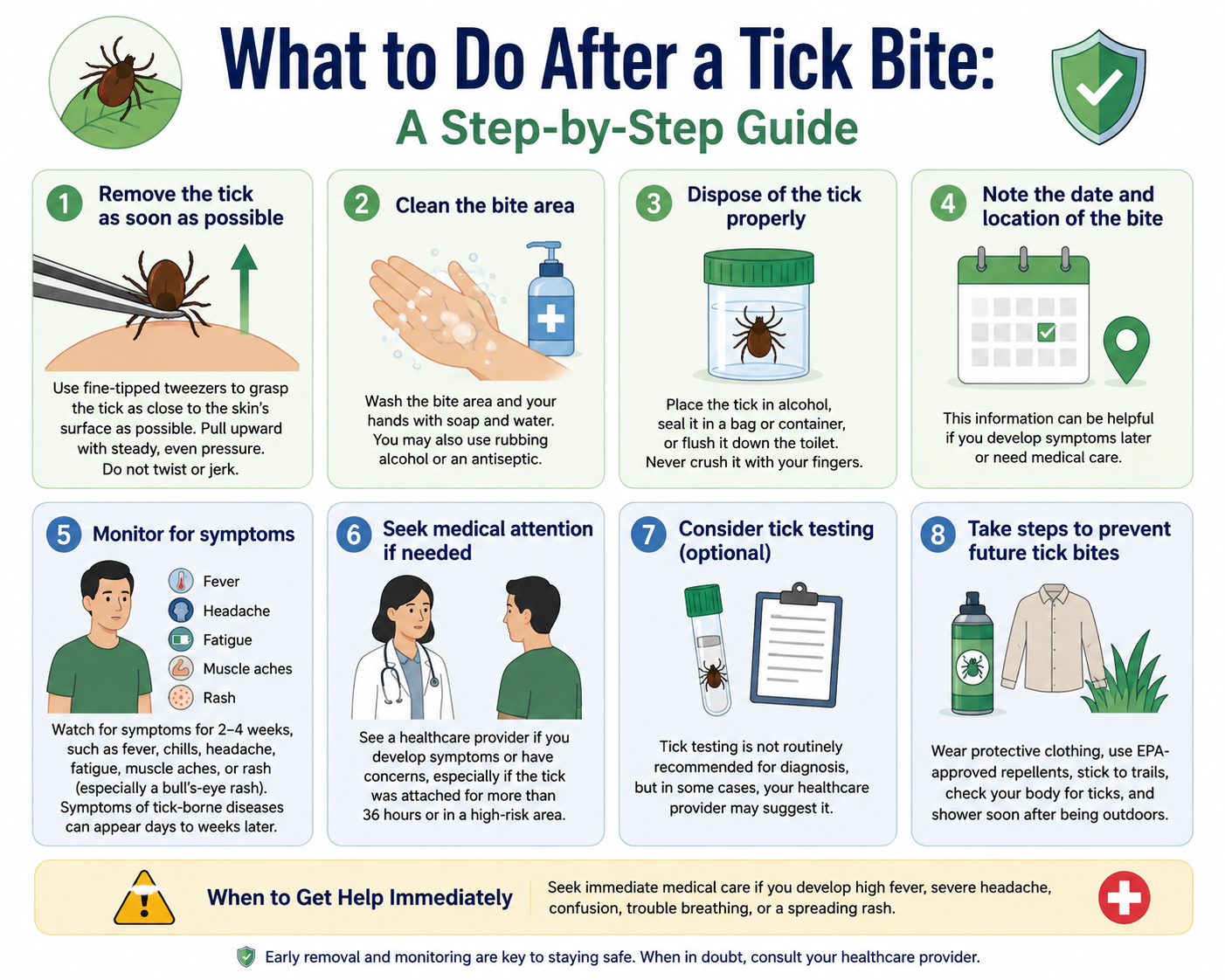
What to Do After a Tick Bite: A Step-by-Step Guide
What to Do After a Tick Bite?
Finding a tick attached to your skin can be concerning. The most important first step is simple: remove the tick as soon as possible.
CDC advises people not to wait for a healthcare provider to remove an attached tick. Delaying removal could increase the risk of getting a disease spread through tick bites.
Step 1: Remove the Tick as Soon as Possible
How to Remove an Attached Tick
- Grasp the tick as close to the skin’s surface as possible.
Use clean, fine-tipped tweezers if available. If fine-tipped tweezers are not available, CDC says regular tweezers or your fingers can be used. Avoid squeezing the tick’s body. - Pull the tick away from the skin using steady, even pressure.
Do not twist or jerk the tick. Twisting or jerking can cause the tick’s mouthparts to break off and remain in the skin. - If mouthparts remain in the skin, do not dig aggressively for them.
If they can be removed easily with tweezers, you may remove them. If they cannot be removed easily, leave them alone. CDC states that the body will naturally push the remaining mouthparts out over time as the skin heals. - Dispose of the live tick safely.
CDC recommends placing it in a sealed container, wrapping it tightly in tape, flushing it down the toilet, or putting it in alcohol. Do not crush a live tick with your fingers. - Clean the bite area and your hands.
After removing the tick, thoroughly clean the bite area and your hands with soap and water, rubbing alcohol, or hand sanitizer.
Do Not Use Petroleum Jelly, Heat, or Nail Polish
Do not try to make an attached tick detach by applying:
- Petroleum jelly
- Heat
- Nail polish
- Other substances or chemicals
CDC warns that these methods may agitate the tick and force infected fluid from the tick into the skin.
Instead, physically remove the tick as soon as possible.
Step 2: Check Your Body for Additional Ticks
If you find one attached tick, there may be others.
CDC recommends performing a careful full-body tick check and paying particular attention to:
- Under the arms
- In and around the ears
- Inside the belly button
- Behind the knees
- In and around the hair
- Between the legs
- Around the waist
Promptly remove any additional attached ticks you find.
Also Check Clothing, Gear, and Pets
Ticks can be carried into the home on clothing and pets and may attach to a person later.
After spending time outdoors, CDC recommends checking clothing and carefully examining pets, coats, daypacks, and other gear for ticks.
Step 3: Remember When and Where the Tick Bite Occurred
It can be helpful to record:
- The date you discovered and removed the tick
- Where on your body the tick was attached
- Where you most likely encountered the tick
If you later develop a rash, fever, or other concerning symptoms, tell your healthcare provider about the recent tick bite, when it occurred, and where you most likely acquired the tick.
Step 4: Watch for Symptoms
CDC advises seeing a healthcare provider if you develop a rash or fever within several days to weeks after removing a tick.
Different tickborne illnesses can cause different symptoms. Depending on the illness, symptoms may include:
- Fever or chills
- Rash
- Headache
- Unusual fatigue
- Muscle aches
- Joint aches or swelling
If you become ill after a known or possible tick exposure, tell your healthcare provider about the exposure.
What About Redness Around the Tick Bite?
A small bump or area of redness immediately around a tick bite can be a normal local reaction.
CDC notes that this type of irritation may resemble a mosquito bite and generally disappears within 1–2 days. This immediate local reaction by itself is not a sign of Lyme disease.
What Does a Lyme Disease Rash Look Like?
The characteristic Lyme disease rash is called erythema migrans (EM).
According to CDC, an EM rash:
- Usually begins after a delay of approximately 3–30 days after the tick bite
- Gradually expands over several days
- May feel warm to the touch
- Is rarely itchy or painful
- Sometimes develops central clearing as it expands
- Can appear on any area of the body
An EM rash does not always look like a classic bull’s-eye.
If you develop an expanding rash after possible tick exposure, seek medical evaluation.
Step 5: Do You Need Antibiotics After a Tick Bite?
Not everyone who is bitten by a tick needs preventive antibiotics.
CDC states that, in certain circumstances, a single dose of doxycycline after a tick bite in an area where Lyme disease is common may lower the risk of developing Lyme disease.
A healthcare provider can determine whether preventive treatment is appropriate.
When Might Lyme Disease Preventive Treatment Be Considered?
CDC’s Lyme disease prophylaxis decision aid considers factors including:
- Whether the bite occurred in an area where Lyme disease is common
- Whether the tick was removed within the previous 72 hours
- Whether the tick was engorged with blood rather than flat
- Whether the tick was an Ixodes tick, also called a blacklegged tick
- Whether doxycycline is appropriate for the patient
These factors should be evaluated by a healthcare provider rather than used to self-prescribe antibiotics.
Because preventive treatment for Lyme disease is time-sensitive when it is appropriate, contact a healthcare provider promptly if you are concerned about a recent potentially higher-risk tick bite.
Preventive Antibiotics Are Not Recommended for Every Tickborne Disease
CDC states that antibiotic treatment following a tick bite is not recommended as a way to prevent:
- Anaplasmosis
- Babesiosis
- Ehrlichiosis
- Rocky Mountain spotted fever
- Other rickettsial diseases
Instead, people who experience a tick bite should watch for symptoms of tickborne illness and seek medical care if fever, rash, or other concerning symptoms develop.
Step 6: Should You Have the Tick Tested?
In general, CDC does not recommend testing removed ticks to guide medical treatment decisions.
There are several reasons:
- Laboratories that conduct tick testing are not required to meet the same quality-control standards used by clinical diagnostic laboratories.
- Finding a disease-causing organism in a tick does not necessarily mean that you were infected.
- A negative result can provide false reassurance because you may have been bitten unknowingly by another infected tick.
- If you become ill, appropriate treatment should not be delayed while waiting for tick-testing results.
Your symptoms, exposure history, geographic location, and clinical evaluation are more important when determining whether medical care or diagnostic testing is needed.
Should You Get a Lyme Disease Blood Test Immediately After a Tick Bite?
Not necessarily.
Lyme disease blood tests commonly look for antibodies produced by your immune system in response to infection. These antibodies can take several weeks to develop.
CDC notes that antibody tests may be falsely negative during the first several weeks after infection. Healthcare providers consider symptoms, the likelihood of exposure to infected blacklegged ticks, and laboratory testing when indicated.
Therefore, a negative Lyme disease blood test performed very soon after a tick bite cannot by itself reliably rule out a recent infection.
How Long Does a Tick Need to Be Attached to Transmit Disease?
There is no single attachment-time rule that applies to every tickborne disease.
The amount of time required for transmission depends on the type of tick and the disease-causing organism. Depending on the tick and germ, transmission times can vary considerably.
Lyme Disease
For Lyme disease specifically, CDC states that in most cases, an infected blacklegged tick must be attached for more than 24 hours before Lyme disease bacteria can be transmitted.
Removing an attached tick promptly can greatly reduce the chance of Lyme disease transmission.
However, the Lyme disease attachment-time guideline should not be applied to every tickborne disease.
Do not delay removing a tick because you believe it has not been attached long enough to transmit disease. Remove any attached tick as soon as it is discovered.
A Note About Alpha-gal Syndrome
Tick bites can also be associated with alpha-gal syndrome (AGS), a serious and potentially life-threatening allergy to alpha-gal, a molecule found in most mammals.
Unlike many infectious tickborne illnesses, AGS symptoms may not begin shortly after the tick bite. CDC states that it can take weeks to months after a tick bite for a person to begin experiencing AGS symptoms.
In people who have developed AGS, allergic reactions usually occur approximately 2–6 hours after exposure to products containing alpha-gal.
Possible reactions can include:
- Hives or an itchy rash
- Swelling of the lips, throat, tongue, or eyelids
- Nausea or vomiting
- Severe stomach pain
- Heartburn or indigestion
- Diarrhea
- Cough
- Shortness of breath or difficulty breathing
- Dizziness or faintness
- A drop in blood pressure
- Anaphylaxis
Seek immediate emergency medical care for a severe allergic reaction or anaphylaxis.
When Should You Contact a Healthcare Provider?
Contact a healthcare provider if you develop a rash or fever within several days to weeks after removing a tick.
Also seek medical evaluation if you develop other concerning symptoms after a known or possible tick exposure.
Be prepared to tell your healthcare provider:
- That you recently had a tick bite or possible tick exposure
- When the exposure occurred
- Where you most likely encountered the tick
- What symptoms you are experiencing
If you recently removed a potentially higher-risk blacklegged tick and are concerned about Lyme disease preventive treatment, contact a healthcare provider promptly because prophylaxis, when appropriate, is time-sensitive.
Seek immediate emergency medical care for a severe allergic reaction, difficulty breathing, significant swelling of the lips, tongue, or throat, fainting, or other signs of anaphylaxis.
Quick Tick Bite Checklist
- Remove the attached tick as soon as possible.
- Grasp it as close to the skin’s surface as possible.
- Pull with steady, even pressure.
- Do not twist or jerk the tick.
- Avoid squeezing the tick’s body.
- Do not use petroleum jelly, heat, nail polish, or similar substances.
- Clean the bite area and your hands after removal.
- Check your entire body for additional ticks.
- Check clothing, gear, and pets.
- Remember when and where the exposure occurred.
- Do not rely on tick-testing results to determine treatment.
- Watch for rash, fever, or other concerning symptoms.
- Contact a healthcare provider if symptoms develop or if you have questions about Lyme disease preventive treatment.
Frequently Asked Questions
Should I wait for a healthcare provider to remove the tick?
No. CDC recommends removing an attached tick as soon as possible. Do not delay removal while waiting to see a healthcare provider.
Do I Have to Use Fine-Tipped Tweezers?
Fine-tipped tweezers are recommended and work well for tick removal. However, CDC’s current guidance states that if fine-tipped tweezers are unavailable, regular tweezers or your fingers may be used. If using your fingers, avoid squeezing the tick’s body.
What If Part of the Tick Remains in My Skin?
If remaining mouthparts can be removed easily with tweezers, you may remove them. If they cannot be removed easily, leave them alone rather than digging into the skin. CDC states that the body will naturally push the remaining mouthparts out over time as the skin heals.
Should I Put Petroleum Jelly or Nail Polish on the Tick?
No. CDC advises against using petroleum jelly, heat, nail polish, or other substances to try to make the tick detach. These methods may agitate the tick and force infected fluid into the skin.
Does Every Tick Bite Cause Disease?
No. A tick bite does not automatically mean that an infection was transmitted.
Risk varies depending on factors such as the tick species, whether the tick was infected with a disease-causing organism, geographic location, and characteristics of the tick’s feeding.
Regardless of perceived risk, an attached tick should be removed promptly.
Should I Have the Tick Tested?
In general, CDC does not recommend tick testing to guide treatment decisions. A positive result does not prove that you were infected, and a negative result does not guarantee that you were not exposed.
Should I Get Tested for Lyme Disease Immediately?
A blood test immediately after a tick bite may be too early to detect Lyme disease because antibodies can take several weeks to develop.
Testing decisions should take into account symptoms, exposure history, and a healthcare provider’s clinical assessment.
How Long Should I Watch for Symptoms?
CDC specifically advises seeking medical care if a rash or fever develops within several days to weeks after removing a tick.
The timing of other tick-associated conditions can differ. For example, CDC states that alpha-gal syndrome symptoms may first appear weeks to months after a tick bite.
The Bottom Line
If you find a tick attached to your skin, remove it as soon as possible.
Grasp the tick close to the skin, remove it using steady, even pressure, clean the bite area and your hands, check yourself for additional ticks, and monitor for symptoms afterward.
Do not rely on home remedies or tick-testing results to determine whether you have been infected.
If you develop a rash, fever, or other concerning symptoms after a known or possible tick exposure, contact a healthcare provider and mention the tick exposure.
Remove promptly. Check carefully. Monitor for symptoms. Seek medical care when appropriate.
Educational Disclaimer
This information is provided for educational purposes only and is not a substitute for professional medical advice, diagnosis, or treatment.
If you develop a fever, rash, unusual fatigue, headache, muscle or joint aches, or other concerning symptoms after a known or possible tick exposure, contact a qualified healthcare provider and mention the possible tick exposure.
Seek immediate emergency medical attention for severe or life-threatening symptoms, including signs of a serious allergic reaction or anaphylaxis.