

Blacklegged Tick (Deer Tick)

Ixodes scapularis

The blacklegged tick (Ixodes scapularis), commonly called the deer tick, is a small, hard-bodied tick widely distributed across the eastern United States. It is medically important because it can transmit several pathogens that cause human illness, including Lyme disease, anaplasmosis, babesiosis, hard tick relapsing fever, ehrlichiosis, and Powassan virus disease.

Nymphs and adult females are the stages most often reported biting people, although larvae can also bite humans.

Common in forests & grassy areas

Active in spring through fall

Can transmit serious diseases

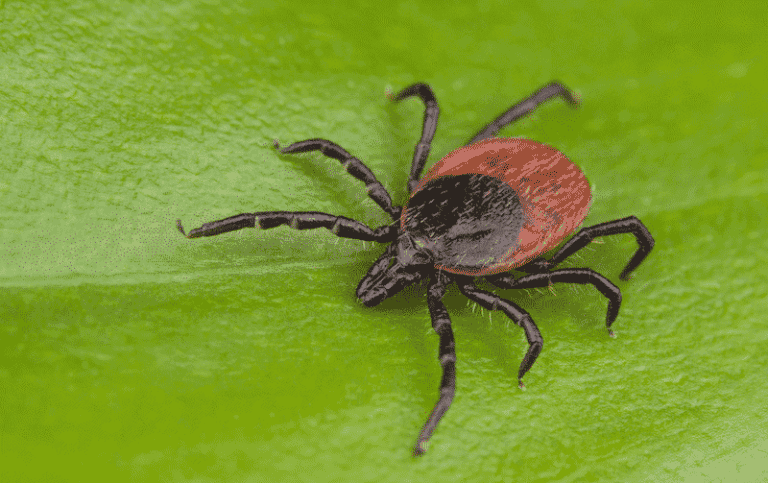
Blacklegged ticks are relatively small and can be difficult to notice, particularly during the nymph stage. Like other hard ticks, they have a hardened plate on the upper surface called a scutum, or shield. Their appearance varies depending on sex, life stage, and whether they have fed.

Adult Female

An unfed adult female typically has:

  • Dark brown to black legs
  • A reddish-brown to reddish-orange body
  • A dark brown to black scutum directly behind the mouthparts
  • Relatively long, straight mouthparts
  • An oval, flattened body when unfed
  • Eight legs

In adult females, the scutum covers the front portion of the dorsal surface. Because the scutum does not expand, the softer portion of the body enlarges considerably during feeding.

After feeding, an adult female can become much larger and may appear tan, gray, or dark brown, making an engorged tick look quite different from an unfed one.

Adult Male

Adult males are generally:

  • Slightly smaller than adult females
  • Predominantly dark brown to black
  • Equipped with eight dark legs
  • Without the reddish coloration typically seen in unfed adult females

In adult males, the scutum covers the entire dorsal surface of the body, giving the male a darker, more uniform appearance.

Nymph

Blacklegged tick nymphs:

  • Have eight legs
  • Are approximately the size of a poppy seed
  • Are very small and difficult to see
  • May be easily overlooked when attached to the skin

Their small size is one reason nymphs are particularly important in human tick exposure.

Larva

Blacklegged tick larvae:

  • Have six legs
  • Are typically less than 1 mm in size
  • Are the smallest active life stage
  • Develop into eight-legged nymphs after feeding and molting

Additional Identification Features

Blacklegged ticks also have several characteristics that can help distinguish them from other species:

  • Dark legs
  • Relatively long, straight mouthparts
  • No ornate white markings
  • No festoons, the small divisions or grooves found along the rear edge of many other hard ticks
  • No eyes – unlike several other common hard tick species, blacklegged ticks lack visible lateral eyes.

Identification Tip

Look for:

✓ Dark legs

✓ Reddish-brown or reddish-orange body in adult females

✓ Dark scutum

✓ No ornate white markings

✓ Long, straight mouthparts

✓ No festoons

✓ No eyes

✓ Very small nymphs

Geographic Distribution

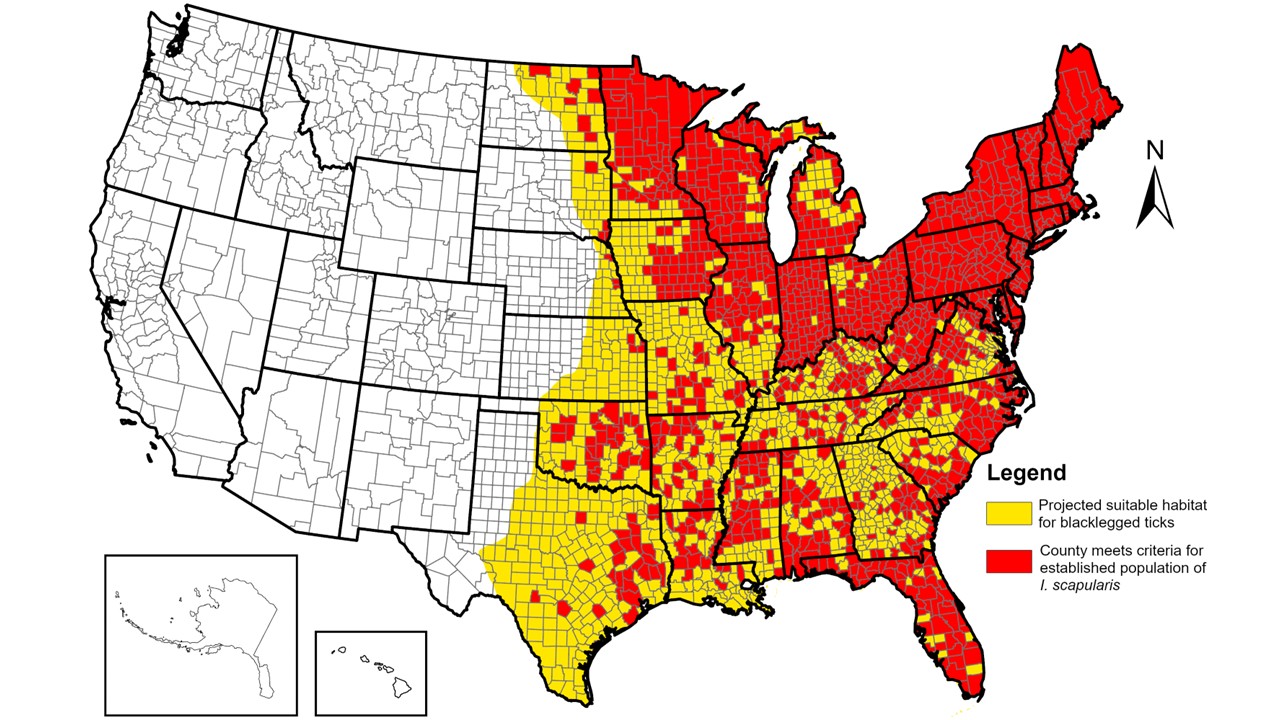
The blacklegged tick is widely distributed across the eastern United States, including large portions of the:

  • Northeast
  • Mid-Atlantic
  • Upper Midwest
  • Southeast

The presence and abundance of blacklegged ticks vary by location. The percentage of ticks carrying particular pathogens also differs significantly from one region to another.

The presence of blacklegged ticks in an area does not mean the risk of every blacklegged tick-borne disease is the same throughout their range.

Preferred Habitat

Blacklegged ticks are commonly encountered in:

  • Wooded areas and forests
  • Leaf litter
  • Brush and low vegetation
  • Woodland edges
  • Grassy or brushy areas bordering woods
  • Forest trail edges and vegetation bordering trails
  • Shaded suburban landscapes
  • Areas around stone walls or woodpiles where suitable habitat and animal hosts are present

They generally favor shaded, humid environments that help protect them from drying out.

Hosts

Blacklegged ticks can feed on a wide variety of:

  • Mammals
  • Birds
  • Reptiles
  • Amphibians

Immature ticks commonly feed on smaller animals such as mice, other small mammals, and birds, while adult females often feed on larger mammals such as white-tailed deer.

White-tailed deer are important hosts for adult blacklegged ticks and help support tick populations. However, deer are not reservoirs for the bacteria that cause Lyme disease and do not infect feeding ticks with these bacteria.

Distribution Map
The blacklegged tick generally completes its life cycle in about two years, although development can vary with environmental conditions.

Its four life stages are:

Egg → Larva → Nymph → Adult

After hatching, larvae and nymphs require a blood meal before molting to the next stage. Adult females require a blood meal to produce eggs, while adult males typically do not take a substantial blood meal.

Blacklegged ticks commonly use different hosts during their active life stages.

Egg

Adult females generally lay eggs during the spring, often in protected environments such as leaf litter.

A female may lay several thousand eggs before dying.

Larva

Eggs hatch into tiny six-legged larvae during the summer.

Larvae seek a host and commonly feed on small mammals, birds, and other animals. After feeding, they drop from the host and eventually molt into nymphs.

Nymph

Nymphs become particularly active during the following spring and summer.

They:

  • Have eight legs
  • Are extremely small
  • Feed on another host
  • Can bite humans

After feeding, nymphs drop from the host and eventually molt into adults.

Adult

Adults develop later in the year and become particularly active during the fall.

Adult females often seek larger mammals for a blood meal. After feeding and mating, females eventually lay eggs the following spring, beginning the life cycle again.

Seasonal Activity

Spring

Nymph activity increases, and adults may also be encountered.

Summer

Nymphs are highly active, while larvae become active during the summer.

Fall

Adult blacklegged ticks become particularly active.

Winter

Adults may continue searching for hosts whenever temperatures rise above freezing.

Important Seasonal Note

Blacklegged ticks are not strictly a warm-weather problem.

Adult blacklegged ticks can remain active during mild winter weather when temperatures are above freezing.

Blacklegged ticks can transmit pathogens responsible for several human diseases.

Lyme Disease

Pathogens: Borrelia burgdorferi and Borrelia mayonii

Anaplasmosis

Pathogen: Anaplasma phagocytophilum

Babesiosis

Pathogen: Babesia microti

Babesiosis is caused by a parasite, rather than a bacterium or virus.

Hard Tick Relapsing Fever

Pathogen: Borrelia miyamotoi

Ehrlichiosis

Pathogen: Ehrlichia muris eauclairensis

The recognized geographic distribution of this particular ehrlichiosis is more limited than the overall range of the blacklegged tick.

Powassan Virus Disease

Pathogen: Powassan virus

Important Health Information

Not every blacklegged tick is infected.

The percentage of ticks carrying a particular pathogen varies by geographic location, life stage, and pathogen. Being bitten by a blacklegged tick therefore does not automatically mean an infection will occur.

Attachment Time

Remove attached ticks as soon as possible.

For Lyme disease, longer attachment generally increases transmission risk, and prompt tick removal can substantially reduce the risk of infection.

However, attachment time is not the same for every pathogen.

Remove attached ticks as soon as possible. Transmission time varies depending on the pathogen, and there is no single “safe” attachment time that applies to every tick-borne infection.

Coinfections

Blacklegged ticks may occasionally carry more than one pathogen. As a result, coinfections can occur, including combinations involving Lyme disease, anaplasmosis, and babesiosis.

Before Going Outdoors

Use additional caution in:

  • Wooded areas
  • Brushy areas
  • Tall grass
  • Leaf litter
  • Overgrown vegetation
  • Woodland edges

Stay near the center of cleared trails whenever practical.

Use Insect Repellent

EPA-registered repellents may contain active ingredients such as:

  • DEET
  • Picaridin
  • IR3535
  • Oil of Lemon Eucalyptus (OLE)
  • para-menthane-diol (PMD)
  • 2-undecanone

Always follow product label directions.

Products containing OLE or PMD should not be used on children younger than 3 years.

Protect Clothing & Gear

Products containing 0.5% permethrin may be used on approved clothing and outdoor gear according to label directions.

Examples include:

  • Pants
  • Socks
  • Boots
  • Jackets
  • Tents
  • Outdoor equipment

Do not apply permethrin products directly to the skin.

After Spending Time Outdoors

Perform a thorough tick check, paying particular attention to:

  • Under the arms
  • In and around the ears
  • In and around the hair
  • Inside the belly button
  • Around the waist
  • Between the legs
  • Behind the knees

Because blacklegged tick nymphs are extremely small, a mirror and magnifier can help with identification.

Also check:

  • Clothing
  • Pets
  • Backpacks
  • Outdoor gear
  • Coats and shoes

Ticks can be carried indoors before attaching to a person.

Shower

Shower within two hours of coming indoors.

Showering may help wash off unattached ticks and provides another opportunity to perform a thorough tick check.

Clothing

For dry clothing:

Tumble dry on high heat for 10 minutes after coming indoors to help kill ticks.

Damp clothing may require additional drying time.

If You Find an Attached Tick

Remove it as soon as possible.

  1. Use clean, fine-tipped tweezers.
  2. Grasp the tick as close to the skin’s surface as possible.
  3. Pull upward and away from the skin using steady, even pressure.
  4. Do not twist or jerk the tick.
  5. Avoid crushing the tick with your fingers.
  6. Clean the bite area and your hands afterward.
  7. Check the rest of your body for additional ticks.

Do Not Use

Do not try to make an attached tick detach using:

  • Petroleum jelly
  • Heat
  • Nail polish
  • Other substances

These methods may delay proper removal.

After Removal

Monitor the bite area and how you feel during the following days and weeks.

If you develop a rash, fever, or other concerning symptoms, contact a healthcare professional and mention the recent tick bite.

Around Your Home

To help reduce tick habitat around residential properties:

  • Remove leaf litter
  • Clear tall grass and brush around homes and lawn edges
  • Mow grass regularly
  • Keep wood stacked neatly in a dry location
  • Keep playground equipment, decks, and patios away from wooded edges when practical
  • Create an approximately 3-foot-wide barrier of wood chips or gravel between lawns and wooded areas
  • Discourage unwanted wildlife from frequently used areas
  • Remove debris that may create favorable tick habitat

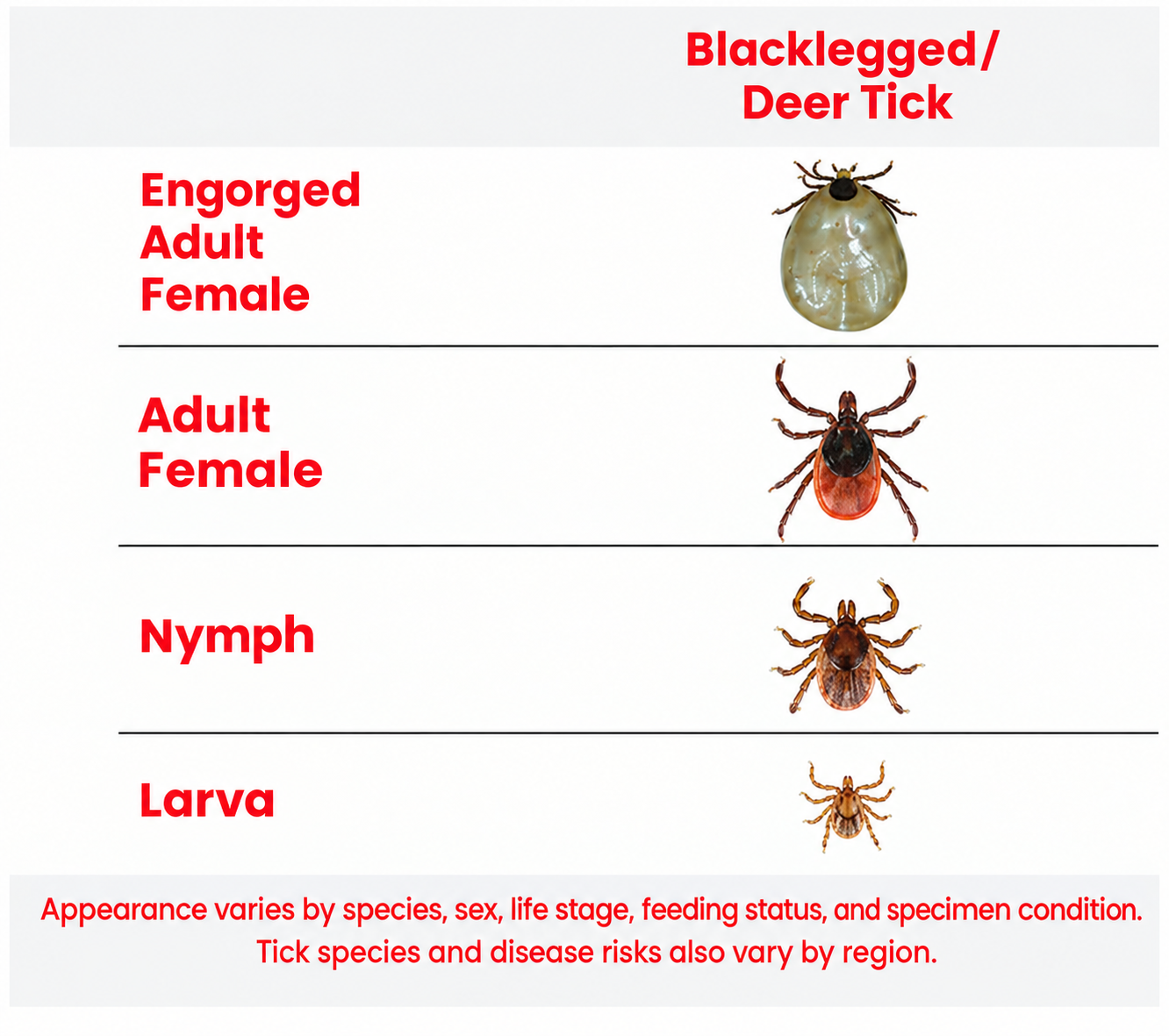
Adult Female

Adult Female Blacklegged Tick

Reddish-brown to reddish-orange body with dark legs and a dark scutum covering the front portion of the back.

Adult Male

Adult Male Blacklegged Tick

Usually darker in appearance because the scutum covers nearly the entire back.

Nymph

Blacklegged Tick Nymph

A very small, eight-legged stage, often compared in size to a poppy seed.

Larva

Blacklegged Tick Larva

The smallest active life stage. Larvae have six legs instead of eight.

Engorged Female

Engorged Adult Female Blacklegged Tick

After feeding, the female becomes much larger and may appear tan, gray, or brown.

Quick Identification

Female: Reddish-brown body with a dark scutum near the front.

Male: Mostly dark, with the scutum covering nearly the entire back.

Nymph: Very small with eight legs.

Larva: Extremely small with six legs.

Life Stages:
Larva → Nymph → Adult
Need Help OR

Have a question?

Email us anytime at
sales@ticktweezers.com
and we will be happy to help.

While you're here, check out our
Resources and Product pages to
learn more.

Be Tick free