
Brown Dog Tick
Rhipicephalus sanguineus
Common around dogs, kennels & infested homes
Can remain active year-round, especially indoors
Can transmit Rocky Mountain spotted fever
Identification & Key Features
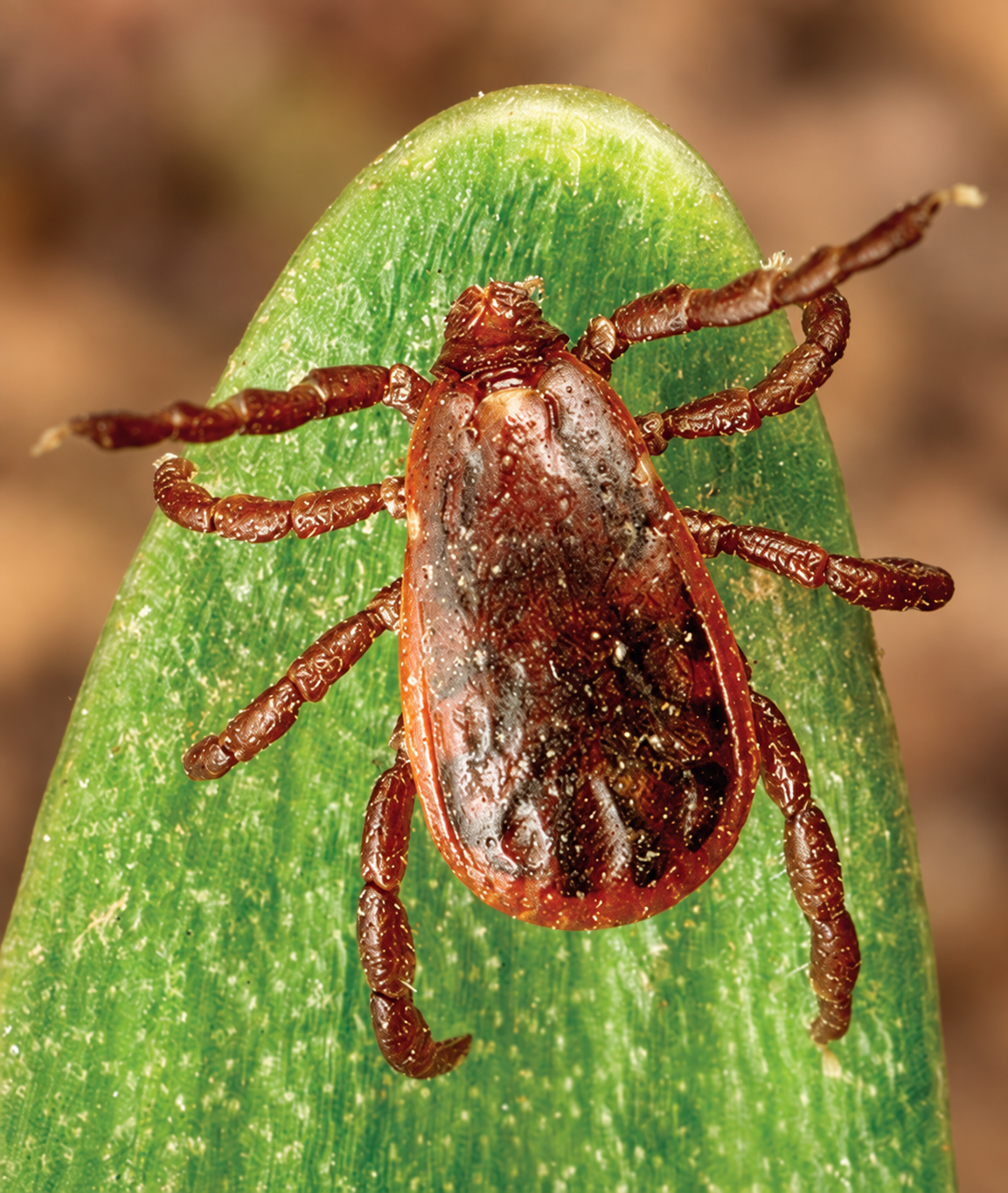
Identification & Key Features Brown dog ticks generally have a fairly uniform reddish-brown to dark-brown appearance and lack the conspicuous white or silvery ornamentation seen on American dog ticks and some other Dermacentor ticks.
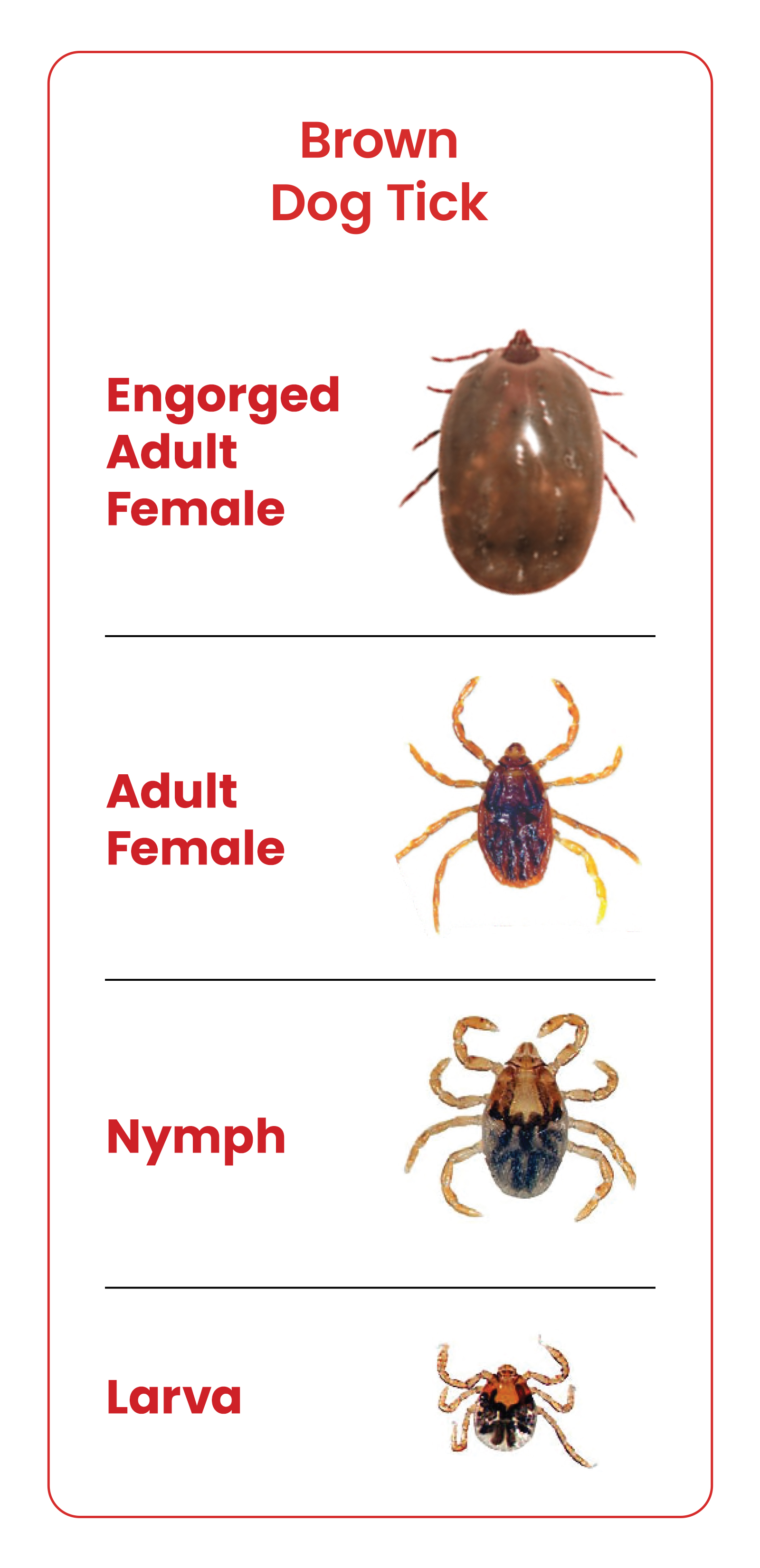
Adult Female
Typical features include:
- Reddish-brown body
- No distinctive pale or white markings
- 8 legs
- A brown, unornamented scutum covering only the front portion of the back
- Relatively short mouthparts
- A characteristically angular, laterally projecting basis capituli, often described as hexagonal-looking when viewed from above
- Eyes and festoons are present
- The abdomen expands dramatically after a blood meal
After feeding, females become greatly enlarged and may appear grayish, gray-brown, or olive-gray rather than uniformly reddish brown.
Adult Male
Adult males:
- Are reddish brown to dark brown
- Have 8 legs
- Lack ornamental white or silvery markings
- Have a scutum covering essentially the entire dorsal surface
- Do not enlarge dramatically during feeding
The extent of the scutum is one of the useful features for distinguishing adult males from adult females, although magnification can make these differences easier to see.
Nymph
Nymphs:
- Have 8 legs
- Are much smaller than adults
- Are generally brown to reddish brown
- Lack ornate markings
- Feed primarily on dogs but may feed on other mammals
Identification of immature brown dog ticks to species can be difficult without magnification or expert examination.
Larva
Larvae:
- Have 6 legs
- Are extremely small
- Feed primarily on dogs
- Drop from the host after feeding before molting into nymphs
Other Identification Features
Under magnification, adult brown dog ticks characteristically have:
- Relatively short mouthparts
- An angular, laterally projecting basis capituli
- An unornamented scutum
- Eyes
- Festoons along the rear margin
- Deeply cleft fore coxae (coxae I)
These features are useful for professional identification, but some are difficult or impossible to evaluate reliably with the naked eye.
Using a magnifier can help make the tick’s body shape, mouthparts, scutum, legs, and other identification features easier to see.
Important Taxonomy Note
The common name brown dog tick refers to members of the Rhipicephalus sanguineus species group, a taxonomically complex group of closely related ticks.
North American brown dog ticks have historically been discussed as two major genetic lineages:
- A temperate lineage, associated with Rhipicephalus sanguineus sensu stricto
- A tropical lineage, now recognized as Rhipicephalus linnaei
Both major lineages have been documented in the United States, with overlapping geographic distributions in some areas. More recent genetic research indicates that the broader R. sanguineus species group is even more diverse than previously recognized and includes additional species-level genetic lineages, some of which remain taxonomically unresolved.
For public-facing U.S. guidance, CDC currently continues to use Rhipicephalus sanguineus as the scientific name for the brown dog tick.
Geographic Distribution & Habitat
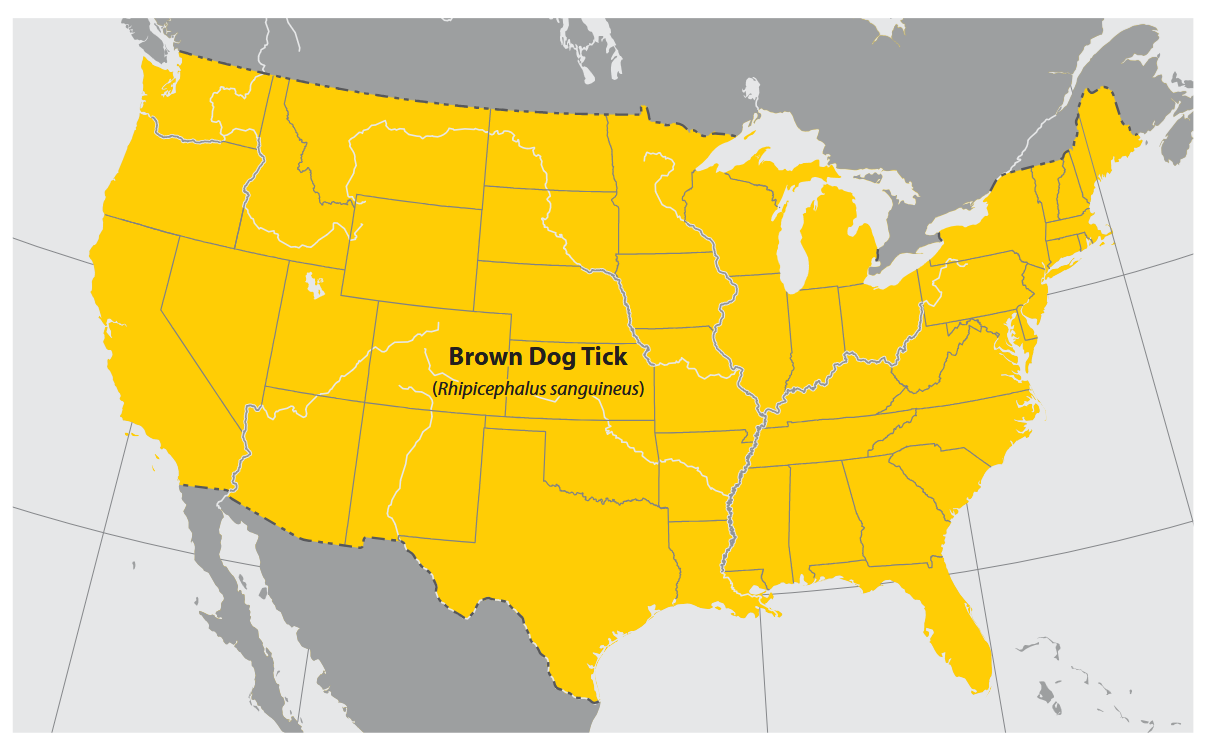
Geographic Distribution & Habitat The brown dog tick group has a nearly worldwide distribution, and brown dog ticks occur throughout the United States. Their distribution is closely associated with domestic dogs and places where dogs live or congregate.
Unlike many ticks that depend primarily on wooded, grassy, or brushy outdoor habitats, brown dog ticks are highly adapted to living inside and around buildings.
Common Locations Include:
- Homes with dogs
- Dog kennels
- Boarding facilities
- Dog runs
- Veterinary facilities
- Animal shelters
- Garages
- Porches
- Dog bedding and sleeping areas
- Cracks and crevices in walls, floors, and other structures
Brown dog ticks have a strong tendency to crawl upward after leaving a host and may be found:
- Along walls
- Behind baseboards or molding
- Behind curtains
- Beneath or behind furniture
- Near ceilings
- In cracks and crevices
- Around dog sleeping areas
Indoor infestations can therefore look very different from encounters with most other common U.S. ticks.
Indoor Survival
Brown dog ticks are particularly noteworthy because they can complete their entire life cycle indoors.
This allows populations to persist in homes, kennels, and other buildings even in climates where outdoor conditions would be unfavorable during part of the year. CAPC notes that brown dog ticks can infest homes and kennels during every month of the year.
Life Cycle & Seasonal Activity
Life Cycle & Seasonal Activity Brown dog ticks develop through four life stages:
Egg → 6-legged Larva → 8-legged Nymph → Adult
The brown dog tick is a three-host tick. Each active stage normally feeds, drops from the host, and then molts to the next stage—or, in the case of an adult female, lays eggs.
Unlike many other three-host ticks, however, dogs are the primary host during the larval, nymphal, and adult stages.
Eggs
After feeding, an engorged adult female:
- Drops from the dog
- Seeks a protected location
- Lays eggs in sheltered areas such as cracks, crevices, kennel structures, garages, or other protected spaces
The female dies after completing egg laying.
Larvae
After hatching:
- Larvae have 6 legs
- Seek a host, usually a dog
- Feed
- Drop from the host
- Molt into nymphs
Nymphs
Nymphs:
- Have 8 legs
- Locate another host, usually a dog
- Feed
- Drop from the host
- Molt into adults
Adults
Adult brown dog ticks:
- Have 8 legs
- Prefer dogs
- Mate and feed on the host
- Adult females become greatly engorged
- Engorged females eventually drop into the environment and lay eggs
How Long Does the Life Cycle Take?
Under highly favorable conditions, development from egg to an egg-laying adult female can be completed in just over two months, although the process frequently takes longer.
Development is influenced by:
- Temperature
- Humidity
- Host availability
- Indoor and outdoor environmental conditions
Unfed stages can also survive for extended periods while waiting for a suitable host.
Seasonal Activity
Brown dog tick activity differs from that of many other U.S. ticks because populations can survive and reproduce indoors.
Brown dog ticks may therefore be encountered year-round, particularly where an indoor infestation has become established.
A U.S. study of brown dog ticks collected from pets found both major brown dog tick lineages during every month of the year. Temperate-lineage ticks were collected most often from March through August, while tropical-lineage ticks were collected more often from June through November.
These findings should not be interpreted as fixed nationwide seasons because activity varies with geography, climate, indoor conditions, and host availability.
Key message: Brown dog ticks can be encountered year-round, especially indoors.
Diseases & Health Risks
Diseases & Health Risks Rocky Mountain Spotted Fever — RMSF
Cause: Rickettsia rickettsii
CDC identifies the brown dog tick as a vector of Rickettsia rickettsii, the bacterium that causes Rocky Mountain spotted fever, particularly in parts of the Southwestern United States and along the U.S.–Mexico border. In parts of Arizona and northern Mexico, brown dog ticks play an especially important role in RMSF transmission.
Possible symptoms of RMSF include:
- Fever
- Headache
- Muscle aches
- Nausea
- Vomiting
- Abdominal pain
- Rash
The rash may appear later in the illness and may not be obvious early, so healthcare providers should not wait for a rash before considering RMSF.
RMSF can become severe or life-threatening if treatment is delayed. CDC recommends prompt treatment with doxycycline when RMSF is clinically suspected rather than waiting for laboratory confirmation.
Important Disease Clarification
For a U.S.-focused human-health page, RMSF is the human disease that CDC specifically identifies as being transmitted by the brown dog tick in the United States.
Brown dog ticks in other parts of the world have been associated with additional pathogens and spotted-fever-group Rickettsia. However, finding a microorganism inside a tick does not by itself prove that the tick is a competent vector capable of transmitting that organism to people.
Important Veterinary Health Risks
The brown dog tick is also particularly important to dog health.
Important canine pathogens associated with brown dog ticks include:
- Ehrlichia canis — causes canine ehrlichiosis
- Babesia vogeli — causes canine babesiosis
- Hepatozoon canis — causes canine hepatozoonosis; dogs typically become infected by ingesting an infected tick, rather than through the tick’s bite
- Anaplasma platys — causes canine cyclic thrombocytopenia; CAPC currently notes that brown dog tick transmission is suspected but has not been definitively documented in North America
- Babesia gibsoni — CAPC lists the brown dog tick among associated vectors, although the role of brown dog ticks in transmission in North America is less clearly established
- Rickettsia rickettsii — can cause RMSF in dogs as well as people
Some brown-dog-tick pathogen relationships vary geographically or remain under investigation, so detection of a pathogen in a tick should not automatically be interpreted as proof of transmission.
Large infestations can also contribute to:
- Skin irritation
- Blood loss
- Anemia, particularly in heavily infested or vulnerable dogs
Because dogs are central to the brown dog tick’s life cycle, maintaining effective tick control on pets is especially important for preventing veterinary disease and household infestations.
Important to Know
Finding a brown dog tick does not automatically mean that it carries Rickettsia rickettsii or that infection has occurred.
Human disease risk can depend on factors such as:
- Geographic location
- Whether the tick is infected
- Local pathogen prevalence
- Whether the tick attached and fed
- Exposure to tick-infested dogs or environments
Humans are not the preferred host for brown dog ticks, but people can be bitten, particularly when large populations become established around dogs, homes, kennels, or other structures.
Bite Prevention & Protection
Bite Prevention & Protection Preventing brown dog tick exposure requires special attention to dogs and the indoor environment, in addition to standard personal tick precautions.
Protect Your Dog
- Check dogs regularly for ticks.
- Pay particular attention around the:
- Ears
- Head
- Neck
- Between the toes
- Legs and underarms
- Talk with a veterinarian about an appropriate year-round tick-control product.
- Use tick-control products consistently according to veterinary and product-label directions.
CAPC recommends year-round tick control for dogs to limit infestations, reduce environmental tick populations, and help prevent brown dog tick populations from becoming established inside homes.
Watch for Indoor Infestations
Possible signs include ticks:
- Crawling on walls
- Around dog bedding
- In cracks or crevices
- Near baseboards or molding
- Behind furniture or curtains
- Near ceilings
- Around kennels or dog runs
Because eggs and immature ticks may be hidden throughout the environment, treating only the visible ticks on a dog may not eliminate an established infestation.
Established household or kennel infestations may require:
- Consistent veterinary tick control for all dogs in the home
- Environmental cleaning and monitoring
- Treatment of the affected building by a qualified or licensed pest-management professional
CAPC notes that established brown dog tick infestations may take several months to bring under control.
Personal Protection
When spending time where ticks may be present:
- Use an EPA-registered insect repellent labeled for protection against ticks and follow label directions.
- Treat clothing and gear with an appropriately labeled permethrin product, or use pretreated clothing.
- Avoid unnecessary contact with tick-infested animals or environments.
- Check your body, clothing, pets, and equipment for ticks after potential exposure.
EPA registration indicates that a repellent has been evaluated for safety and effectiveness when used according to its label.
If You Find an Attached Tick
Remove the tick as soon as possible. Do not delay removal while waiting to see a healthcare provider.
How to Remove a Tick
CDC’s tick-removal guidance, updated June 9, 2026, recommends:
- Use clean fine-tipped tweezers to grasp the tick as close to the skin’s surface as possible.
- If fine-tipped tweezers are unavailable, CDC states that regular tweezers or your fingers may be used. Grasp the tick close to the skin and avoid squeezing its body.
- Pull the tick away from the skin with steady, even pressure.
- Do not twist or jerk the tick.
- If mouthparts remain in the skin and can be removed easily with tweezers, remove them. If they cannot be removed easily, leave them alone and allow the skin to heal.
- Dispose of the tick safely.
- Thoroughly clean the bite area and your hands.
- Check the rest of your body for additional ticks.
Do not use methods such as:
- Petroleum jelly
- Nail polish
- Heat
- Matches
- Other substances intended to make the tick detach
Prompt mechanical removal is recommended rather than attempting to make an attached tick release on its own.
Tick Testing
CDC generally does not recommend commercial testing of a removed tick to guide medical treatment.
A positive result does not establish that infection was transmitted to the person, while a negative result can provide false reassurance. Treatment decisions should not be based on results from testing the removed tick.
If fever, rash, headache, or other concerning symptoms develop during the days to weeks after a tick bite, contact a healthcare provider and mention:
- The recent tick bite
- When the bite occurred
- Where the exposure probably occurred
- Any known exposure to dogs or a brown dog tick infestation
Identification Gallery
Identification Gallery Adult Female
- Uniform reddish-brown color
- No pale or silvery markings
- Scutum covers the front portion of the back
- Short mouthparts
- 8 legs
Adult Male
- Reddish-brown body
- No pale markings
- Scutum covers nearly the entire back
- 8 legs
Engorged Female
- Greatly enlarged after feeding
- Often grayish or olive-gray
- Much larger than an unfed female
Nymph
- Small brown or reddish-brown body
- 8 legs
Larva
- Very small
- 6 legs
Life Stages
Egg → 6-legged Larva → 8-legged Nymph → Adult
Show adults separately as:
Adult Female | Adult Male
Note: Adult males and females are different sexes, not separate developmental stages.