
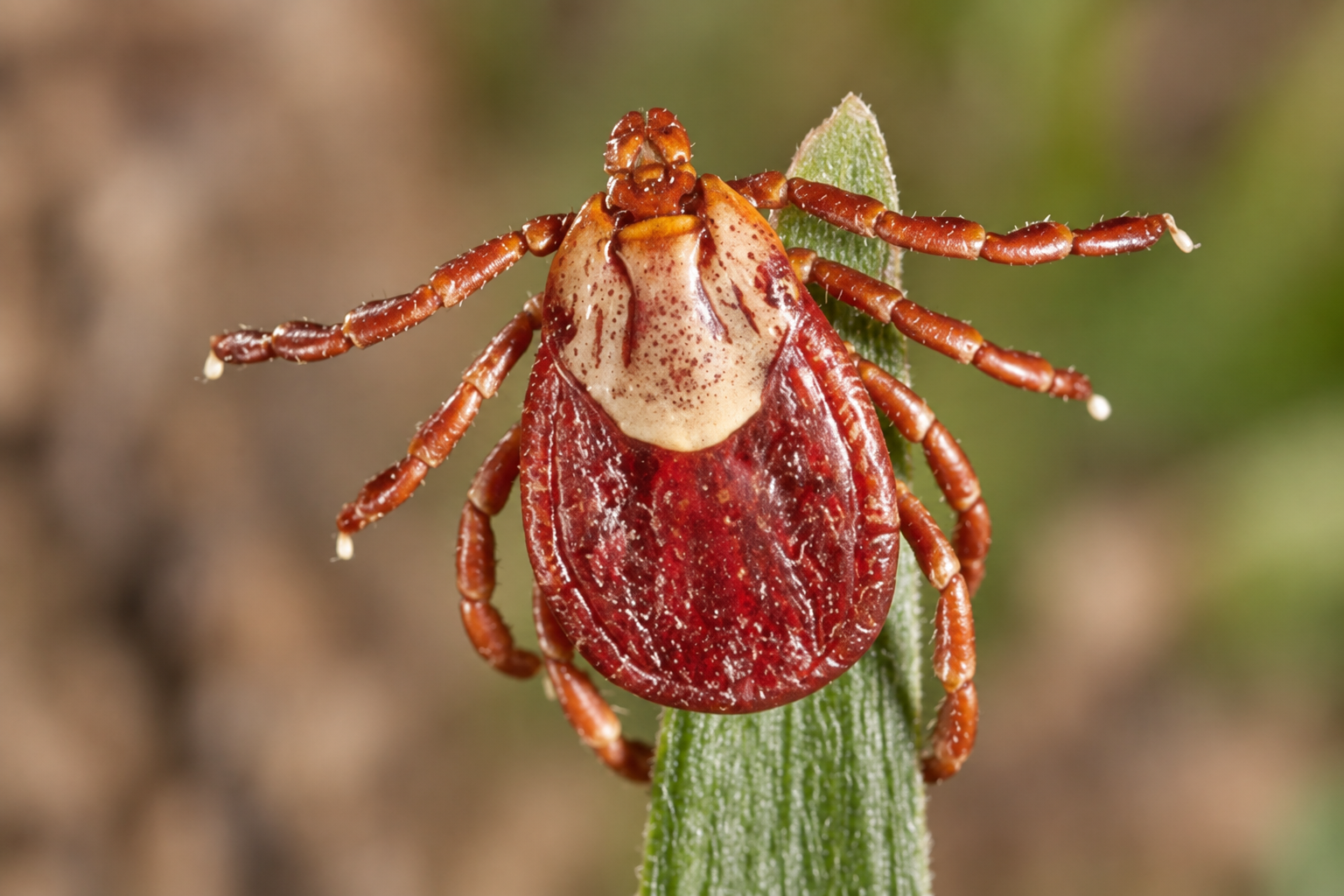

Rocky Mountain Wood Tick

Dermacentor andersoni
The Rocky Mountain wood tick (Dermacentor andersoni) is a large, hard-bodied tick commonly found in the western United States and parts of Canada, typically at higher elevations. It can transmit several pathogens that cause human illness, including Rocky Mountain spotted fever, Colorado tick fever, tularemia, and a form of spotted fever caused by Rickettsia rickettsii and other Rickettsia species.

Adult ticks are the primary stage that bites humans and is associated with disease transmission. This tick is commonly found in grassy, brushy, and mountainous areas, often at higher elevations.

Found in grassy, brushy & mountainous areas

Most active in spring & early summer

Can transmit serious diseases

Adult Rocky Mountain wood ticks are brown to reddish-brown with distinctive pale, grayish-white, or silvery markings on the scutum.

Like other members of the genus Dermacentor, adults have an ornate dorsal shield, relatively short mouthparts, eyes, and festoons along the rear edge of the body.

Adult Female

Typical features include:

  • 8 legs
  • Brown to reddish-brown abdomen
  • Pale, grayish, or silvery ornamentation on the scutum
  • Scutum covering only the front portion of the back
  • Relatively short mouthparts
  • Eyes
  • Festoons along the rear edge of the body
  • Abdomen capable of expanding dramatically during feeding

The adult female’s smaller scutum allows the abdomen behind it to expand substantially as she takes a blood meal.

After feeding, the body can become greatly enlarged and may appear grayish or gray-brown, making an engorged female look considerably different from an unfed tick.

Adult Male

Adult males:

  • Have 8 legs
  • Are generally brown to reddish-brown
  • Have extensive pale or silvery ornamentation
  • Have a scutum covering essentially the entire dorsal surface
  • Have relatively short mouthparts
  • Have eyes and festoons
  • Do not enlarge as dramatically as females during feeding

Because the male’s scutum covers nearly the entire back, the pale-and-dark pattern usually extends across much more of the dorsal surface than it does in the female.

Nymph

Nymphs:

  • Have 8 legs
  • Are much smaller than adults
  • Lack the conspicuous ornate appearance of adult ticks
  • Feed primarily on small mammals
  • Can be difficult to identify accurately without magnification

Nymphal Rocky Mountain wood ticks generally feed on small mammals rather than people.

Larva

Larvae:

  • Have 6 legs
  • Are extremely small
  • Feed primarily on small mammals, particularly rodents
  • Drop from the host after feeding
  • Later molt into eight-legged nymphs

Other Identification Features

Adult Dermacentor andersoni characteristically have:

  • An ornate scutum
  • Relatively short mouthparts
  • Eyes
  • Festoons along the rear edge of the body

Some of these characteristics can be difficult to see without magnification.

Using a magnifier can help make the tick’s markings, mouthparts, scutum, legs, festoons, and other identification features easier to see.

Distinguishing It From Similar Ticks

The Rocky Mountain wood tick can closely resemble other Dermacentor ticks, particularly the American dog tick (Dermacentor variabilis).

Both species can have:

  • Brown or reddish-brown bodies
  • Pale or silvery ornamentation
  • Short mouthparts
  • Eyes
  • Festoons

Because their external appearance can be very similar, geographic location alone should not be used as definitive identification.

Reliable separation of D. andersoni and D. variabilis may require examination of microscopic characteristics, particularly the spiracular plates.

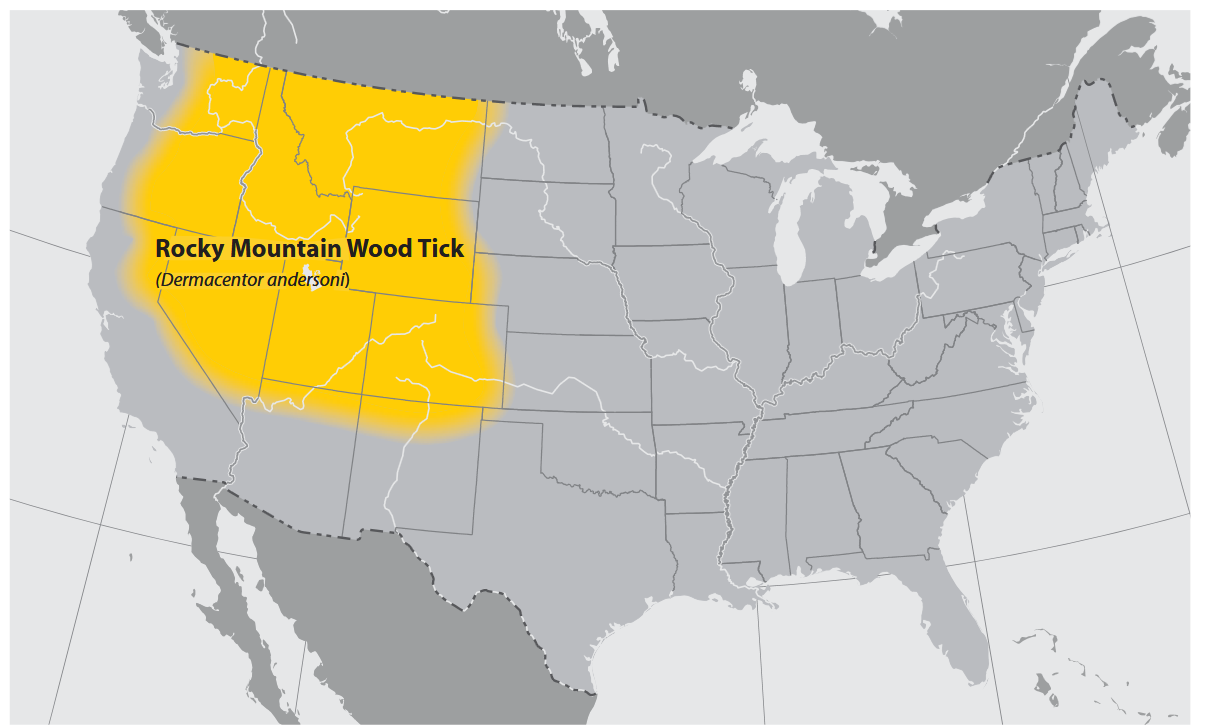
The Rocky Mountain wood tick occurs in the Rocky Mountain states and southwestern Canada, primarily at elevations of approximately:

4,000–10,500 feet

Its distribution is centered in the mountainous and intermountain regions of western North America.

Common Habitats

Rocky Mountain wood ticks may be encountered in:

  • Mountain and foothill environments
  • Grassy areas
  • Shrublands
  • Brushy areas
  • Open woodland
  • Woodland edges
  • Field edges
  • Trails and commonly traveled wildlife paths
  • Areas where grasses, shrubs, and larger mammal hosts occur

In Colorado, ticks are particularly common in suitable higher-elevation habitats, and exposure often occurs along brushy field and woodland edges, grassy paths, and shrublands.

Rocky Mountain wood ticks locate hosts using a behavior known as questing.

They climb vegetation and wait with their front legs extended for a suitable animal or person to brush against them.

They do not jump or fly.
The Rocky Mountain wood tick has four developmental stages:

Egg → Larva → Nymph → Adult

It follows a three-host life cycle, meaning that the larva, nymph, and adult generally feed on different individual hosts.

After each immature stage finishes feeding, it drops from the host and later molts into the next developmental stage.

Larvae

Larvae:

  • Have 6 legs
  • Feed primarily on small mammals
  • Commonly use rodents as hosts
  • Drop from the host after feeding
  • Molt into nymphs

Nymphs

Nymphs:

  • Have 8 legs
  • Continue to feed primarily on small mammals
  • May feed on rodents and other small mammalian hosts
  • Drop from the host after feeding
  • Later molt into adults

Adults

Adults:

  • Have 8 legs
  • Feed primarily on larger mammals
  • Common hosts include deer and other large mammals
  • May feed on livestock
  • Can feed on dogs
  • Readily bite humans in areas where the species is common

Adults are the Rocky Mountain wood tick life stage most strongly associated with human biting and pathogen transmission.

After feeding and mating, an engorged adult female drops from the host and lays a large mass of eggs.

Life-Cycle Timing

Development varies according to:

  • Temperature
  • Elevation
  • Humidity
  • Host availability
  • Geography
  • Local environmental conditions

The Rocky Mountain wood tick life cycle may require up to approximately 2–3 years to complete, although development time varies with environmental conditions.

Seasonal Activity

Rocky Mountain wood ticks are particularly associated with spring and early-summer activity.

In Colorado, the species is most active and bites people most frequently during spring. Activity declines as conditions become warmer and drier, and many ticks become dormant during hot weather.

Seasonal timing can vary according to:

  • Geographic location
  • Elevation
  • Temperature
  • Snowmelt
  • Weather conditions

For a national website, the most accurate summary is:

Rocky Mountain wood ticks are most active during spring and early summer, although exact activity periods vary by location, elevation, and weather conditions.

The Rocky Mountain wood tick is a recognized vector of the pathogens responsible for:

  • Rocky Mountain spotted fever
  • Colorado tick fever
  • Tularemia

Rocky Mountain Spotted Fever

Cause: Rickettsia rickettsii

The Rocky Mountain wood tick is a recognized vector of Rickettsia rickettsii in the western United States.

Rocky Mountain spotted fever, or RMSF, can be a serious and potentially life-threatening bacterial illness.

Possible Symptoms

Symptoms can include:

  • Fever
  • Severe headache
  • Muscle aches
  • Nausea or vomiting
  • Abdominal pain
  • Rash

A rash may develop several days after illness begins, but not every patient develops a rash, and treatment should not be delayed while waiting for one to appear.

RMSF can become severe without prompt treatment.

Doxycycline is the treatment of choice for suspected RMSF in adults and children of all ages.

Colorado Tick Fever

Cause: Colorado tick fever virus

Colorado tick fever is typically transmitted to humans through the bite of an infected Rocky Mountain wood tick (Dermacentor andersoni).

The virus circulates naturally between Rocky Mountain wood ticks and small mammals, particularly rodents such as:

  • Squirrels
  • Chipmunks
  • Mice

Possible Symptoms

Common symptoms include:

  • Fever
  • Chills
  • Headache
  • Body aches
  • Fatigue

Some patients experience a biphasic fever, meaning symptoms improve and then return for a second period.

Most people recover completely, although fatigue and weakness can sometimes persist for several weeks. Rarely, more serious illness affecting the central nervous system may occur.

Colorado tick fever occurs primarily in the western United States and western Canada, especially in higher-elevation areas where Rocky Mountain wood ticks occur.

Tularemia

Cause: Francisella tularensis

The Rocky Mountain wood tick is one of the U.S. tick species capable of transmitting Francisella tularensis, the bacterium that causes tularemia.

Tick-associated tularemia commonly presents as ulceroglandular or glandular tularemia.

Possible Symptoms

Symptoms can include:

  • Sudden fever
  • Chills
  • Headache
  • Fatigue
  • Swollen and painful lymph nodes
  • A skin ulcer at or near the site where the bacteria entered the body

Tularemia can also be acquired through routes other than tick bites, including contact with infected animals.

Tick Paralysis

Rocky Mountain wood ticks can also cause tick paralysis.

Tick paralysis is a rare, noninfectious neurologic condition and is not caused by bacteria, viruses, or parasites.

Instead, it results from a neurotoxin released in the saliva of certain feeding ticks. In Rocky Mountain wood ticks, tick paralysis is associated primarily with feeding adult females.

Dermacentor andersoni is one of the tick species historically associated with human tick-paralysis cases in western North America.

Possible Symptoms

Symptoms may include:

  • Tingling or unusual sensations
  • Weakness
  • Difficulty walking
  • Loss of coordination
  • Progressive ascending muscle weakness
  • Paralysis
  • Difficulty breathing in severe cases

Symptoms often begin in the legs and progress upward.

Removal of the responsible tick is essential, and improvement commonly begins after the tick is removed.

Difficulty breathing, rapidly worsening weakness, or paralysis requires immediate medical attention.

Important Lyme Disease Clarification

The Rocky Mountain wood tick does not transmit Lyme disease bacteria.

In the United States, Lyme disease is transmitted primarily by:

  • Ixodes scapularis — Blacklegged Tick
  • Ixodes pacificus — Western Blacklegged Tick

The established infectious diseases associated with Rocky Mountain wood tick transmission to people are Rocky Mountain spotted fever, Colorado tick fever, and tularemia.

A bite from a Rocky Mountain wood tick is not considered a Lyme disease exposure because Dermacentor andersoni is not a vector of Lyme disease bacteria.

Important to Know

Finding a Rocky Mountain wood tick does not automatically mean the tick is infected.

The risk of tick-borne disease depends on several factors, including:

  • Tick species
  • Geographic location
  • Whether the tick was infected
  • Pathogen prevalence in the area
  • Attachment and feeding
  • The specific pathogen involved

A tick’s presence alone does not establish that disease transmission occurred.

When Outdoors

To reduce the chance of tick bites:

  • Avoid brushing directly against tall grass, brush, shrubs, and dense vegetation when practical.
  • Walk near the center of maintained trails.
  • Use an EPA-registered insect repellent according to label instructions.
  • Treat clothing and outdoor gear with products containing 0.5% permethrin, or wear commercially pretreated clothing.
  • Wear long pants, long sleeves, socks, and closed shoes when practical.
  • Light-colored clothing can make crawling ticks easier to see.

EPA-registered repellents containing active ingredients such as DEET, picaridin, IR3535, oil of lemon eucalyptus (OLE), PMD, or 2-undecanone can help prevent tick bites when used according to label directions.

After Outdoor Activity

Perform a thorough tick check after spending time in potential tick habitat.

Pay particular attention to:

  • In and around the hair
  • In and around the ears
  • Under the arms
  • Around the waist
  • Inside the belly button
  • Behind the knees
  • Between the legs

Also inspect:

  • Children
  • Pets
  • Clothing
  • Backpacks
  • Outdoor equipment

Showering within two hours after coming indoors may help wash away unattached ticks and provides a good opportunity to conduct a complete body check.

If You Find an Attached Tick

Remove it as soon as possible.

Do not delay tick removal while waiting to see a healthcare provider. Prompt removal can help reduce the risk of diseases transmitted through tick bites.

How to Remove a Tick

  1. Use clean fine-tipped tweezers whenever possible.
  2. Grasp the tick as close to the skin’s surface as possible, avoiding unnecessary squeezing of the tick’s body.
  3. Pull the tick away from the skin with steady, even pressure.
  4. Do not twist or jerk the tick.
  5. If mouthparts remain and can be removed easily with tweezers, remove them. If they cannot be removed easily, leave them alone and allow the skin to heal.
  6. Dispose of the live tick safely.
  7. Thoroughly clean the bite area and your hands.
  8. Check the rest of your body for additional ticks.

If fine-tipped tweezers are unavailable, current CDC guidance states that regular tweezers or fingers may be used carefully, while avoiding squeezing the tick’s body.

Do not use:

  • Petroleum jelly
  • Nail polish
  • Heat
  • Other substances intended to make the tick detach

These methods may agitate the tick and should not replace prompt mechanical removal.

Tick Testing

Commercial testing of removed ticks is generally not recommended for making medical treatment decisions.

A positive tick test does not prove that infection was transmitted to the person, while a negative result can provide false reassurance.

If a fever, rash, headache, muscle aches, unusual weakness, difficulty walking, or other concerning symptoms develop during the following days or weeks, contact a healthcare provider and mention:

  • The tick bite
  • When it occurred
  • Where the tick exposure most likely occurred

Seek immediate medical attention for rapidly progressive weakness, paralysis, or difficulty breathing.

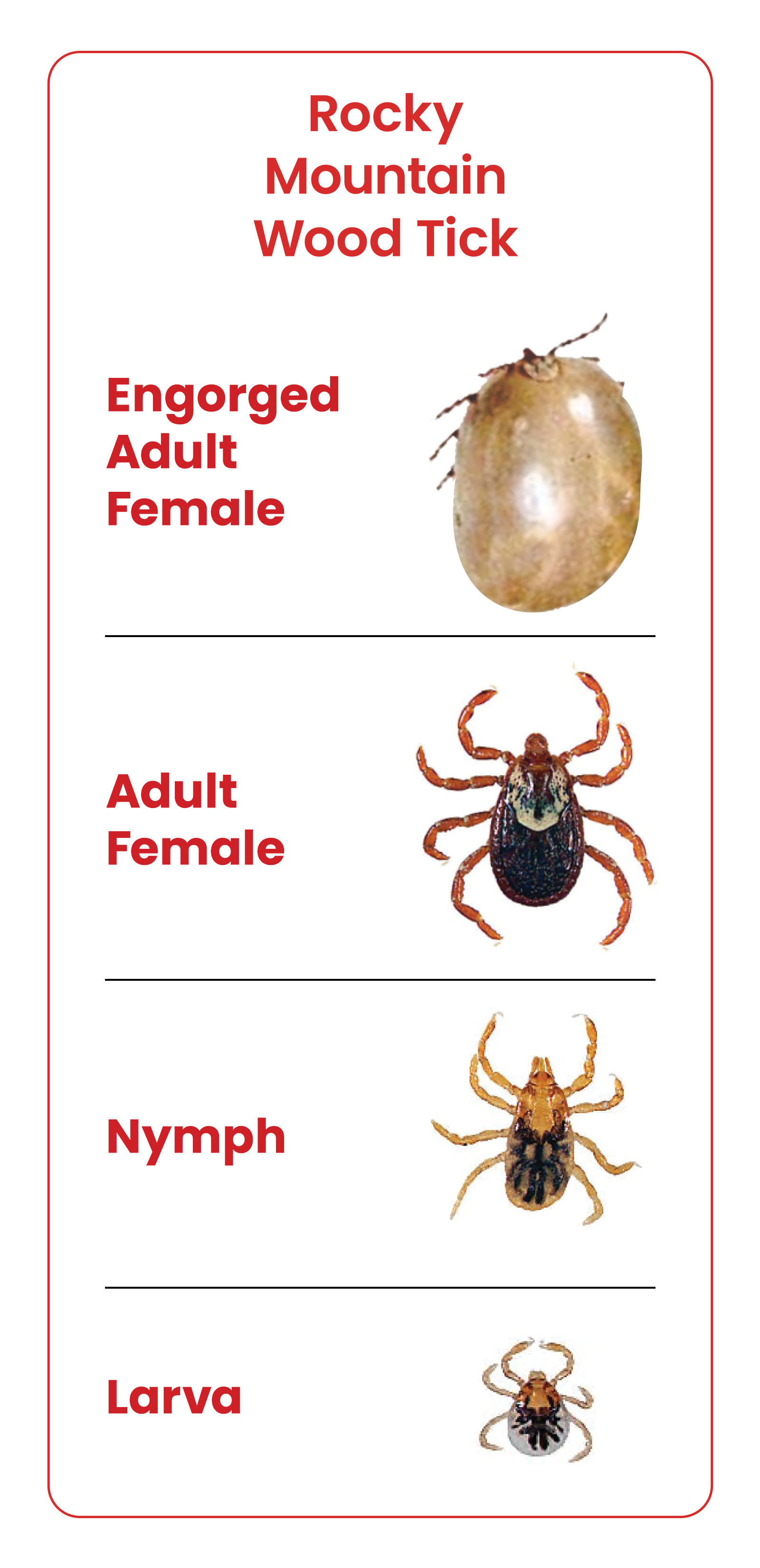
Adult Female

  • Brown to reddish-brown body
  • Pale or silvery markings on the front scutum
  • Short mouthparts
  • 8 legs

Adult Male

  • Pale or silvery markings across most of the back
  • Scutum covers nearly the entire back
  • Short mouthparts
  • 8 legs

Engorged Female

  • Greatly enlarged after feeding
  • Grayish or gray-brown body
  • Small ornate scutum remains visible at the front

Nymph

  • Small body
  • 8 legs
  • Lacks the strong adult pattern

Larva

  • Very small
  • 6 legs

Male vs. Female

  • Female: ornate scutum only at the front
  • Male: ornate pattern across nearly the entire back

Life Stages Egg → 6-legged Larva → 8-legged Nymph → Adult

Show adults separately as:

Adult Female | Adult Male

Similar Species Rocky Mountain Wood Tick can look very similar to the American Dog Tick (Dermacentor variabilis). Microscopic examination may be needed for reliable species identification.
Need Help OR

Have a question?

Email us anytime at
sales@ticktweezers.com
and we will be happy to help.

While you're here, check out our
Resources and Product pages to
learn more.

Be Tick free