
Ixodes angustus
The Ixodes angustus tick is a small hard-bodied tick found in the United States and Canada. It is typically associated with cool, moist habitats, especially forests-particularly coniferous tracts- and along river edges. It is rarely found outside the nest or sheltered resting area of its host.
It primarily feeds on mice and voles, and occasionally on shrews and rats. It rarely feeds on humans or domestic animals. The life cycle of this tick has not been thoroughly studied, and limited data suggest that development times can vary.
Although Ixodes angustus rarely bites humans, it has been identified as a potential vector of Lyme disease and Powassan virus. Because human bites are uncommon, its importance in human disease transmission is considered limited.
Associated with mice, voles & host nests
Cool, moist forests & river edges
Rarely bites humans; potential vector of Lyme disease & Powassan virus
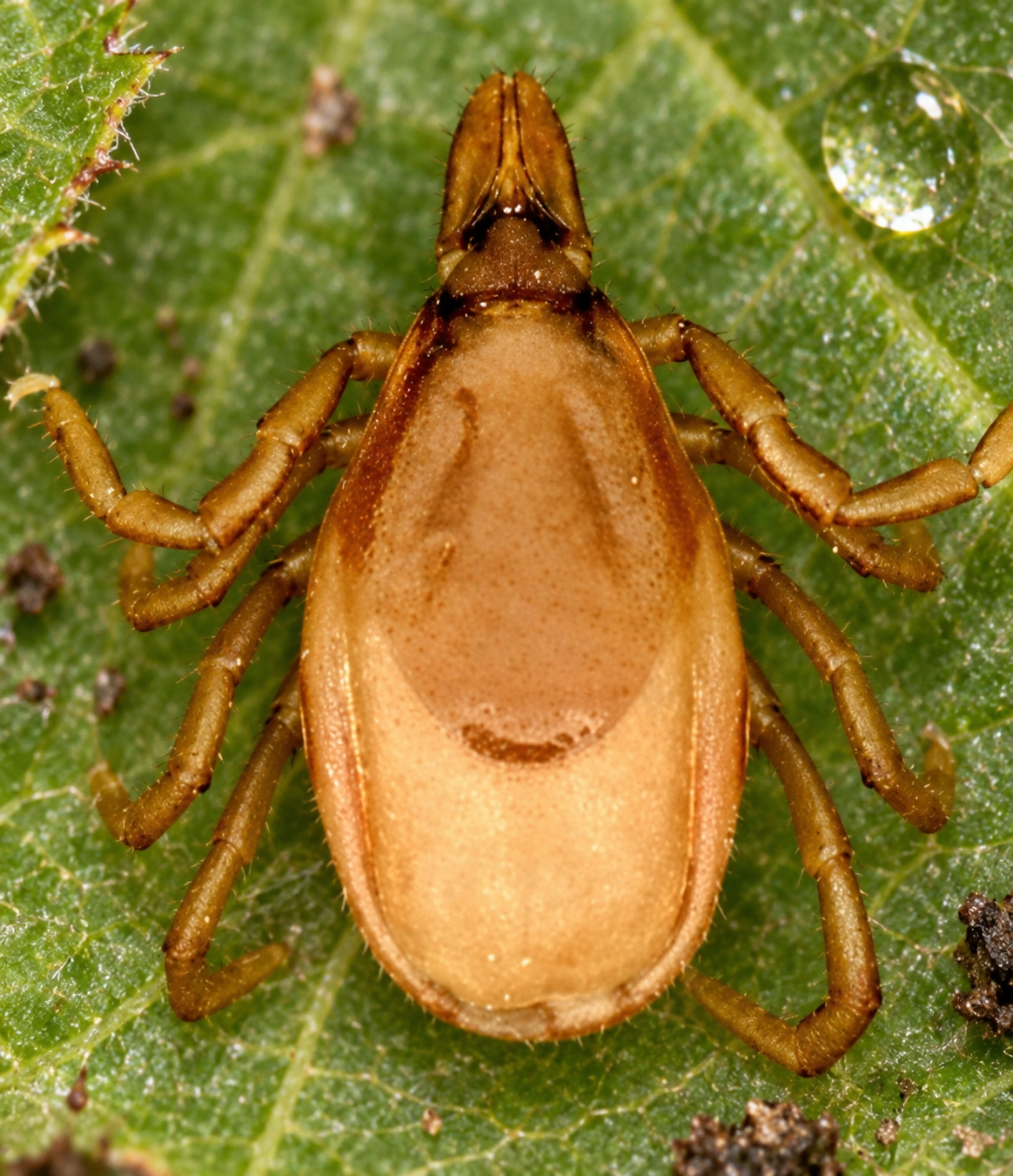
 Identification & Key Features
 Identification & Key Features
 Ixodes angustus is a small hard tick primarily associated with small mammals and their nests.
- Adult females are generally tan to light brown
- Females have a darker, unornamented scutum directly behind the head
- Adult females are small when unfed and expand substantially after taking a blood meal
- Adult males are generally slightly smaller and tan to brown
- Adults and nymphs have 8 legs
- Larvae have 6 legs
- Eyes are absent
- Festoons are absent
- In adult females, the scutum covers only the front portion of the back
- In adult males, the conscutum (dorsal shield) covers essentially the entire back
Common-name note: The University of Maine lists no common name for I. angustus. The Alaska Department of Environmental Conservation uses “Squirrel or Vole Tick.” Therefore, that name is appropriate as a regional common name, but it should not be presented as a universally standardized common name.
Geographic Distribution & Habitat
Geographic Distribution & Habitat Ixodes angustus has a broad Holarctic distribution, occurring in both the Nearctic and Palearctic regions.
In North America, it has been documented in:
- Much of the United States
- Canada
- Northern Mexico, including Coahuila
University of Maine describes it as widely distributed in the United States and Canada, while a formal Mexican taxonomic treatment documents I. angustus in Coahuila.
Outside North America, it has also been documented in parts of the eastern Palearctic, including:
- Japan
- The Russian Far East
- Kamchatka
- Sakhalin
- The Kuril Islands
Published records confirm I. angustus in Japan and extensive records from the Russian Far East.
It is strongly associated with cool, moist environments, including:
- Coniferous and mixed forests
- Boreal and montane habitats
- Moist woodland
- Riparian habitats
- River and stream margins
- Small-mammal nests and burrows
- angustus is primarily nidicolous, meaning much of its off-host life occurs within or near the nests and shelters of its hosts. It is rarely encountered away from host nests compared with more actively questing human-biting ticks.
Life Cycle & Seasonal Activity
Life Cycle & Seasonal Activity Ixodes angustus develops through four stages:
Egg → Larva → Nymph → Adult
Larvae, nymphs, and adult females take blood meals during their respective feeding stages. Larvae and nymphs molt after feeding, while adult females feed before producing eggs.
Because the species is strongly nidicolous, its entire life cycle can be completed within the host’s nesting environment when suitable hosts are available. Adult males are rarely encountered on vertebrate hosts because mating generally occurs in the nest, although males have occasionally been documented mating with females directly on mammalian hosts.
Its most important hosts are small mammals, including:
- Mice
- Voles
- Shrews
- Rats
- Chipmunks
- Squirrels
Studies in Alaska and California confirm particularly strong associations with rodents, shrews, chipmunks, and squirrels.
- angustus has also been recorded from dogs, cats, other mammals, and humans. Human bites occur, but humans are sporadic hosts rather than the tick’s principal hosts.
Seasonal activity varies geographically.
In Alaska, surveillance documented I. angustus from April through October, with adult and nymph activity peaking during summer, particularly July.
California studies have documented different seasonal patterns, including year-round nymphal activity at some sites. Therefore, the Alaska April–October pattern should not be treated as a universal activity calendar for the species.
Diseases & Health Risks
Diseases & Health Risks Ixodes angustus is not considered a major human disease vector. Its strong association with small-mammal nests and relatively infrequent feeding on humans greatly limits its importance as a human vector.
However, it is involved in wildlife pathogen cycles and has demonstrated experimental competence for certain pathogens.
Lyme Disease Bacteria
Laboratory studies have confirmed that I. angustus is a competent experimental vector of Borrelia burgdorferi sensu stricto, the principal bacterium responsible for Lyme disease in North America.
Researchers demonstrated that:
- Larvae could acquire B. burgdorferi while feeding
- The bacterium survived the molt into the nymphal stage
- Infected nymphs subsequently transmitted the bacterium to a naïve mammalian host
Researchers therefore concluded that I. angustus is a competent experimental vector of B. burgdorferi sensu stricto.
However, experimental vector competence does not mean that I. angustus is an important human Lyme disease vector in nature. Its nidicolous behavior and relatively uncommon feeding on people make its public-health role much smaller than that of Ixodes scapularis and Ixodes pacificus.
Anaplasma phagocytophilum
Anaplasma phagocytophilum DNA has been detected in I. angustus collected in California.
One study detected A. phagocytophilum DNA in approximately 2% of tested I. angustus.
However, detection of pathogen DNA in a tick does not establish vector competence. Therefore, I. angustus should not be described as an established vector of human granulocytic anaplasmosis.
Babesia microti and Related Parasites
Ixodes angustus is associated with rodent enzootic cycles involving Babesia microti and closely related B. microti-like organisms.
Research on Alaskan small mammals identified B. microti organisms belonging to a lineage genetically distinct from the principal zoonotic lineage responsible for human babesiosis. More recent Alaska surveillance detected two B. microti-like lineages in I. angustus and specifically noted that neither was identical to the human disease-causing variant.
Separately, a 2026 British Columbia study detected B. microti in two I. angustus ticks—one nymph and one adult female.
These findings support an association between I. angustus and enzootic Babesia cycles, but they do not establish I. angustus as an important or confirmed vector of human babesiosis.
Powassan Virus
Ixodes angustus should not be presented as a confirmed Powassan virus vector.
Some references describe it as a potential vector. However, its role in Powassan virus transmission remains uncertain. An Alaska investigation found serologic evidence of a Powassan-like virus in voles but detected no viral RNA in the I. angustus ticks collected from those mammals.
Therefore, the safest wording is:
The role of I. angustus in Powassan virus transmission remains uncertain, and it is not established as a confirmed Powassan virus vector.
Bite Prevention & Protection
Bite Prevention & Protection Because I. angustus is closely associated with small mammals and their nesting environments, exposure may occur when people or pets encounter rodent nests, burrows, or other infested areas.
- Avoid unnecessary contact with rodent nests and nesting material
- Wear gloves when handling nesting material
- Reduce rodent nesting opportunities around buildings
- Check yourself, clothing, and pets after exposure to wooded or rodent-inhabited environments
- Use an EPA-registered tick repellent when appropriate
- Remove attached ticks promptly with clean, fine-tipped tweezers
Although human bites are relatively uncommon throughout most of its range, I. angustus is notable in Alaska, where surveillance identifies it as the state’s most commonly recorded human-biting tick.
Identification Gallery
Identification Gallery Adult Female
- Tan to light-brown body
- Dark, unornamented scutum
- Scutum covering the front portion of the back
- 8 legs
- No eyes
- No festoons
Adult Male
- Tan to brown body
- Generally smaller than the female
- Conscutum covering essentially the entire dorsal surface
- 8 legs
- No eyes
- No festoons
Engorged Female
- Substantially enlarged body after feeding
- Dark scutum remaining visible near the front
- Show an unfed vs. engorged comparison
Nymph
- Small body
- 8 legs
- Plain, unornamented appearance
- Show size comparison with an adult
Larva
- Extremely small body
- 6 legs
- Show size comparison with a nymph
Habitat Image
- Small-mammal nest or burrow
- Cool, moist woodland
- Coniferous or mixed forest
- Riparian or streamside habitat
Important: Use only specimens specifically verified as Ixodes angustus. It can resemble other small Ixodes species, and reliable identification may require microscopic examination of the hypostome, palps, scutum, coxal spurs, and other anatomical characteristics. In adult females, the Christmas-tree-shaped hypostome with 3/3 dentition and the approximately equal internal and external coxa I spurs are useful diagnostic features.

