A Lyme-Like Rash Illness Associated With Lone Star Tick Bites
What Is Southern Tick-Associated Rash Illness?
Southern tick-associated rash illness (STARI) is an illness associated with the bite of the lone star tick (Amblyomma americanum).
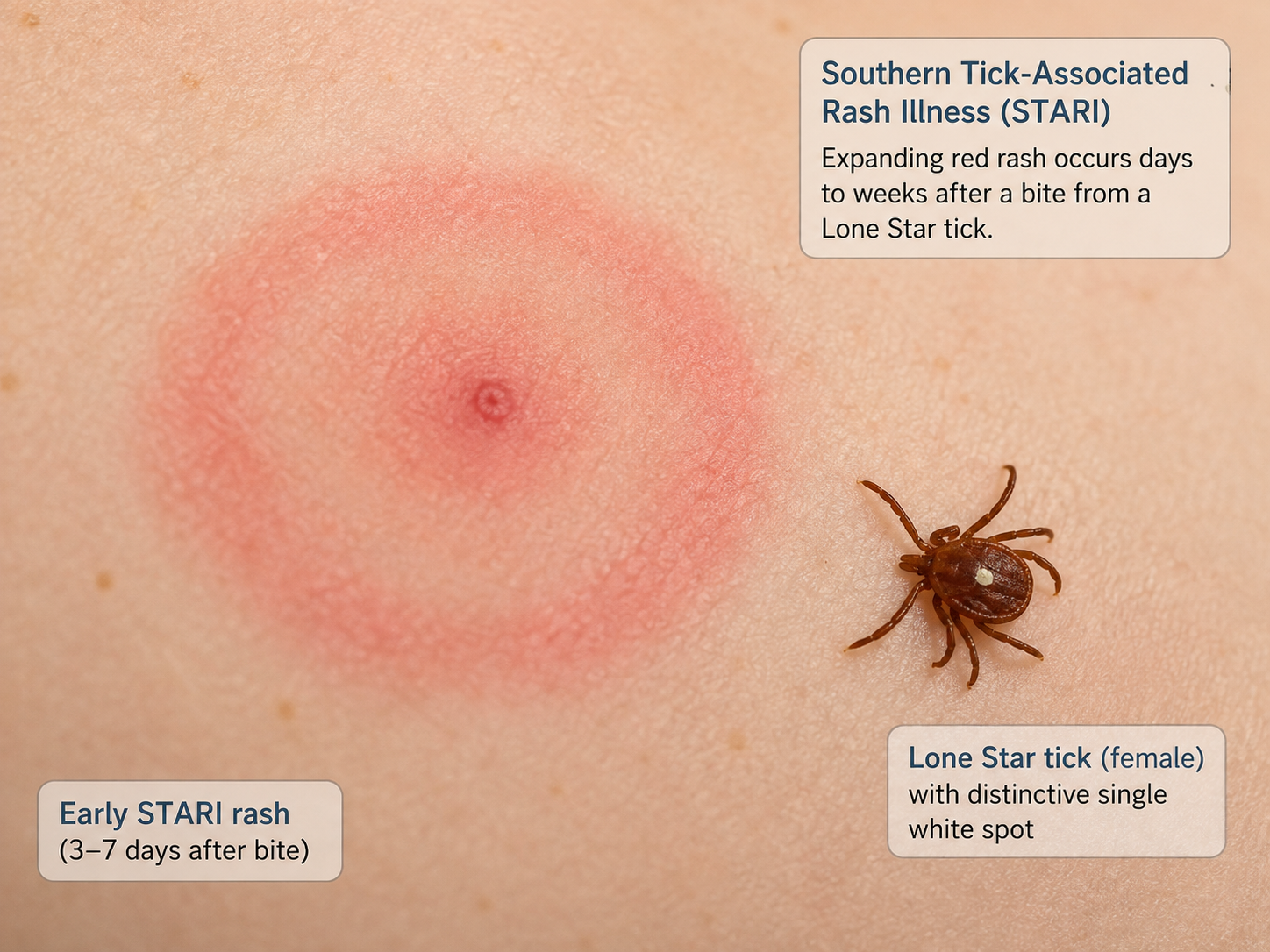
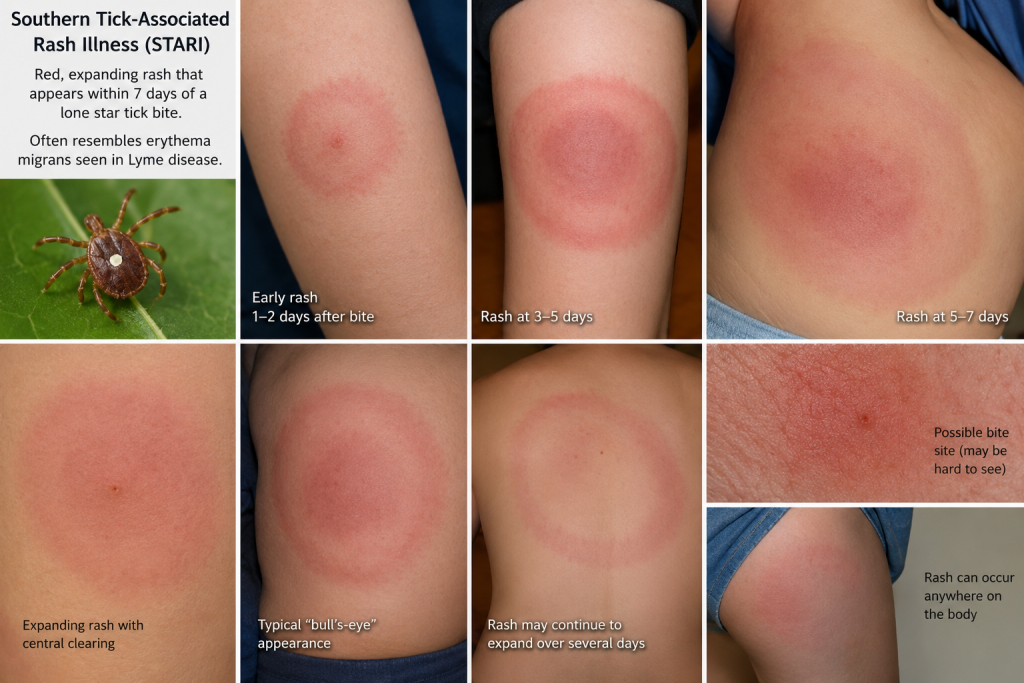
The main feature of STARI is a red, expanding rash that develops around the site of a tick bite. The rash can closely resemble the erythema migrans (EM) rash associated with Lyme disease.
Some people with STARI may also experience fatigue, headache, fever, and muscle or joint pain.
The exact cause of STARI is not known. Studies have shown that STARI is not caused by Borrelia burgdorferi, one of the bacteria known to cause Lyme disease in the United States.
Because its cause remains unknown, STARI is not currently established as a bacterial infection
How Is STARI Associated With Tick Bites?
STARI is specifically associated with bites from the lone star tick (Amblyomma americanum).
Lone star ticks are aggressive human-biting ticks. Larvae, nymphs, and adults can bite people.
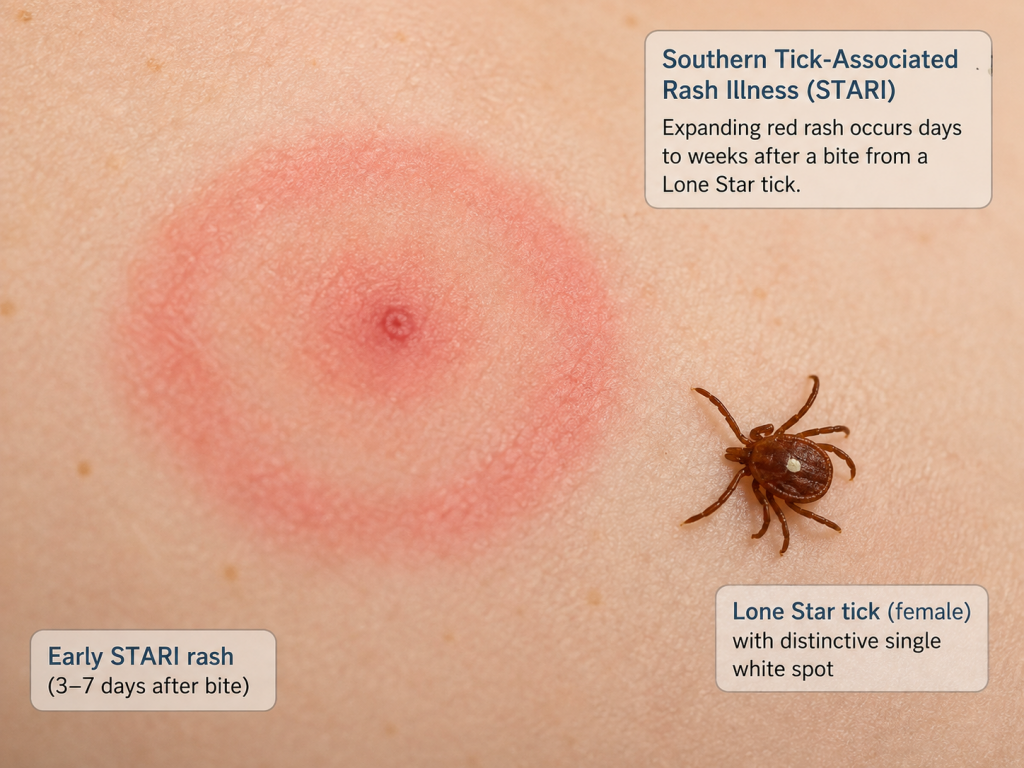
The adult female lone star tick can be recognized by the distinctive white dot or “lone star” on her back that gives the species its common name.
Researchers once suspected that a bacterium called Borrelia lonestari might cause STARI. However, subsequent research did not establish B. lonestari as the cause, and the exact cause of STARI remains unknown.
Where Is STARI Found?
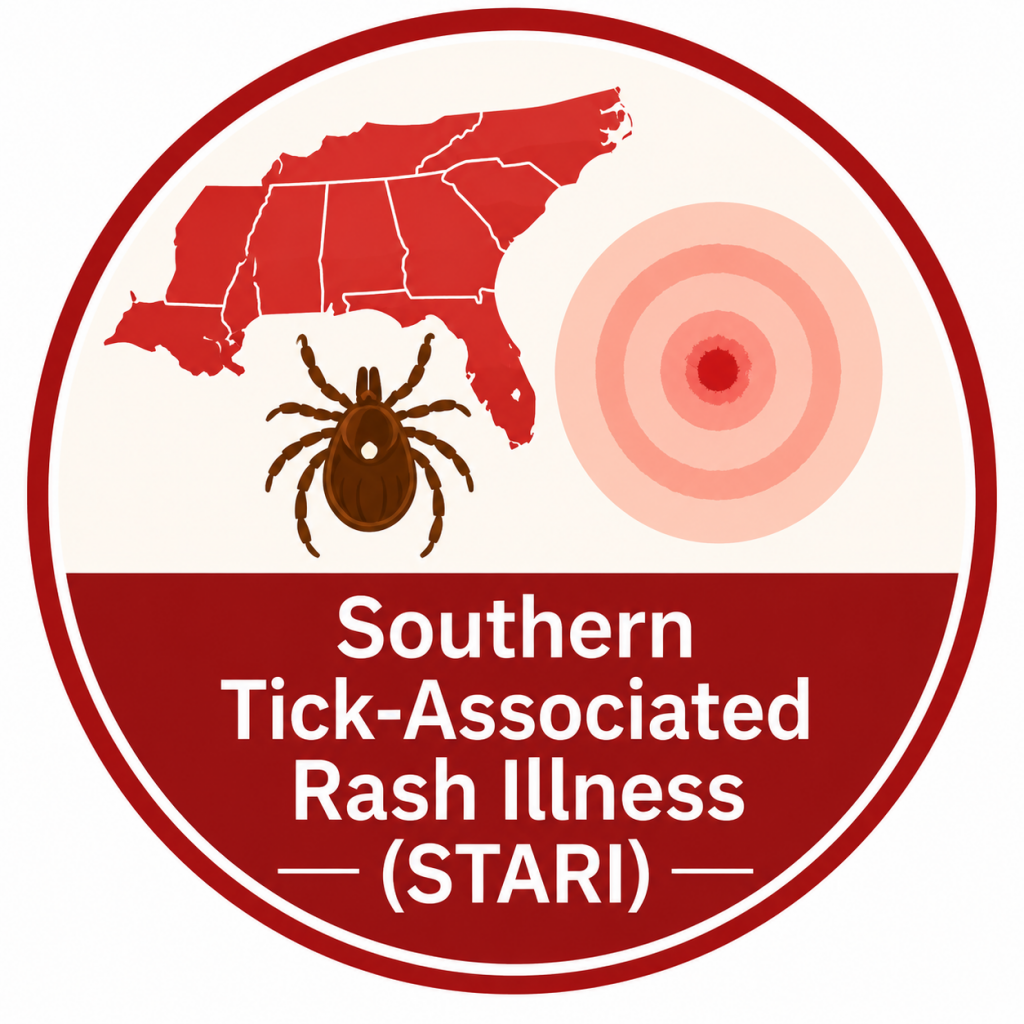
STARI occurs most often in the southern United States, where Lyme disease has historically been less common than in major Lyme-endemic regions.
The lone star tick itself is now widely distributed in the Northeast, South, and Midwest United States.
As lone star ticks occur in areas where blacklegged ticks and Lyme disease are also found, distinguishing STARI from early Lyme disease can be challenging.
In July 2026, a report published in CDC’s Emerging Infectious Diseases journal described a pediatric STARI case on Long Island, New York, following a confirmed lone star tick bite. The report highlights the diagnostic challenge created by increasing lone star tick populations in areas of the Northeast where Lyme disease is also common.
Although its name contains the word “Southern,” STARI therefore should not be assumed to occur exclusively in the southern United States.
What Are the Symptoms of STARI?
The most characteristic sign of STARI is a red, expanding rash around the site of a lone star tick bite.
Other symptoms may include:
- Fatigue
- Headache
- Fever
- Muscle pain
- Joint pain
Not everyone with STARI will necessarily experience all of these symptoms.
What Does a STARI Rash Look Like?
According to CDC, the STARI rash typically:
- Appears within 7 days of the tick bite
- Expands outward
- Reaches approximately 3–12 inches (8–30 centimeters) in diameter
- May develop central clearing
- Can sometimes have a target-like or “bull’s-eye” appearance
STARI rashes do not always look the same.
A small area of redness, irritation, or discomfort immediately around a tick bite is relatively common and is not the same as the larger, expanding rash associated with STARI.
Is STARI the Same as Lyme Disease?
No. STARI and Lyme disease are different conditions.
STARI can closely resemble early Lyme disease because both may produce a red, expanding, erythema-migrans-like rash.
However, there are important differences:
- STARI is specifically associated with the lone star tick (Amblyomma americanum).
- Lyme disease in the United States is transmitted by infected blacklegged ticks (Ixodes scapularis) and western blacklegged ticks (Ixodes pacificus).
- The exact cause of STARI is unknown.
- Lyme disease is caused by certain Borrelia bacteria.
- Studies have shown that STARI is not caused by Borrelia burgdorferi.
- Lone star ticks have not been shown to transmit B. burgdorferi.
- There is currently no diagnostic blood test for STARI.
Because the rashes can look very similar, it may sometimes be difficult to distinguish STARI from early Lyme disease based on the appearance of the rash alone.
Is STARI Serious?
Current scientific literature generally considers STARI to be self-limited, and STARI is not known to cause lasting health effects after the rash resolves. However, relatively few untreated patient case histories have been reported, and the natural history of STARI remains incompletely understood.
In addition, an expanding rash following a known or possible tick bite can resemble early Lyme disease, so a person should not attempt to determine the diagnosis solely from the appearance of the rash.
An expanding rash or other concerning symptoms following a tick bite or possible tick exposure should be evaluated by a healthcare provider.
How Is STARI Diagnosed?
There is currently no diagnostic blood test specifically for STARI because the cause of the illness is unknown.
CDC states that healthcare providers diagnose STARI based on symptoms, geographic location, and the possibility of a tick bite.
The appearance and progression of the rash and identification of the responsible tick, when available, can provide additional information and may help distinguish STARI from early Lyme disease.
Identifying the tick can sometimes be particularly useful because STARI is specifically associated with the lone star tick, while Lyme disease is transmitted by certain Ixodes ticks.
However, CDC generally does not recommend commercial testing of removed ticks for disease-causing organisms to guide medical treatment.
A positive result does not necessarily mean that the person was infected, while a negative result may provide false reassurance.
How Is STARI Treated?
It is currently not known whether antibiotics are necessary or beneficial specifically for STARI.
CDC notes that because STARI resembles early Lyme disease, some healthcare providers treat patients with oral antibiotics.
The clinical practice guideline from the Infectious Diseases Society of America (IDSA), American Academy of Neurology (AAN), and American College of Rheumatology (ACR) makes no recommendation for or against antibiotic treatment for STARI because of a knowledge gap.
The guideline also notes an important practical issue: in geographic areas where both STARI and Lyme disease occur, it may not be possible to distinguish a single Lyme disease erythema migrans lesion from STARI unless the responsible tick has been identified.
When STARI cannot be distinguished from Lyme disease-associated erythema migrans in an area where both conditions occur, the guideline states that antibiotic treatment directed toward Lyme disease is indicated.
Treatment decisions should therefore be made by a qualified healthcare provider based on the individual’s symptoms, exposure history, geographic location, and clinical findings.
What Is the Connection Between STARI and Borrelia lonestari?
Borrelia lonestari has been investigated as a possible cause of STARI, but it has not been established as the cause of the illness.
Earlier research raised the possibility that B. lonestari could be responsible for STARI. However, subsequent research did not consistently identify the organism in people with STARI, and CDC continues to state that the cause of STARI is unknown.
A 2025 study involving 58 patients diagnosed with STARI used 16S sequencing to look for bacterial causes. Researchers detected no known bacterial pathogen using that method.
This finding does not identify the cause of STARI or rule out every possible cause, but it provides additional evidence that a known bacterial pathogen has not yet been established as responsible for the illness.
Important 2026 Research Update
A report published in CDC’s Emerging Infectious Diseases journal on July 24, 2026, described an 8-year-old girl from eastern Long Island, New York, who developed an erythema-migrans-like rash after a confirmed lone star tick bite.
The tick was identified as an adult male lone star tick (Amblyomma americanum).
Researchers detected a Borrelia lonestari-specific DNA sequence in the tick. However, the patient herself was not tested for B. lonestari infection.
The researchers therefore stated that they could not determine whether B. lonestari caused her symptoms.
The finding is scientifically important and supports further research, but it does not establish B. lonestari as the cause of STARI.
How Common Is STARI?
The exact number of STARI cases in the United States is unknown.
STARI is not a nationally notifiable condition, and its national incidence remains unknown. In addition, the lack of a specific diagnostic test and the clinical similarity between STARI and Lyme disease make accurate case counts difficult to determine.
Can STARI Be Prevented?
Because STARI is associated with lone star tick bites, reducing exposure to ticks is the primary way to reduce risk.
Before Going Outdoors
- Avoid wooded and brushy areas with high grass and leaf litter when practical.
- Walk in the center of trails.
- Use an EPA-registered insect repellent according to label directions.
- Treat clothing and outdoor gear with products containing 0.5% permethrin, following product instructions.
After Coming Indoors
- Check your clothing for ticks.
- Examine pets, coats, backpacks, and outdoor equipment.
- Shower soon after returning indoors.
- Perform a full-body tick check.
- Carefully check children for ticks.
- Remove any attached ticks as soon as possible.
Common areas to check include:
- Under the arms
- In and around the ears
- Inside the belly button
- Behind the knees
- In and around the hair
- Between the legs
- Around the waist
How Should an Attached Tick Be Removed?
If you find an attached tick, remove it as soon as possible. Do not delay removal while waiting to see a healthcare provider.
- Use clean, fine-tipped tweezers to grasp the tick as close to the skin’s surface as possible.
- Pull the tick away from the skin with steady, even pressure.
- Do not twist or jerk the tick.
- If the tick’s mouthparts break off and remain in the skin, they may be removed with tweezers if they can be removed easily. If they cannot be removed easily, leave them alone and allow the skin to heal.
- After removing the tick, thoroughly clean the bite area and your hands with soap and water, rubbing alcohol, or hand sanitizer.
Do not use petroleum jelly, heat, nail polish, or other substances to try to make an attached tick detach.
If possible, noting what the tick looked like, taking a clear photograph, or keeping the tick available for identification may provide useful information if symptoms later develop.
However, do not rely on commercial tick pathogen testing to determine whether medical treatment is needed.
When Should You Contact a Healthcare Provider?
Contact a healthcare provider if you develop an expanding rash, fever, or other concerning or unusual symptoms after a known or possible tick exposure.
CDC recommends seeking medical care if a rash or fever develops within several days to weeks after removing a tick.
Tell your healthcare provider:
- When the tick bite or possible exposure occurred
- Where the exposure most likely occurred
- When your symptoms began
- What the tick looked like, if known
Remember that not everyone notices or remembers being bitten by a tick. If you develop an unexplained expanding rash, fever, or other unusual symptoms after spending time in an area where ticks may be present, mention the possible tick exposure to your healthcare provider.
Important Facts to Remember
- STARI stands for Southern Tick-Associated Rash Illness.
- STARI is specifically associated with bites from the lone star tick (Amblyomma americanum).
- The exact cause of STARI remains unknown.
- STARI is not currently established as a bacterial infection.
- STARI is not the same as Lyme disease.
- Studies have shown that STARI is not caused by Borrelia burgdorferi.
- Lone star ticks have not been shown to transmit B. burgdorferi.
- Borrelia lonestari has not been established as the cause of STARI.
- The primary sign is a red, expanding rash around the tick-bite site.
- The rash usually appears within 7 days of the tick bite.
- The rash typically expands to approximately 3–12 inches (8–30 centimeters) in diameter.
- The rash may sometimes develop a target-like or “bull’s-eye” appearance.
- Other symptoms may include fatigue, headache, fever, muscle pain, and joint pain.
- There is currently no diagnostic blood test specifically for STARI.
- It is not known whether antibiotics are necessary or beneficial specifically for STARI.
- STARI occurs most often in the southern United States, but lone star ticks are widely distributed in the Northeast, South, and Midwest.
- The exact national incidence of STARI is unknown.
- STARI is not a nationally notifiable condition.
- Current literature generally considers STARI self-limited, and lasting health effects after the rash resolves are not known to occur; however, relatively few untreated cases have been described.
- A July 2026 CDC report documented a STARI case on Long Island, New York, further showing that STARI can also be encountered in the Northeast.
- Preventing tick bites and promptly removing attached ticks are important steps in reducing tick-related health risks.
More Resources
For additional information about STARI, lone star ticks, tick-bite prevention, proper tick removal, and current research, visit or review:
- Centers for Disease Control and Prevention (CDC) – Southern Tick-Associated Rash Illness (STARI)
- CDC – Lone Star Tick Surveillance
- CDC – Preventing Tick Bites
- CDC – What to Do After a Tick Bite
- CDC Emerging Infectious Diseases – Southern Tick-Associated Rash Illness in Pediatric Patient, New York, USA, 2025
- Infectious Diseases Society of America (IDSA) – Guidelines for the Prevention, Diagnosis and Treatment of Lyme Disease
- Lindell K, Sheldon S, Kingry L, Mead PS, Molins C, Hinckley AF. Epidemiologic and clinical characteristics and outcomes of patients diagnosed with Southern Tick Associated Rash Illness (STARI) – 2018-2019. Diagnostic Microbiology and Infectious Disease. 2025;113(2):116928.
Educational Disclaimer
This information is provided for educational purposes only and is not intended to replace professional medical advice, diagnosis, or treatment.
If you develop a fever, rash, unusual fatigue, headache, body aches, nausea, vomiting, or other concerning symptoms following a known or possible tick exposure, contact a qualified healthcare provider and mention the potential tick exposure.