Asian Longhorned Tick
Haemaphysalis longicornis
Found in fields, forest edges, meadows & pastures
Generally active March through November
U.S. human disease transmission not established
 Identification & Key Features
 Identification & Key Features
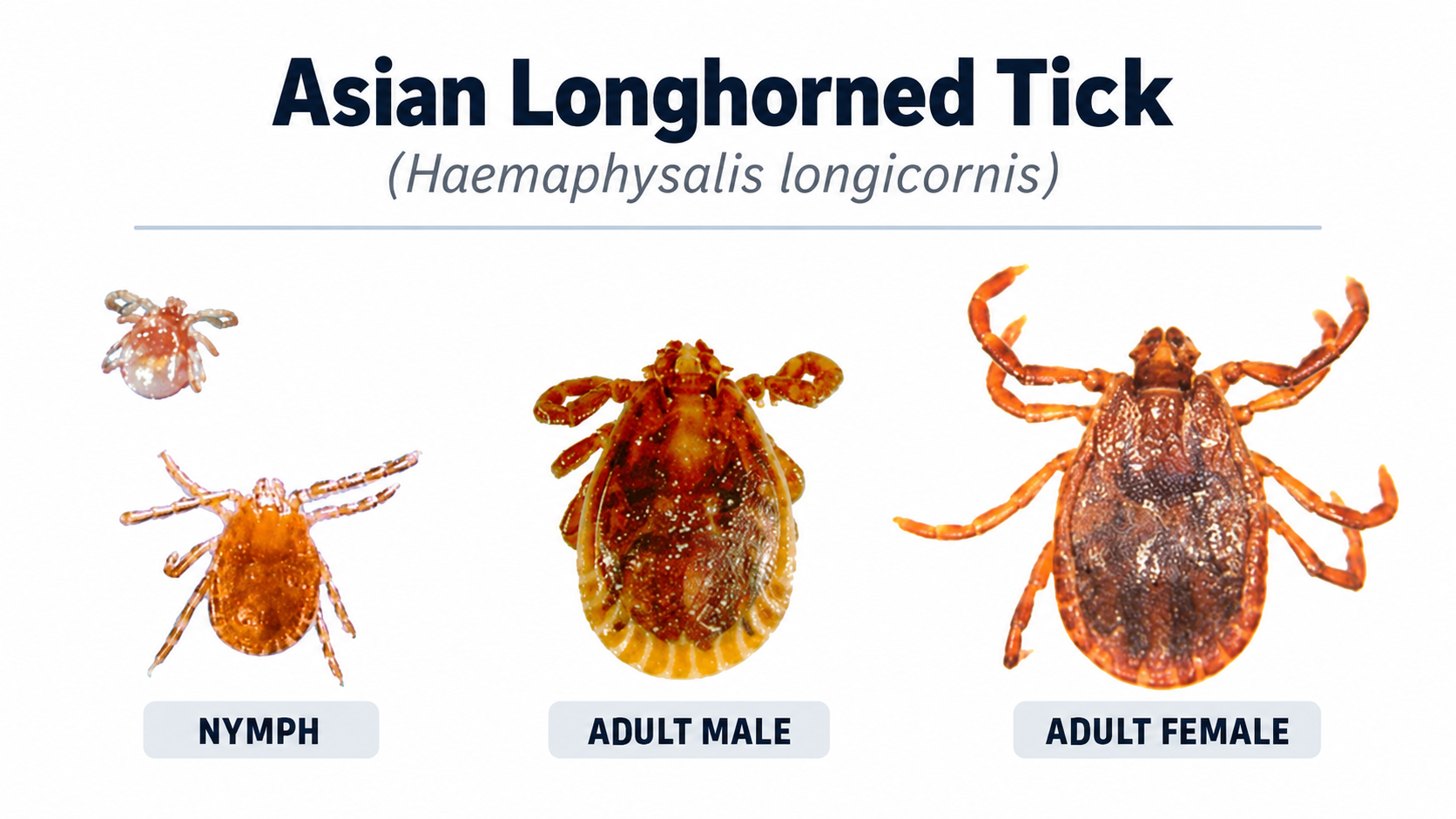
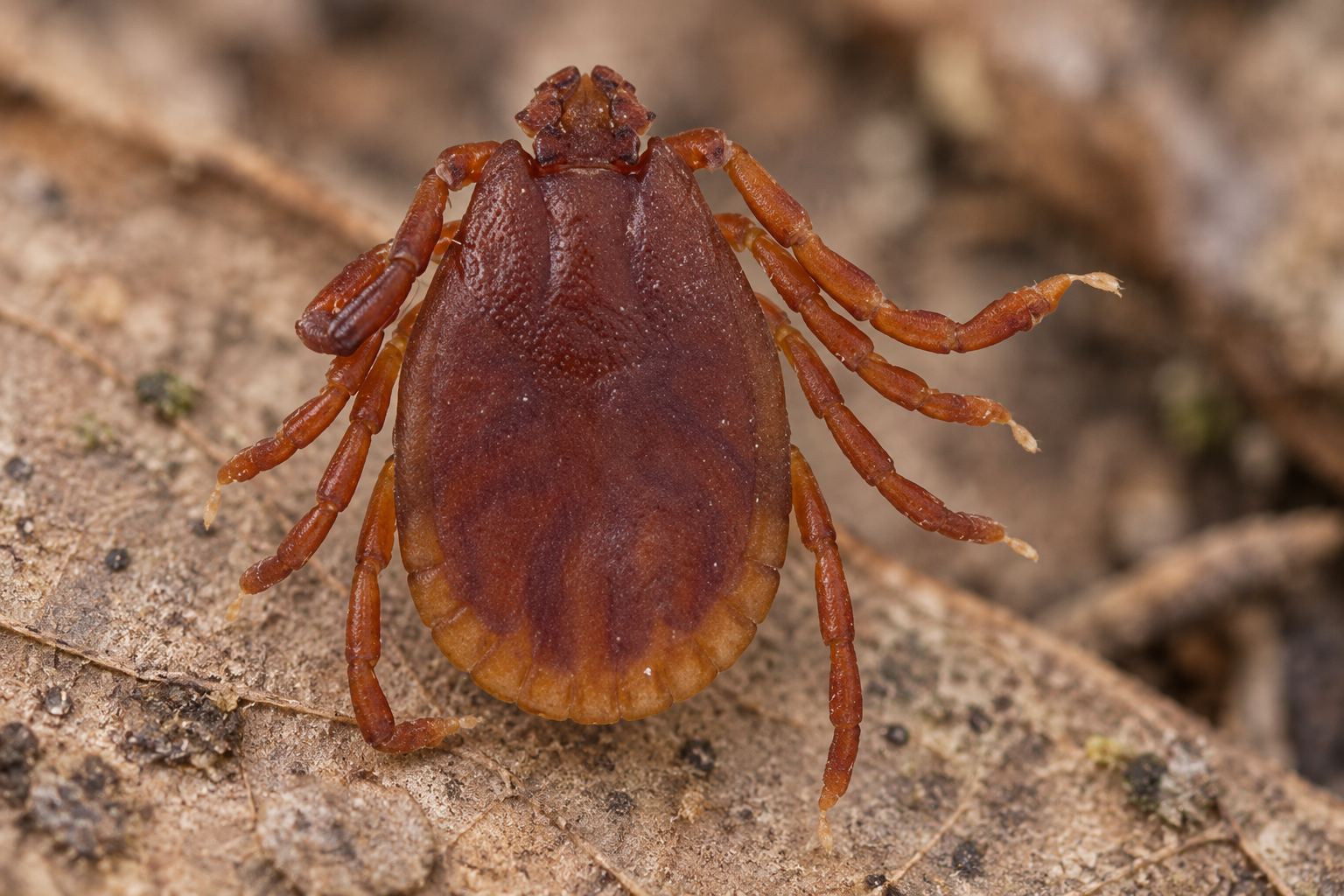
 Asian longhorned ticks are relatively small, generally reddish brown, and lack the conspicuous white or silvery ornamentation seen on ticks such as the American dog tick or Gulf Coast tick.
Unfed Asian longhorned ticks may range from light reddish-tan to dark reddish brown. After feeding, an adult female becomes dramatically enlarged and may appear gray-green with yellowish coloration, reaching approximately the size of a pea.
Adult Female
Typical features include:
- 8 legs
- Reddish-brown coloration when unfed
- Plain or inornate scutum
- Scutum covering only the front portion of the back
- Relatively short mouthparts
- Rectangular basis capituli
- No eyes
- Festoons along the rear edge of the body
- Oval body shape
- Abdomen capable of expanding dramatically during feeding
After taking a full blood meal, the adult female becomes much larger and may reach approximately the size of a pea.
Adult Male
Adult males:
- Have 8 legs
- Are generally reddish brown
- Have a plain or inornate appearance
- Have a scutum covering essentially the entire dorsal surface
- Do not enlarge dramatically during feeding
Male Asian longhorned ticks are rare in established U.S. populations.
Known established U.S. populations reproduce parthenogenetically, allowing females to reproduce without mating.
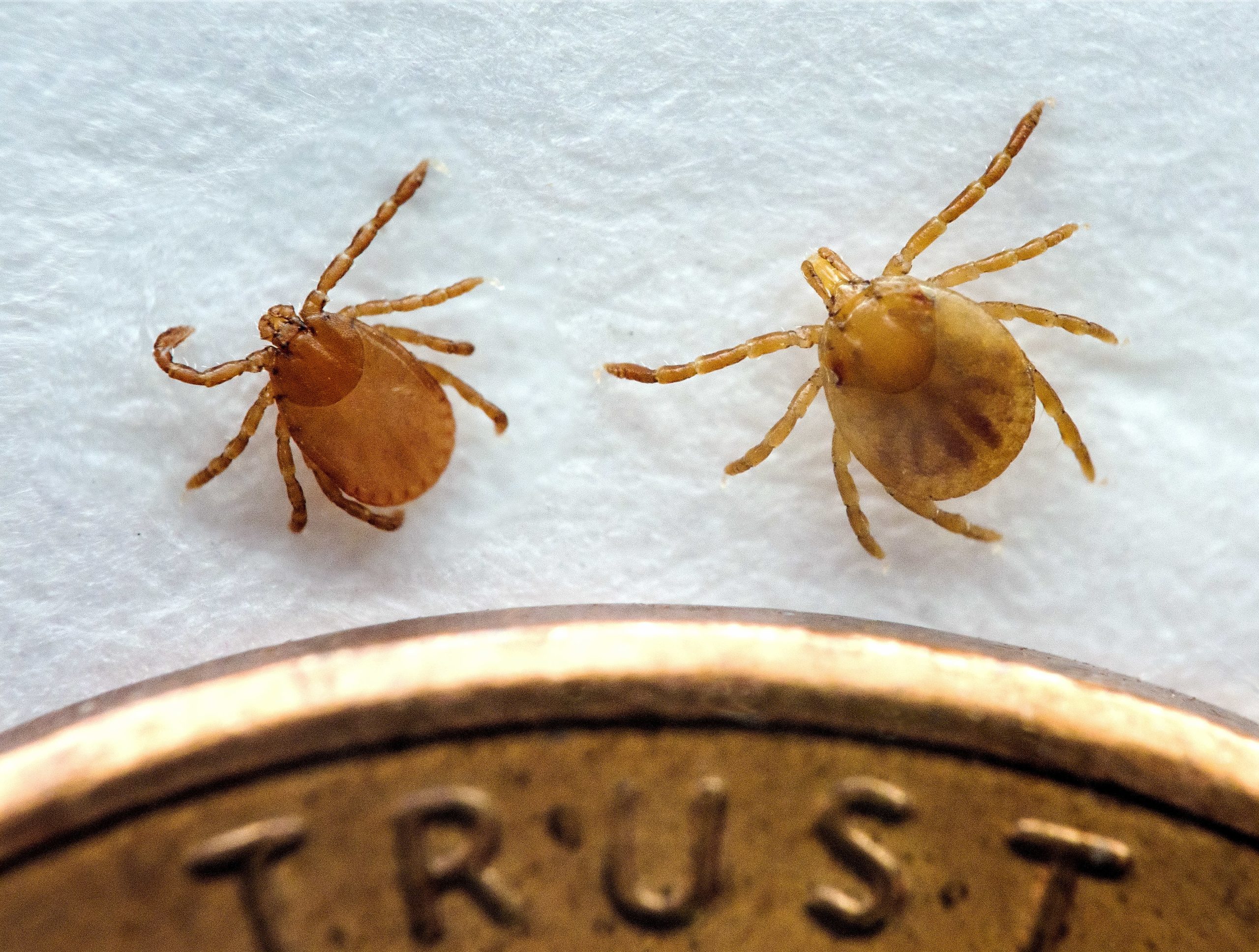
Nymph
Nymphs:
- Have 8 legs
- Are considerably smaller than adult females
- Are reddish brown
- Lack conspicuous ornamentation
- Are approximately sesame-seed sized or smaller
- Can be difficult to identify without magnification
Because of their small size and plain coloration, nymphs can resemble immature stages of other tick species.
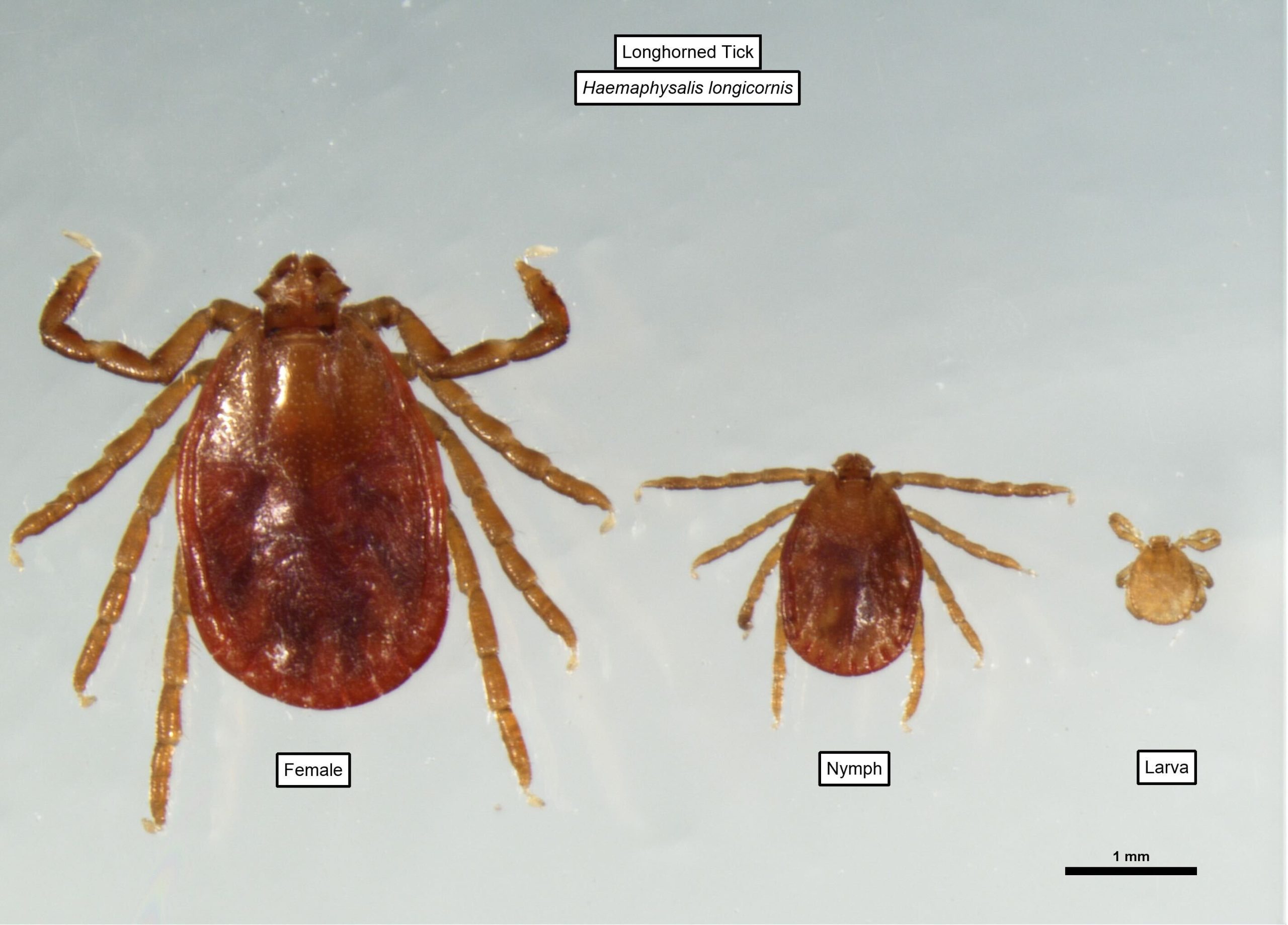
Larva
Larvae:
- Have 6 legs
- Are extremely small
- Are smaller than nymphs
- Feed on a host before dropping into the environment
- Later molt into eight-legged nymphs
Large concentrations of larvae may occur where Asian longhorned tick populations are well established.
Other Identification Features
Under magnification, Asian longhorned ticks characteristically have:
- Short mouthparts
- A relatively rectangular basis capituli
- Second palpal segments that project outward laterally
- A characteristic dorsal spur on the third palpal segment
- No eyes
- Festoons
- An inornate scutum
The outward-projecting second palpal segments are characteristic of the genus Haemaphysalis. The prominent dorsal spur on the third palpal segment is an important feature used to distinguish adult H. longicornis from closely related North American Haemaphysalis species.
Some of these characteristics are extremely small and require microscopic examination.
Using a magnifier can help make the tick’s mouthparts, scutum, legs, festoons, and other identification features easier to see.
Distinguishing It From Similar Ticks
The Asian longhorned tick can be difficult to distinguish from other small brown ticks.
It may especially be confused with native North American Haemaphysalis species, including:
Rabbit Tick
Haemaphysalis leporispalustris
and
Bird Tick
Haemaphysalis chordeilis
One useful distinguishing characteristic of adult H. longicornis is the prominent dorsal spur on the third palpal segment, but this feature generally requires magnification.
The Asian longhorned tick may also superficially resemble the brown dog tick, although their mouthpart structures differ.
Because these identifying characteristics can be subtle, reliable species-level identification may require microscopic examination or evaluation by someone trained in tick identification.
Geographic Distribution & Habitat
Geographic Distribution & Habitat The native range of the Asian longhorned tick includes:
- Eastern China
- Japan
- Korea
- Russian Far East
It has also become established outside its native range, including:
- Australia
- New Zealand
- Several western Pacific island nations
- United States
United States
The Asian longhorned tick was reported outside a U.S. port-of-entry inspection setting in Hunterdon County, New Jersey, in 2017.
Retrospective examination of archived specimens later demonstrated that the species had been present in the United States before its formal recognition, including a specimen collected from a white-tailed deer in West Virginia in 2010.
According to USDA’s May 27, 2026 information, Asian longhorned ticks have been collected throughout many areas of the eastern half of the United States, broadly extending:
From New York south to Georgia and west to Missouri.
USDA maintains county-level information showing locations with reported or established populations.
Because the species continues to spread and surveillance varies among locations, the absence of a reported population in a particular county should not automatically be interpreted as proof that the tick is absent.
Common Habitats
Asian longhorned ticks may occur in:
- Pastures
- Fields
- Meadows
- Grassy areas
- Tall or unmowed grass
- Brushy areas
- Forest and woodland edges
- Grassy patches near wooded areas
- Areas used by livestock
- Areas frequented by deer and other wildlife
They may also occur around residential or recreational properties where suitable vegetation and animal hosts are present.
Asian longhorned ticks locate hosts by questing on vegetation and attaching when an animal or person brushes past.
They do not jump or fly.
Life Cycle & Seasonal Activity
Life Cycle & Seasonal Activity The Asian longhorned tick has four developmental stages:
Egg → Larva → Nymph → Adult
It follows a three-host life cycle, meaning larvae, nymphs, and adults normally seek a host for each active feeding stage.
After feeding, the tick drops into the environment. Larvae and nymphs later molt into the next life stage, while fed adult females eventually lay eggs.
Larvae
Larvae:
- Have 6 legs
- Are extremely small
- Feed on animal hosts
- Drop from the host after feeding
- Later molt into nymphs
- Are generally most active during late summer and fall
Nymphs
Nymphs:
- Have 8 legs
- Are larger than larvae but smaller than adults
- Feed on wildlife and domestic animals
- Drop from the host after feeding
- Later molt into adults
- Are generally most active during spring
Adults
Adults:
- Have 8 legs
- Commonly feed on medium and large animals
- May infest cattle, sheep, goats, horses, dogs, deer, and other animals
- Can bite humans
- Are generally most active during summer
U.S. surveillance guidance generally summarizes host-seeking activity as:
Nymphs — Spring
Adults — Summer
Larvae — Late Summer and Fall
Activity periods may overlap, and exact timing varies by location and environmental conditions.
Unusual Reproductive Biology
One of the most important characteristics of the Asian longhorned tick is its ability to reproduce by parthenogenesis.
Known established U.S. populations are parthenogenetic.
This means an adult female can:
- Feed on a host
- Drop into the environment
- Lay eggs
- Produce offspring without first mating with a male
A single adult female may lay up to approximately 2,000 eggs.
This reproductive strategy allows Asian longhorned tick populations to increase rapidly and helps explain why extremely heavy infestations can sometimes develop.
Hosts
Asian longhorned ticks have been found on a wide variety of animals in the United States, including:
- Cattle
- Sheep
- Goats
- Horses
- Dogs
- Cats
- White-tailed deer
- Elk
- Black bears
- Raccoons
- Opossums
- Coyotes
- Foxes
- Groundhogs
- Rabbits
- Birds
- Humans
The species therefore has a broad host range, although host use varies according to geographic location and life stage.
Seasonal Activity
According to USDA’s May 27, 2026 information, Asian longhorned ticks are generally active from approximately:
March through November
Exact activity varies according to:
- Geographic location
- Temperature
- Weather
- Humidity
- Life stage
- Year-to-year conditions
For a national website, the most accurate summary is:
Asian longhorned ticks may be active from early spring through late fall, with nymphs generally most active in spring, adults in summer, and larvae in late summer and fall.
Diseases & Health Risks
Diseases & Health Risks Research into the human-health importance of the Asian longhorned tick in the United States is continuing.
It is essential to distinguish among:
Pathogen Detection
Finding genetic material from a pathogen in a tick.
Laboratory Vector Competence
Experimentally demonstrating that a tick can acquire, maintain, and transmit a pathogen.
Natural Transmission
Demonstrating that a tick species participates in real-world transmission of a pathogen to people or animals.
These findings are not interchangeable.
At present, Asian longhorned ticks should not be presented as established natural U.S. vectors of the human pathogens discussed below.
Heartland Virus — Laboratory Vector Competence
Cause: Heartland virus
The lone star tick (Amblyomma americanum) is primarily associated with natural transmission of Heartland virus in the United States.
However, Asian longhorned ticks have been shown to be competent vectors of Heartland virus under laboratory conditions.
This means they can acquire and transmit Heartland virus experimentally.
It does not establish that Asian longhorned ticks are currently responsible for natural human Heartland virus infections in the United States.
Rocky Mountain Spotted Fever — Laboratory Competence & Field Detection
Cause: Rickettsia rickettsii
Laboratory studies have demonstrated that Asian longhorned ticks can acquire, maintain, and transmit Rickettsia rickettsii, the bacterium that causes Rocky Mountain spotted fever (RMSF).
In 2025, researchers reported the first detection of R. rickettsii in field-collected Asian longhorned ticks in North America, based on surveillance in New Jersey.
This finding is important, but it does not by itself demonstrate natural transmission to people.
Therefore:
Asian longhorned ticks have demonstrated laboratory vector competence for R. rickettsii, and the bacterium has been detected in field-collected U.S. Asian longhorned ticks, but natural human transmission by this tick species has not been established.
Powassan Virus — Laboratory Vector Competence
Laboratory research has demonstrated that Asian longhorned ticks can acquire and transmit Powassan virus.
Experimental studies have demonstrated horizontal, transstadial, and vertical transmission under laboratory conditions.
However:
Natural transmission of Powassan virus to people by Asian longhorned ticks has not been established in the United States.
Native Ixodes ticks remain the recognized vectors involved in natural Powassan virus transmission in the United States.
Lyme Disease — Important Clarification
Cause: Borrelia burgdorferi
USDA states that Asian longhorned ticks are not competent vectors of Borrelia burgdorferi, the principal bacterium responsible for Lyme disease in the United States.
Experimental research found that Asian longhorned tick larvae could acquire B. burgdorferi while feeding, but the bacteria did not persist effectively through the molt into the nymphal stage.
Field-collected Asian longhorned ticks have occasionally tested positive for B. burgdorferi DNA.
For example, a June 2025 CDC Emerging Infectious Diseases report evaluated 445 Asian longhorned ticks — 357 nymphs and 88 adult females — from southwestern Connecticut. Two nymphs tested positive for B. burgdorferi DNA.
Detection of bacterial DNA in a tick is not the same as demonstrating that the tick can transmit the bacterium to a person.
Therefore, Asian longhorned ticks are not considered an important U.S. Lyme disease vector.
The principal U.S. Lyme disease vectors remain:
- Ixodes scapularis — Blacklegged Tick
- Ixodes pacificus — Western Blacklegged Tick
Anaplasmosis — Important Clarification
Cause: Anaplasma phagocytophilum
USDA states that Asian longhorned ticks are not competent vectors of Anaplasma phagocytophilum, the primary cause of human granulocytic anaplasmosis.
Experimental research found inefficient maintenance of the pathogen through the molt, and infected adult Asian longhorned ticks in the study failed to transmit the organism to naïve hosts.
Genetic material from A. phagocytophilum has been detected in some field-collected Asian longhorned ticks, but pathogen detection does not establish vector competence or natural transmission.
Therefore:
Asian longhorned ticks should not be presented as an established U.S. vector of human anaplasmosis.
Ehrlichia chaffeensis — Emerging Research Finding
Cause: Ehrlichia chaffeensis
A June 2025 CDC Emerging Infectious Diseases study detected Ehrlichia chaffeensis DNA in one field-collected Asian longhorned tick nymph from southwestern Connecticut.
- chaffeensis causes human monocytic ehrlichiosis.
However:
Detection of E. chaffeensis DNA does not demonstrate that Asian longhorned ticks can naturally transmit the bacterium to people.
The principal established U.S. vector of E. chaffeensis remains the:
Amblyomma americanum — Lone Star Tick
The possible role of the Asian longhorned tick remains under investigation.
Bourbon Virus — Field Detection
Cause: Bourbon virus
Bourbon virus RNA has been detected in field-collected Asian longhorned ticks in Virginia.
These findings show that Asian longhorned ticks can encounter or acquire Bourbon virus under natural field conditions.
However:
Detection of Bourbon virus RNA does not establish that Asian longhorned ticks are competent vectors or that they naturally transmit Bourbon virus to people.
Their possible role in the natural transmission cycle remains under investigation.
Babesia microti — Field Detection
Cause: Babesia microti
Genetic material associated with Babesia microti has been reported in field-collected Asian longhorned ticks in the United States.
However, pathogen detection does not establish that Asian longhorned ticks can efficiently acquire, maintain, and transmit B. microti to people.
The principal recognized U.S. vector of B. microti is the:
Ixodes scapularis — Blacklegged Tick
Therefore:
Asian longhorned ticks should not be presented as an established U.S. vector of human babesiosis.
Important Veterinary Health Risk
Bovine Theileriosis
Cause: Theileria orientalis Ikeda genotype
One of the most important confirmed U.S. disease concerns associated with the Asian longhorned tick involves cattle rather than humans.
U.S. Asian longhorned ticks have successfully transmitted Theileria orientalis Ikeda to cattle under laboratory conditions, and the parasite has also been detected in field-collected Asian longhorned ticks.
- orientalis Ikeda can cause bovine theileriosis, a potentially serious disease of cattle.
Possible Signs in Cattle
Signs may include:
- Weakness
- Fever
- Anemia
- Pale or yellowish mucous membranes
- Loss of appetite
- Difficulty breathing
- Reduced milk production
- Reluctance to walk
- Foamy nasal discharge
- Abortion or pregnancy loss
- Death in severe cases
Theileria orientalis is not known to be a human pathogen.
Heavy Tick Infestations & Blood Loss
Asian longhorned ticks can reproduce rapidly and may occur in extremely large numbers on an individual animal.
Severe infestations can cause:
- Significant blood loss
- Anemia
- Stress
- Weakness
- Reduced growth
- Reduced livestock productivity
- Death in severe infestations
The Asian longhorned tick is therefore considered a serious livestock pest.
Important Disease Clarification
Research on Asian longhorned ticks in the United States continues to evolve.
A pathogen being detected inside an Asian longhorned tick does not automatically mean the tick can transmit it to a person.
Likewise, demonstrating pathogen transmission in a laboratory does not necessarily mean the tick is currently spreading that pathogen to people under natural U.S. conditions.
Important to Know
Finding an Asian longhorned tick does not automatically mean that it carries a pathogen or that disease transmission occurred.
The human-health importance of this invasive species in the United States remains an active area of research.
Bite Prevention & Protection
Bite Prevention & Protection When Outdoors
To reduce the chance of tick bites:
- Avoid direct contact with tall grass, brush, and dense vegetation when practical.
- Walk near the center of maintained trails.
- Use an EPA-registered insect repellent according to label instructions.
- Treat clothing and outdoor gear with products containing 0.5% permethrin, or use commercially pretreated clothing.
- Wear long pants, long sleeves, socks, and closed shoes when practical.
- Light-colored clothing can make crawling ticks easier to see.
Do not apply permethrin products intended for clothing and gear directly to the skin.
After Outdoor Activity
Perform a thorough tick check.
Pay particular attention to:
- In and around the hair
- In and around the ears
- Under the arms
- Around the waist
- Inside the belly button
- Behind the knees
- Between the legs
Also inspect:
- Children
- Pets
- Clothing
- Backpacks
- Outdoor equipment
Showering within two hours after coming indoors may help wash away unattached ticks and provides a good opportunity to perform a complete body check.
Ticks can also remain on clothing. Dry clothing may be placed in a dryer on high heat for approximately 10 minutes after coming indoors. Damp clothing may require additional drying time.
Protect Pets & Livestock
Because Asian longhorned ticks frequently infest animals:
- Check pets and livestock regularly for ticks.
- Pay particular attention to protected areas around the ears, neck, legs, underside, and other areas where ticks may be difficult to see.
- Consult a veterinarian about appropriate tick-control products.
- Investigate unusually heavy infestations promptly.
- Contact a veterinarian if cattle develop unexplained weakness, fever, anemia, difficulty breathing, reduced appetite, or other concerning signs.
Regular tick control and surveillance are especially important for livestock in areas where Asian longhorned ticks occur.
Around Properties & Pastures
Environmental tick-management measures may include:
- Mowing tall grass
- Managing overgrown vegetation
- Removing excessive understory vegetation
- Reducing excessive shade where appropriate
- Managing woodland edges
- Creating mulch barriers in appropriate locations
- Applying approved acaricides according to label directions and applicable State or local regulations when appropriate
If You Find an Attached Tick
Remove it as soon as possible.
Current CDC guidance emphasizes that an attached tick should be removed promptly rather than waiting to see a healthcare provider.
How to Remove a Tick
- Use clean fine-tipped tweezers when available.
- Grasp the tick as close to the skin’s surface as possible.
- Pull the tick away from the skin with steady, even pressure.
- Do not twist or jerk the tick.
- If mouthparts remain and can be removed easily with tweezers, remove them. If they cannot be removed easily, leave them alone and allow the skin to heal.
- Dispose of the tick safely.
- Thoroughly clean the bite area and your hands.
- Check the rest of your body for additional ticks.
Do not attempt to make the tick detach by using:
- Petroleum jelly
- Nail polish
- Heat
- Other substances or chemicals
Prompt mechanical removal is preferred.
Tick Testing
CDC generally does not recommend commercial testing of removed ticks to guide treatment decisions.
A positive tick test does not prove that infection was transmitted, while a negative result can provide false reassurance.
If a rash or fever develops during the following days or weeks, contact a healthcare provider and mention:
- The recent tick bite
- When it occurred
- Where the tick exposure most likely occurred
Identification Gallery
Identification Gallery Adult Female — Unfed
- Reddish-brown body
- Plain appearance
- Scutum covers the front portion of the back
- Short mouthparts
- 8 legs
Adult Female — Engorged
- Greatly enlarged after feeding
- Can become about pea-sized
- Often gray-green or lighter in color
- Small scutum remains visible at the front
Nymph
- Small reddish-brown body
- Plain appearance
- 8 legs
Larva
- Extremely small
- 6 legs
Adult Male
- Reddish-brown body
- Scutum covers nearly the entire back
- 8 legs
- Rare in established U.S. populations
Male vs. Female
- Female: scutum only at the front; abdomen expands greatly after feeding
- Male: scutum covers nearly the entire back
Mouthpart Close-Up
Show the short mouthparts and key microscopic features used for identification.
Life Stages
Egg → 6-legged Larva → 8-legged Nymph → Adult Female
Size Comparison
Larva → Nymph → Adult Female → Engorged Female
Similar Species
Compare with:
- Rabbit Tick
- Bird Tick
- Brown Dog Tick
Note: Asian longhorned ticks are small, brown, and lack a distinctive marking, so magnification may be needed for reliable identification.