
Babesia duncani Babesiosis: A Rare Western U.S. Tick-Borne Infection
Babesia duncani is a microscopic protozoan parasite that infects red blood cells and can cause babesiosis in humans.
It is a recognized but very rare cause of human babesiosis in the United States, distinct from Babesia microti, which causes the great majority of reported U.S. babesiosis cases. CDC recognizes B. duncani as a human-infecting Babesia species and reports that it has been isolated from patients in Washington and California.
Published historical case literature has documented confirmed B. duncani infections along the Pacific Coast of the United States, including California, Oregon, and Washington.
CDC’s 2025 babesiosis surveillance case definition, which remains the current surveillance case definition, states that B. duncani is transmitted by the winter tick (Dermacentor albipictus). Ecological research provides evidence supporting the winter tick as the parasite’s enzootic vector.
What Causes Babesia duncani Babesiosis?
The infection is caused by:
Babesia duncani
Babesia parasites are protozoan parasites that invade and reproduce within red blood cells.
Although numerous Babesia species infect animals, only a relatively small number have been recognized as causes of human infection.
Human-infecting Babesia organisms reported in the United States include:
- Babesia microti
- Babesia duncani
- Babesia divergens or B. divergens-like organisms
- The currently unnamed MO-1 strain
- microti is by far the most frequently identified cause of human babesiosis in the United States.
Former Name: WA1
Babesia duncani was originally known as the WA1-type parasite after the organism was first isolated in 1991 from a patient in Washington State.
Detailed morphologic, ultrastructural, biologic, and genetic studies subsequently demonstrated that WA1 represented a distinct species.
In 2006, it was formally described as Babesia duncani.
Which Tick Is Associated With Babesia duncani Transmission?
The tick currently identified by CDC for B. duncani is the:
Winter Tick (Dermacentor albipictus)
CDC’s 2025 babesiosis surveillance case definition states that B. duncani is transmitted by Dermacentor albipictus.
Ecological research also provides evidence supporting the winter tick as the enzootic vector involved in maintaining B. duncani in nature.
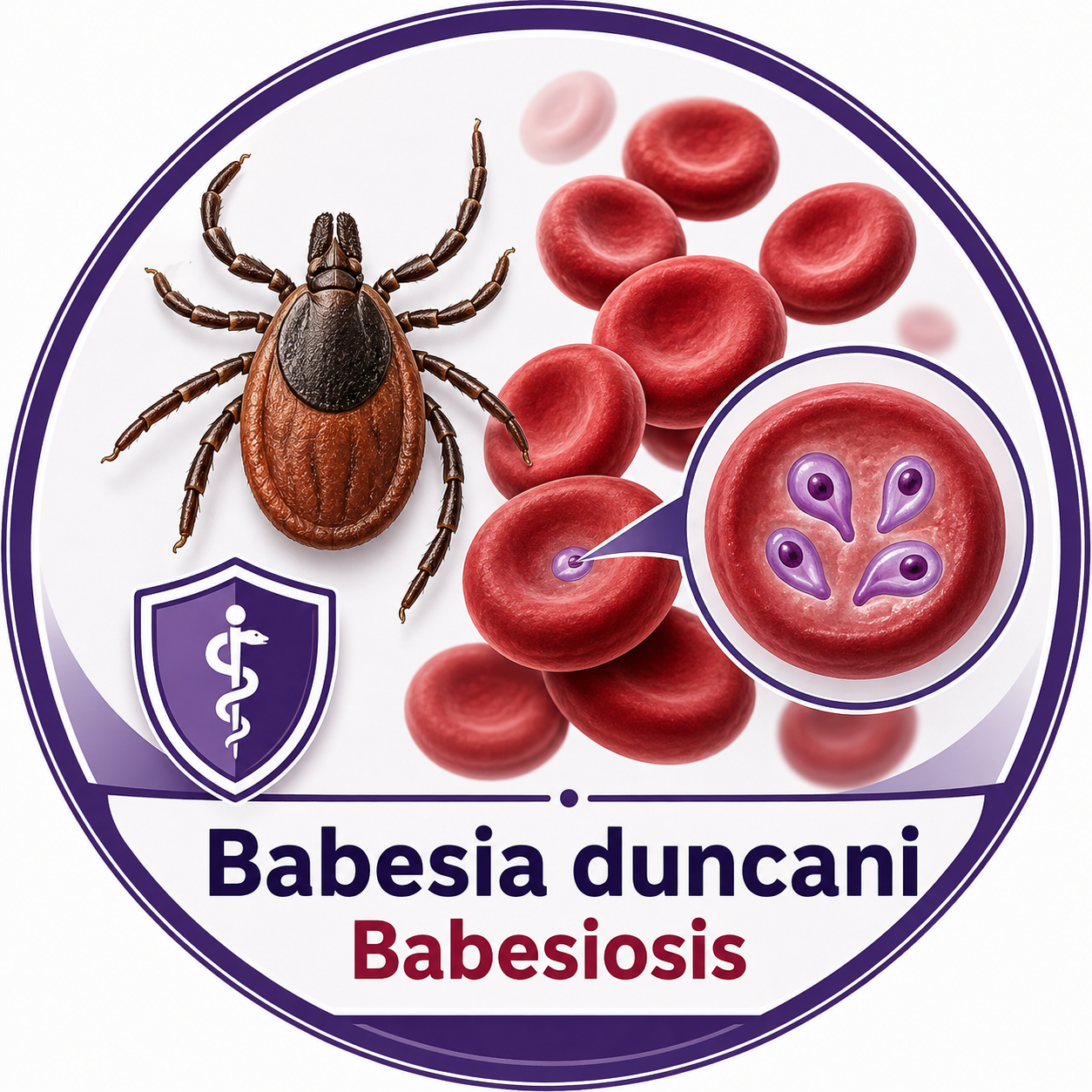
This differs from the transmission cycle responsible for most U.S. babesiosis.
- microti
Primarily transmitted in the United States by:
Ixodes scapularis
Blacklegged tick / deer tick
- duncani
CDC identifies:
Dermacentor albipictus
Winter tick
Therefore, information established for the B. microti–Ixodes scapularis transmission cycle should not automatically be applied to B. duncani.
An Important 2025 Research Finding
A 2025 Northern California field study detected B. duncani DNA in collected ticks and reported B. duncani in Ixodes pacificus, the western blacklegged tick.
However:
Detection of parasite DNA in a tick does not by itself establish vector competence.
Finding B. duncani DNA in I. pacificus does not prove that I. pacificus can biologically acquire, maintain, and transmit the parasite to humans.
Earlier experimental work reviewed in the B. duncani ecology literature did not demonstrate transmission by I. pacificus.
Therefore, the 2025 finding should not be interpreted as establishing the western blacklegged tick as a confirmed human vector of B. duncani.
CDC’s current surveillance case definition continues to identify Dermacentor albipictus for B. duncani.
Additional research is needed to determine the significance of B. duncani detection in other tick species.
What Animal Maintains the Parasite?
Research into the natural ecology of B. duncani has identified the:
Mule Deer (Odocoileus hemionus)
as a likely reservoir host involved in maintaining the parasite’s natural transmission cycle.
The ecological investigation that provided evidence supporting D. albipictus as the enzootic vector also concluded that the mule deer is likely the reservoir host.
Because the ecology of B. duncani has been studied much less extensively than that of B. microti, additional research is needed to fully define its reservoir hosts, geographic range, and natural transmission cycle.
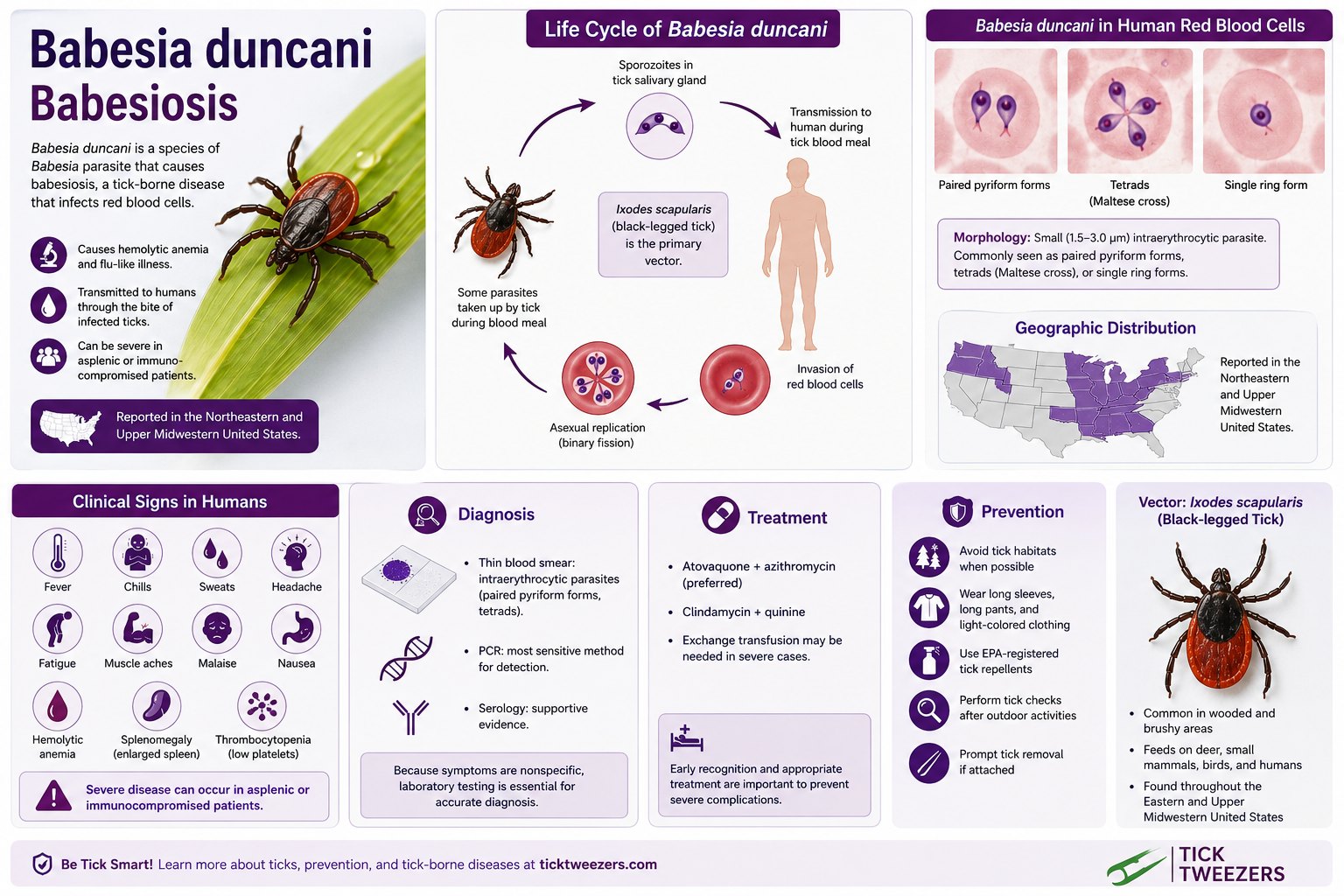
How Long Must a Tick Be Attached?
A minimum attachment time for human transmission of Babesia duncani has not been established.
CDC states that Ixodes scapularis nymphs usually must remain attached to a person for more than 36–48 hours to transmit the Babesia parasite in the usual U.S. babesiosis transmission context.
That figure pertains to I. scapularis and the predominantly B. microti transmission cycle.
It should not be presented as an established transmission-time threshold for B. duncani transmitted by Dermacentor albipictus.
CDC does not currently provide a specific minimum attachment duration for human transmission of B. duncani by the winter tick.
Attached ticks should therefore be removed promptly and properly.
Where Does Babesia duncani Occur?
Human B. duncani babesiosis has historically been associated with the western United States, particularly the Pacific Coast.
CDC DPDx reports that B. duncani has been isolated from patients in:
- Washington
- California
Published historical case literature includes confirmed infections from:
- California
- Oregon
- Washington
However, the complete geographic distribution of B. duncani remains less clearly defined than that of B. microti.
The winter tick has a broader geographic range than the locations where historically confirmed human B. duncani infections have been reported.
Therefore, the presence of D. albipictus in an area does not by itself establish that human B. duncani transmission occurs there.
How Common Is Babesia duncani?
Recognized human disease appears to be very rare.
CDC’s current babesiosis surveillance case definition states that U.S. cases caused by B. duncani and other non-microti Babesia species have been described very rarely.
A published ecological review identified 12 confirmed historical human cases and two presumed earlier cases in the literature available when that analysis was conducted.
That historical literature count should not be interpreted as a current national case total.
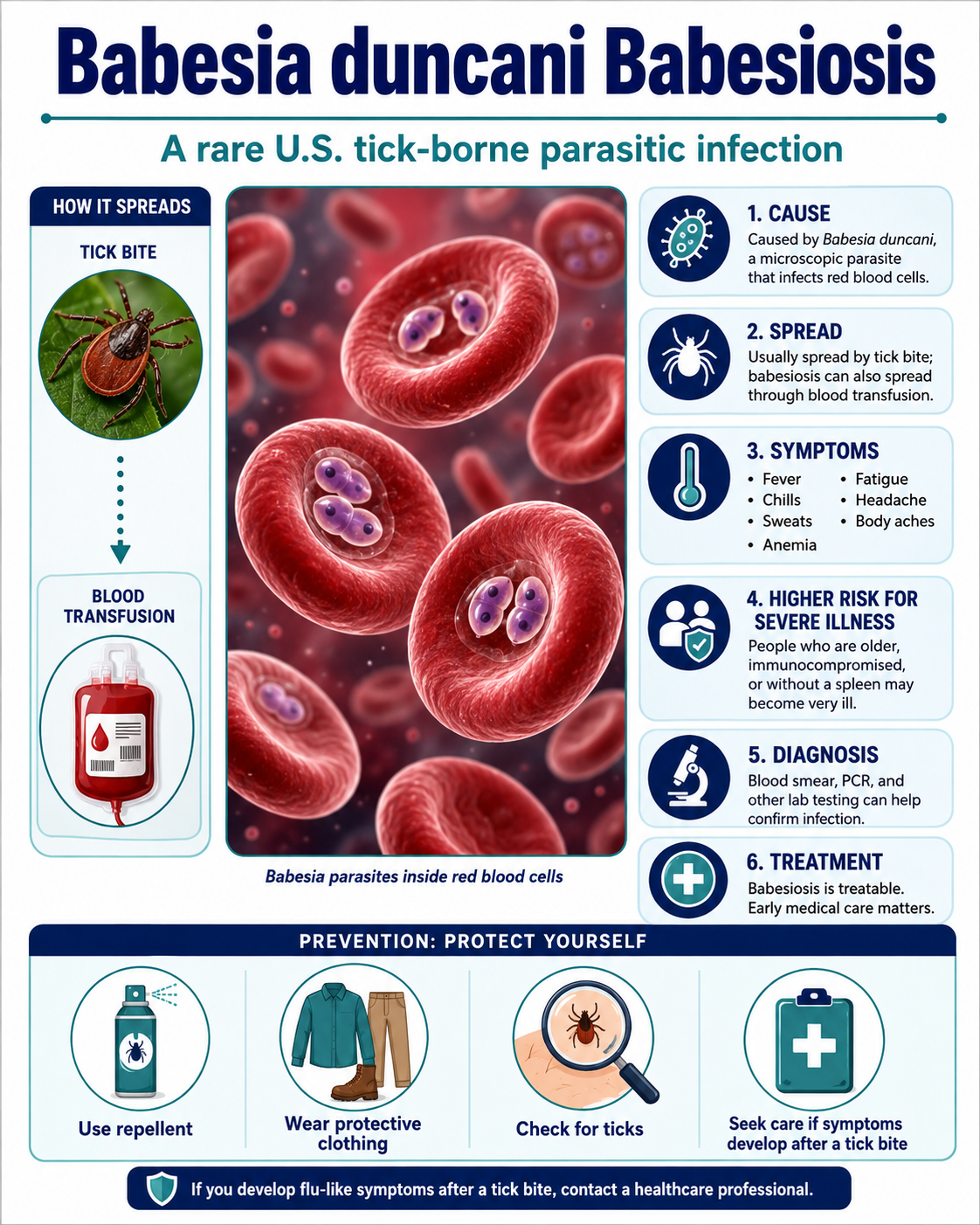
There is no routine CDC public dashboard providing a current annual case count specifically for B. duncani, and national U.S. babesiosis statistics are overwhelmingly driven by B. microti.
Signs and Symptoms
CDC’s symptom guidance applies to babesiosis generally.
Because recognized human B. duncani infections are rare, there is not a large species-specific clinical dataset comparable with that available for B. microti.
Babesiosis can range from asymptomatic infection to severe and potentially life-threatening illness.
Possible symptoms include:
- Fever
- Chills
- Sweats
- Headache
- Body or muscle aches
- Weakness
- Fatigue
- Loss of appetite
- Nausea
Because Babesia parasites infect and damage red blood cells, babesiosis can also cause:
- Hemolytic anemia
- Jaundice
- Dark urine
CDC DPDx also describes manifestations including fever, chills, sweating, myalgias, fatigue, hepatosplenomegaly, and hemolytic anemia.
These findings are best described as features of babesiosis generally, rather than implying that every clinical feature has been independently quantified specifically for B. duncani.
When Do Symptoms Begin?
CDC states that babesiosis symptoms may take weeks or months to develop and can sometimes appear even later.
CDC DPDx describes a typical general babesiosis incubation period of approximately:
1–4 Weeks
However, because relatively few human B. duncani infections have been characterized, there is not a well-established species-specific incubation period for B. duncani based on a large human dataset.
Therefore, 1–4 weeks should be presented as general babesiosis information, rather than an exact incubation period established uniquely for B. duncani.
Can Babesia duncani Cause Severe Disease?
Yes.
Serious B. duncani infections have been reported in the human case literature.
Because the number of confirmed cases is small and published reports can disproportionately represent clinically recognized or severe infections, the literature cannot reliably establish a population-wide B. duncani-specific severity rate.
For babesiosis generally, CDC identifies increased risk of severe disease and/or relapse among people with factors including:
- Asplenia or hyposplenia
- Advanced age
- HIV infection
- Cancer, especially B-cell lymphoma or similar malignancy
- Immunosuppressive medications, particularly drugs such as rituximab
- Other causes of impaired immune function
- Serious heart, liver, or kidney disease
Severe babesiosis can involve:
- Severe hemolytic anemia
- Thrombocytopenia
- Disseminated intravascular coagulation
- Hemodynamic instability
- Acute respiratory distress
- Kidney failure
- Hepatic compromise
- Altered mental status
- Other serious organ complications
- Death
These severe-disease risks and complications are established for babesiosis generally and should not be interpreted as B. duncani-specific risk percentages.
Can Babesia duncani Be Transmitted Through Blood Transfusion?
Yes.
Transfusion transmission of Babesia duncani has been documented.
A published investigation described a 59-year-old California resident with sickle cell disease whose identified risk factor for B. duncani infection was receipt of red-blood-cell transfusions.
The investigation implicated an asymptomatic California blood donor, and the patient’s infection was described as the third documented transfusion-transmitted B. duncani case at that time.
This illustrates an important feature of babesiosis:
People can carry Babesia parasites in their blood without obvious symptoms.
Asymptomatic parasitemia can create the potential for transmission through donated blood.
CDC’s current surveillance case definition notes that an FDA-approved nucleic-acid blood-donor screening test detects multiple Babesia species, including:
- B. microti
- B. duncani
- B. divergens
- B. venatorum
Is It Contagious From Person to Person?
Babesiosis does not ordinarily spread through casual person-to-person contact like influenza or the common cold.
Recognized routes by which babesiosis can be acquired include:
- Tick bites
- Blood transfusion
- Rare maternal-to-infant transmission during pregnancy or around the time of birth
Transfusion transmission of B. duncani itself has been documented.
However, the evidence for maternal-to-infant transmission primarily concerns babesiosis generally and particularly B. microti.
Therefore, maternal-to-infant transmission should not automatically be presented as a documented B. duncani-specific route without species-specific evidence.
How Is Babesia duncani Diagnosed?
Diagnosis of babesiosis may involve several laboratory approaches.
Blood Smear
A healthcare professional or laboratory can examine a stained peripheral blood smear for parasites inside red blood cells.
Babesia parasites may appear as:
- Ring forms
- Pleomorphic forms
- Pyriform forms
- Occasionally tetrads known as Maltese-cross forms
CDC DPDx includes a blood-smear image of B. duncani showing a tetrad form.
However:
Blood-smear morphology cannot reliably identify the exact Babesia species.
CDC DPDx specifically states that Babesia species cannot be identified to the species level by morphology alone and recommends additional testing, such as PCR.
PCR / Molecular Testing
Molecular testing can detect Babesia DNA and can be especially useful when species identification is important.
CDC recommends considering confirmation through a reference laboratory, including molecular and/or serologic methods tailored to the clinical setting and suspected species.
For suspected non-microti infections such as B. duncani, species-level confirmation is particularly important because assays targeting B. microti do not necessarily identify other Babesia species.
Antibody Testing
CDC’s 2025 babesiosis surveillance case definition recognizes:
- duncani IgG or total-antibody IFA titer ≥1:512
as supportive laboratory evidence for public-health surveillance purposes.
This threshold is a surveillance criterion.
It should not be interpreted as a stand-alone clinical diagnostic threshold.
CDC notes that antibodies may indicate active or previously resolved infection, and laboratory findings should be interpreted together with symptoms and exposure information whenever possible.
CDC further states that although a single IgG result may satisfy surveillance criteria, molecular testing or blood-smear examination is recommended for clinical diagnosis, especially when a species other than B. microti is suspected.
Is Babesiosis Nationally Notifiable?
Yes.
Babesiosis remains a nationally notifiable condition within the U.S. National Notifiable Diseases Surveillance System framework.
CDC’s current surveillance case definition applies to Babesia spp., rather than limiting surveillance to B. microti.
Beginning with the 2025 NNDSS tables, babesiosis was removed from the weekly published tables, but CDC states that it remains in the annual tables. This remains the reporting arrangement in 2026.
National babesiosis statistics should not be interpreted as B. duncani-specific totals, because B. microti causes the great majority of reported U.S. cases.
How Is Babesiosis Treated?
Treatment requires careful clinical and species-specific interpretation.
CDC states that treatment of symptomatic babesiosis typically involves:
Preferred Regimen
Atovaquone + azithromycin
Alternative Regimen
Clindamycin + quinine
For ill patients with competent immune systems, treatment generally lasts at least 7–10 days.
Highly immunocompromised patients may require much longer therapy. CDC notes that treatment may be needed for at least six consecutive weeks or longer in some highly immunocompromised patients, with continued treatment until parasites are no longer detected on blood smears for two consecutive weeks.
Importantly, CDC states:
Treatment may differ depending on the Babesia species.
Because recognized human B. duncani infections are rare, evidence defining an optimal species-specific treatment regimen is much more limited than the evidence available for B. microti.
Treatment should therefore be directed by a qualified healthcare professional, particularly when B. duncani or another uncommon Babesia species is suspected.
Treatment of Severe Babesiosis
Patients with severe babesiosis may require hospitalization and supportive treatment.
CDC notes that supportive care may include:
- Antipyretics
- Blood transfusion
- Vasopressor support for low or unstable blood pressure
- Mechanical ventilation
- Dialysis
- Exchange transfusion in selected severe cases
CDC states that exchange transfusion is typically used with:
- High-grade parasitemia (>10%), or
- Moderate-to-high-grade parasitemia accompanied by severe hemolytic anemia or declining pulmonary, renal, or hepatic function
These recommendations apply to severe babesiosis generally and are not a treatment protocol developed specifically for B. duncani.
Should Someone Without Symptoms Be Treated?
CDC states that most asymptomatic patients do not require treatment.
Treatment decisions should be individualized, particularly for people who have or are at risk for severe or relapsing infection.
A healthcare professional should determine whether treatment is appropriate based on symptoms, laboratory findings, immune status, clinical circumstances, and the suspected Babesia species.
Is There a Vaccine?
No.
There is currently no approved human vaccine for babesiosis.
Avoiding tick bites remains the primary prevention strategy.
How to Reduce the Risk of Tick Bites
General CDC tick-prevention measures include:
- Use an EPA-registered insect repellent as directed.
- Treat clothing and gear with products containing 0.5% permethrin, following product instructions.
- Avoid grassy, brushy, wooded, and leaf-litter areas when practical.
- Walk in the center of clear trails.
- Check your clothing and gear after outdoor activity.
- Check pets for ticks.
- Perform a full-body tick check after being outdoors.
- Shower after outdoor activity.
- Remove attached ticks promptly with fine-tipped tweezers.
CDC’s babesiosis prevention page states that I. scapularis nymphs usually need to remain attached for more than 36–48 hours to transmit the parasite.
Again, this should not be presented as an established B. duncani–Dermacentor albipictus transmission threshold.
Selected Recent Research on Babesia duncani
Research on B. duncani remains active. Recent studies are improving understanding of parasite biology, host interactions, potential drug targets, and possible vaccine or diagnostic candidates.
These studies are experimental research and have not established new standard clinical recommendations for human B. duncani infection.
2026: Vesicle-Associated Immunodominant Antigens
A study published online June 3, 2026, in Infection and Immunity investigated proteins exported by B. duncani and vesicles released from infected red blood cells.
Researchers screened 105 known or predicted secreted or surface-associated proteins and identified 11 immunodominant antigens across their experimental screening approaches.
Further work demonstrated that selected antigens were associated with vesicles produced by B. duncani-infected red blood cells.
The findings may help researchers better understand:
- Parasite-host interactions
- Immune recognition of B. duncani
- Parasite antigen export
- Potential future diagnostic targets
- Potential future vaccine targets
However, this was laboratory and experimental research.
It did not establish:
- A new approved diagnostic test
- A human vaccine
- A new standard treatment
- An increase in human B. duncani cases
- Geographic expansion of documented human disease
2026: Experimental Acridone Drug Research
A study published online April 27, 2026, in Antimicrobial Agents and Chemotherapy evaluated experimental compounds called acridones against human-infecting Babesia parasites.
Several acridone derivatives demonstrated potent in-vitro activity against:
- Babesia duncani
- Babesia divergens
Selected compounds were then advanced into preliminary mouse studies involving B. duncani and B. microti.
However:
The in-vivo results were not therapeutically successful.
Representative acridone compounds did not achieve parasite clearance in the tested mouse models.
The findings provide chemical information that may assist future drug-development and optimization efforts, but the compounds require substantially more research.
These compounds are experimental.
They are not established or CDC-recommended treatments for human B. duncani infection.
Current clinical treatment decisions should continue to follow established medical guidance.
2026: Research Into B. duncani Thioredoxin Peroxidase-2
Another 2026 study characterized an antioxidant enzyme known as:
Babesia duncani thioredoxin peroxidase-2 (BdTPx-2)
Researchers found that BdTPx-2 functions as an antioxidant protein and exhibits immunologic cross-reactivity with sera from hosts infected with several Babesia species.
In an experimental mouse immunization study, recombinant BdTPx-2 was associated with:
- Reduced parasite burden
- Increased IFN-γ responses
- Evidence of an experimentally induced immune response
These findings may help researchers better understand B. duncani biology and evaluate possible future antigen targets.
However:
This was experimental laboratory and animal research.
It does not establish BdTPx-2 as an effective human vaccine, and there is currently no approved human vaccine for babesiosis.
Substantial additional research would be required before such findings could be translated into a human vaccine or other clinical application.
Babesia duncani vs. Babesia microti
Understanding the distinction between these organisms is important.
Babesia duncani | Babesia microti | |
Recognized U.S. frequency | Very rare | Causes the great majority of U.S. cases |
Historical U.S. pattern | Primarily western/Pacific Coast | Northeast & Upper Midwest |
CDC-identified tick | Winter tick — Dermacentor albipictus | Blacklegged tick — Ixodes scapularis |
Reservoir ecology | Mule deer considered a likely reservoir host | White-footed mice and other small mammals |
Human evidence base | Limited number of confirmed published cases | Extensive |
Routine U.S. surveillance data | Very limited species-specific data | Dominates reported U.S. babesiosis |
Both organisms infect red blood cells and can cause babesiosis, but their ecology, geographic patterns, vectors, and epidemiologic evidence differ.
The 2025 detection of B. duncani DNA in I. pacificus is an important research finding but does not presently establish I. pacificus as a competent human vector of B. duncani
What Scientists Still Need to Learn
Despite decades of study since B. duncani was first recognized, important questions remain incompletely answered.
Research continues to investigate:
- Its complete geographic distribution
- How frequently humans become infected
- The true proportion of asymptomatic infections
- Species-specific incubation time
- Minimum tick attachment time required for transmission
- The complete range of reservoir hosts
- The full natural transmission cycle
- The significance of detecting B. duncani in additional tick species
- Species-specific risk factors for severe disease
- Optimal species-specific treatment
- Improved diagnostic methods
- Potential future therapies
- Potential future vaccine targets
Because recognized human infections are rare, findings established for B. microti should not automatically be assumed to apply identically to B. duncani.
When to Contact a Healthcare Provider
Contact a healthcare professional if you develop symptoms such as:
- Fever
- Chills
- Sweats
- Headache
- Unusual fatigue or weakness
- Body or muscle aches
- Loss of appetite
- Nausea
- Dark urine
- Jaundice
- Other concerning symptoms
after a known or possible tick exposure, or if you develop an unexplained illness after a blood transfusion.
Tell your healthcare provider:
- Whether you noticed a tick
- When the possible exposure occurred
- Where the exposure occurred
- Recent outdoor activities
- Recent travel
- Any recent blood transfusion
- Whether you have had your spleen removed
- Whether you have a weakened immune system
- Whether you take medications that suppress your immune system
Because babesiosis can resemble other illnesses and Babesia species cannot reliably be identified to the species level by blood-smear morphology alone, appropriate laboratory testing may be important.
Key Takeaway
Babesia duncani is a rare but established cause of human babesiosis in the United States.
Historically confirmed U.S. infections have been concentrated in the western United States, particularly along the Pacific Coast. CDC specifically reports isolates from patients in Washington and California, while historical case literature also includes Oregon.
CDC’s current surveillance case definition states that B. duncani is transmitted by the winter tick (Dermacentor albipictus), while ecological research supports D. albipictus as the enzootic vector and the mule deer as a likely reservoir host.
A 2025 field study detected B. duncani in Ixodes pacificus ticks in Northern California, but parasite detection does not demonstrate vector competence, and this finding does not establish I. pacificus as a confirmed vector of human B. duncani infection.
The infection can cause clinically significant babesiosis and has also been transmitted through blood transfusion, but recognized human case numbers remain small and important aspects of its epidemiology and transmission cycle remain incompletely defined.
Recent 2026 experimental research is advancing scientific understanding of B. duncani biology and exploring potential future diagnostic, vaccine, and therapeutic targets. These developments, however, have not established a new approved human vaccine, diagnostic standard, or species-specific treatment regimen.
The Most Important Distinction
Do not assume that every fact established for Babesia microti—including its blacklegged-tick vector and commonly cited 36–48-hour attachment window—also applies to Babesia duncani.
Educational Disclaimer
This information is provided for educational purposes only and is not a substitute for professional medical advice, diagnosis, or treatment. If you develop fever, chills, unusual fatigue, headache, body aches, nausea, dark urine, jaundice, or other concerning symptoms after a known or possible tick exposure, contact a qualified healthcare professional.

