
Winter Tick
Dermacentor albipictus
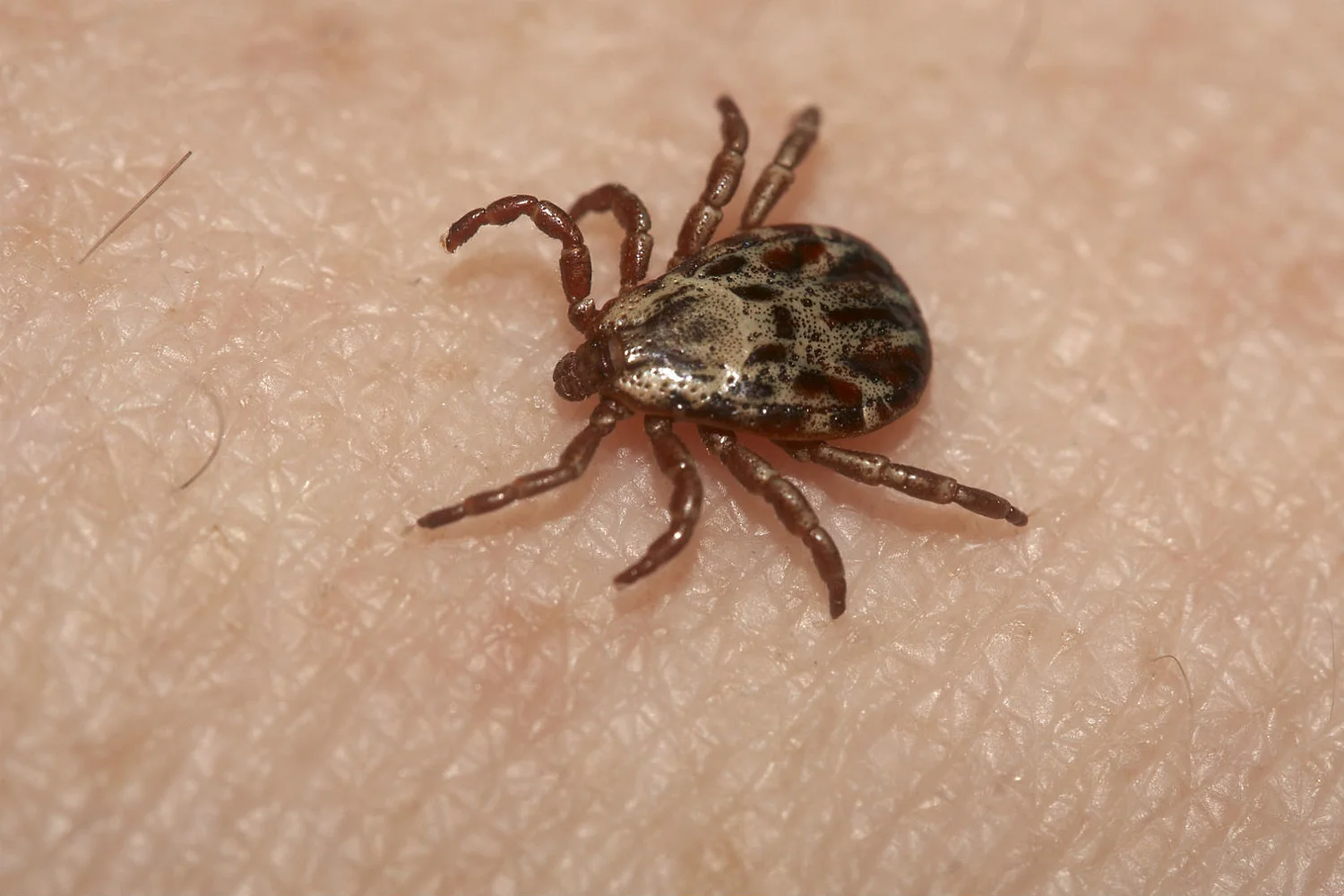
Primarily feeds on large mammals, especially moose and white-tailed deer, but can also feed on livestock and Occasionally humans
Most active in fall, winter, and early spring (colder months)
Can transmit pathogens such as Anaplasma phagocytophilum (anaplasmosis) and Babesia odocoilei (a Babesia species)
 Identification & Key Features
 Identification & Key Features
 Adult winter ticks are ornate members of the genus Dermacentor.
They generally have:
- 8 legs
- Brown to reddish-brown coloration
- Pale cream or whitish ornamentation
- Relatively short mouthparts
- Eyes
- Festoons along the rear edge of the body
- A hard dorsal shield, or scutum
Winter ticks can resemble other Dermacentor species, particularly the American dog tick and Rocky Mountain wood tick.
Adult Female
Adult females typically:
- Have 8 legs
- Are reddish brown to dark brown
- Have a small, ornamented scutum with pale cream or whitish markings
- Have the scutum covering only the front portion of the back
- Have relatively short mouthparts
- Have eyes
- Have festoons
- Become greatly enlarged after feeding
Unfed adult winter ticks are approximately 1/4 inch long, while a fully engorged female may reach approximately 3/4 inch in length.
Because only the front portion of the female’s back is covered by the scutum, the abdomen can expand dramatically during feeding.
Adult Male
Adult males typically:
- Have 8 legs
- Are generally dark brown to reddish brown
- Often have pale or whitish ornamentation extending across much of the back
- Frequently display a distinctive crosshatched or reticulated pattern
- Have a scutum covering essentially the entire dorsal surface
- Have relatively short mouthparts
- Have eyes
- Have festoons
- Do not become dramatically engorged
The amount of pale ornamentation can vary considerably among individuals.
Some winter tick males have very obvious pale crosshatching, while others may have much weaker ornamentation or appear comparatively plain.
For this reason, color and dorsal pattern alone should not be used for definitive identification.
Nymph
Nymphs:
- Have 8 legs
- Are smaller and less distinctively patterned than adults
- Have a scutum covering only the anterior portion of the back
- Remain on the same host acquired during the larval stage
- Feed and develop during fall and winter
- Eventually molt into adults without normally leaving that host
This is an important biological distinction.
Unlike most familiar three-host ticks, winter tick nymphs do not normally drop from the host and quest for another animal.
Larva
Larvae:
- Have 6 legs
- Are extremely small
- Are the principal free-living, host-seeking stage
- May gather together in large clusters on vegetation
- Become especially active from late summer through fall
- Attach to passing animals
- Remain on that host through subsequent development
Winter tick larvae may cluster together in large numbers on vegetation, allowing an animal brushing past to acquire many larvae at once.
Other Identification Features
Adult Dermacentor albipictus typically have:
- Ornate dorsal markings
- Relatively short mouthparts
- Eyes
- Festoons
- Female scutum restricted to the anterior portion of the back
- Male scutum covering nearly the entire back
Species-level identification can sometimes require close examination of structures such as the spiracular plates.
For example, the winter tick’s spiracular plate is relatively rounded, while some similar Dermacentor species have differently shaped projections.
Using a magnifier can help make the tick’s markings, mouthparts, scutum, legs, festoons, and other identification features easier to see.
However, microscopic examination or expert identification may be necessary when species-level confirmation is important.
Distinguishing It From Similar Ticks
The winter tick may resemble:
American Dog Tick
Dermacentor variabilis
Western American Dog Tick
Dermacentor similis
Rocky Mountain Wood Tick
Dermacentor andersoni
These ticks can share features such as:
- Brown bodies
- Pale or whitish ornamentation
- Short mouthparts
- Eyes
- Festoons
One of the strongest clues for identifying a winter tick is not simply its appearance—but its biology.
Winter Tick — Dermacentor albipictus
- One-host life cycle
- Larvae are the principal free-living host-seeking stage
- Commonly associated with moose, elk, deer, caribou, horses, and cattle
- Most commonly encountered from fall through spring
- Adult males frequently have extensive pale crosshatched or reticulated ornamentation
Most other commonly encountered U.S. Dermacentor ticks have a three-host life cycle, with larvae, nymphs, and adults feeding on separate hosts.
Because these species can look similar, appearance alone may not provide definitive identification.
Geographic Distribution & Habitat
Geographic Distribution & Habitat The winter tick has an exceptionally broad geographic distribution in North America.
It occurs coast to coast through much of Canada and the United States, extending south into Mexico.
In the United States, populations occur across many northern, western, central, and eastern areas.
The species is particularly conspicuous in regions supporting substantial populations of large ungulate hosts.
Common Habitats
Winter ticks can occur in a variety of environments used by their animal hosts, including:
- Northern forests
- Boreal forest
- Mixed woodland
- Shrublands
- Grasslands
- Forest edges
- Moose habitat
- Elk habitat
- Deer habitat
- Rangeland
- Pastures containing horses or cattle
Despite the name “winter tick,” the species is not restricted to extremely cold or northern environments.
Why Is It Called the “Winter Tick”?
The name refers primarily to when the tick spends much of its parasitic life on its host.
Larvae generally attach from late summer through fall, and the developing ticks remain on the same animal through:
Fall → Winter → Early Spring
Larvae feed and molt into nymphs, which subsequently develop into adults without normally leaving the host.
Adult females complete their major feeding period during late winter and spring before dropping from the animal.
The species is therefore particularly noticeable on its hosts during the winter months, unlike many familiar human-biting ticks that are most conspicuous during warmer weather.
Life Cycle & Seasonal Activity
Life Cycle & Seasonal Activity The winter tick has four developmental stages:
Egg → Larva → Nymph → Adult
But unlike most commonly encountered hard ticks in the United States, the winter tick has a:
One-Host Life Cycle
This means:
Larva → Nymph → Adult
normally feed and develop on the same individual host animal.
Only after an adult female finishes feeding does she leave the host.
The winter tick generally produces one generation per year.
Eggs
Engorged adult females drop from their hosts during spring.
They then:
- Seek protected locations on or near the ground
- Lay thousands of eggs
- Die after reproduction
Egg laying commonly occurs during late spring to early summer, although exact timing varies geographically.
Larvae
After hatching, larvae:
- Have 6 legs
- May remain clustered and relatively inactive for a period
- Become increasingly active from late summer into fall
- Climb vegetation
- Frequently cluster together
- Wait for a suitable host to pass
Larval host-seeking activity is especially important during fall.
In moose habitat, this period overlaps with the moose breeding season, when animals may travel extensively and encounter clusters of questing larvae.
Once larvae attach to a suitable host, they normally remain on that same animal throughout the remainder of their parasitic development.
Nymphs
After feeding, larvae molt into 8-legged nymphs while remaining on the same animal.
Nymphs:
- Feed on the same host
- Remain associated with the animal through winter
- Eventually molt into adults
Adults
Adults develop on the same host.
Adult females take their largest blood meals during the latter part of winter and into spring.
After becoming fully engorged:
Adult Female → Drops From Host → Lays Eggs → Dies
The next generation then develops off-host until larvae begin seeking animals later in the year.
Seasonal Activity
A simplified annual cycle is:
Spring
- Adult females become fully engorged
- Engorged females drop from hosts
- Females begin laying eggs
Late Spring–Summer
- Eggs develop and hatch
- Larvae may remain clustered and relatively inactive for a period
Late Summer–Fall
- Larvae become increasingly active
- Larvae climb vegetation and quest in clusters
- Large mammals acquire the ticks
Fall–Winter
- Attached larvae feed and molt into nymphs
- Nymphs feed and develop into adults
- The ticks remain on the same individual host
Late Winter–Spring
- Adult ticks feed
- Females become greatly engorged
- Engorged females drop to the ground
- The annual cycle begins again
Exact timing can vary with:
- Latitude
- Elevation
- Temperature
- Snow cover
- Local climate
- Host availability
Diseases & Health Risks
Diseases & Health Risks The winter tick is unusual because its greatest health significance comes from heavy parasitism of wildlife and livestock rather than frequent transmission of disease to humans.
Human Health Risk
Winter ticks rarely bite humans.
As a result, human exposure is much less common than exposure to species such as the blacklegged tick, lone star tick, or American dog tick.
Winter ticks are not recognized as important vectors of Lyme disease, Rocky Mountain spotted fever, or most of the common tick-borne diseases affecting people in the United States.
However, there is an important association with Babesia duncani that should be included.
Babesia duncani — Babesiosis
Babesia duncani is a microscopic parasite capable of causing human babesiosis.
Human infections with B. duncani are rare and have historically been associated particularly with the western United States.
Research investigating its natural transmission cycle has identified:
Winter Tick — Dermacentor albipictus
as a vector associated with B. duncani transmission.
Researchers detected B. duncani in winter ticks and found evidence supporting mule deer (Odocoileus hemionus) as an important reservoir host.
Current CDC babesiosis surveillance guidance also recognizes Dermacentor albipictus as the tick associated with transmission of Babesia duncani.
Important Perspective
This does not mean the winter tick is responsible for most human babesiosis.
In the United States:
- The overwhelming majority of babesiosis is caused by Babesia microti
- B. microti is transmitted primarily by the blacklegged tick (Ixodes scapularis)
- Human infections caused by B. duncani are comparatively rare
- Winter ticks themselves rarely bite people
Therefore, the winter tick’s overall importance as a human-biting disease vector remains relatively low, despite its recognized association with B. duncani.
Important Veterinary Disease — Bovine Anaplasmosis
Cause: Anaplasma marginale
Winter ticks can participate in transmission of Anaplasma marginale, the bacterium responsible for bovine anaplasmosis.
Dermacentor ticks are important biological vectors of A. marginale in the United States, and D. albipictus has been specifically implicated in its transmission.
Bovine anaplasmosis can cause:
- Fever
- Severe anemia
- Weakness
- Loss of appetite
- Weight loss
- Reduced productivity
- Abortion
- Death in severe cases
Disease is generally more severe in older susceptible cattle.
This is principally a veterinary and livestock concern, not the same disease as human anaplasmosis caused by Anaplasma phagocytophilum.
Heavy Infestations & Wildlife Health
This is the most important health effect associated with the winter tick.
Moose are particularly vulnerable to enormous winter tick burdens.
A single moose can carry:
More than 100,000 winter ticks during a severe infestation.
Heavy infestations can contribute to:
- Significant blood loss
- Anemia
- Skin irritation
- Intense itching
- Excessive grooming
- Hair loss
- Reduced feeding
- Weight loss
- Poor body condition
- Increased energy expenditure
- Reduced ability to withstand winter conditions
- Death in severe cases
“Ghost Moose”
Moose irritated by thousands of feeding ticks may rub, scratch, lick, and bite at their coats repeatedly.
This excessive grooming can break off the darker outer portions of the hair, leaving lighter-colored shafts exposed.
Affected animals can develop a pale or gray-white appearance and are commonly called:
“Ghost Moose.”
Severe coat damage can reduce the insulating protection of the winter coat and contribute to worsening body condition.
Moose Calves
Young moose can be particularly vulnerable to severe winter tick infestations.
The combined effects of:
- Blood loss
- Anemia
- Energy expenditure
- Hair loss
- Reduced feeding
- Poor body condition
- Winter exposure
can contribute to substantial illness and mortality.
Other Wildlife & Domestic Animals
Winter ticks can also infest:
- Elk
- Caribou
- Deer
- Reindeer
- Mountain sheep
- Horses
- Cattle
They have also been documented on incidental hosts including dogs, bears, beavers, and coyotes.
Severe infestations can occasionally cause serious illness or death in susceptible ungulates other than moose.
Important Lyme Disease Clarification
The winter tick is not a recognized vector of Lyme disease.
The principal Lyme disease vectors in the United States are:
- Ixodes scapularis — Blacklegged Tick
- Ixodes pacificus — Western Blacklegged Tick
Therefore, finding a winter tick should not by itself be interpreted as evidence of Lyme disease exposure.
Important to Know
The winter tick differs from many other ticks on this website because its primary health significance is:
Heavy parasitism of wildlife and livestock
rather than:
Frequent transmission of disease to humans.
Its one-host life cycle is also an important ecological distinction because larvae, nymphs, and adults normally remain on the same individual animal rather than feeding on different hosts at each life stage.
Nevertheless, its association with Babesia duncani demonstrates that a one-host life cycle does not completely eliminate the possibility of pathogen transmission.
Bite Prevention & Protection
Bite Prevention & Protection Human bites are uncommon, but people can encounter winter ticks—particularly the tiny larvae—in areas used heavily by large mammals.
When Outdoors
To reduce tick exposure:
- Avoid brushing directly against tall grass, brush, and vegetation when practical.
- Be particularly alert from late summer through fall, when winter tick larvae are actively seeking hosts.
- Walk near the center of maintained trails.
- Use an EPA-registered insect repellent according to label directions.
- Treat clothing and outdoor gear with products containing 0.5% permethrin, or wear commercially pretreated clothing.
- Do not apply permethrin products intended for clothing directly to the skin.
- Wear long pants, long sleeves, socks, and closed shoes when practical.
Watch for Larval Clusters
Winter tick larvae may cluster together on vegetation.
A passing animal—or occasionally a person—can therefore pick up multiple tiny larvae at the same time.
Because larvae are extremely small, careful inspection may be necessary after walking through areas heavily used by:
- Moose
- Deer
- Elk
- Horses
- Other large mammals
After Outdoor Activity
Perform a thorough tick check.
Pay particular attention to:
- In and around the hair
- In and around the ears
- Under the arms
- Around the waist
- Inside the belly button
- Behind the knees
- Between the legs
Also inspect:
- Children
- Pets
- Clothing
- Backpacks
- Outdoor equipment
CDC recommends showering within two hours after coming indoors. Showering can help wash away unattached ticks and provides an opportunity to perform a thorough tick check.
Protect Pets & Domestic Animals
Although wildlife—especially ungulates—are the primary hosts, winter ticks may also occur on:
- Horses
- Cattle
- Dogs
- Other domestic animals
Check animals regularly during fall, winter, and early spring, particularly if they live or travel in areas heavily used by deer, elk, or moose.
For significant infestations in livestock or pets, consult a veterinarian about appropriate tick-control measures.
If You Find an Attached Tick
Remove the tick as soon as possible.
Current CDC guidance advises removing an attached tick promptly rather than waiting to visit a healthcare provider.
How to Remove a Tick
- Use clean fine-tipped tweezers when available.
- Grasp the tick as close to the skin’s surface as possible.
- Pull the tick away from the skin with steady, even pressure.
- Do not twist or jerk the tick.
- If mouthparts remain in the skin and can be removed easily with tweezers, remove them. If they cannot be removed easily, leave them alone and allow the skin to heal.
- Dispose of the tick safely.
- Thoroughly clean the bite area and your hands.
- Check the rest of the body for additional ticks.
Do not attempt to make an attached tick detach by using:
- Petroleum jelly
- Nail polish
- Heat
- Other substances or chemicals
These methods can agitate the tick and should not replace prompt mechanical removal.
Tick Testing
CDC generally does not recommend commercial testing of removed ticks to guide medical treatment decisions.
A positive tick-test result does not prove that infection was transmitted to the person bitten.
A negative result can provide false reassurance.
Medical evaluation and treatment decisions should therefore not depend on the result of commercial tick testing.
After Removal
Because winter ticks rarely bite humans, the overall risk associated with a winter tick bite is generally considered low.
However, the species has an established association with Babesia duncani, so a winter tick bite should not be described as carrying zero disease risk.
After any tick bite, seek medical advice if concerning symptoms develop during the following days or weeks.
Tell the healthcare provider:
- That a tick bite occurred
- When the bite occurred
- Where the likely exposure occurred
The identified tick species, if known
Identification Gallery
Identification Gallery Adult Female
Show:
- Reddish-brown to dark-brown abdomen
- Pale cream or whitish ornamentation on the scutum
- Scutum covering only the front portion of the back
- Relatively short mouthparts
- 8 legs
Adult Male
Show:
- Dark-brown to reddish-brown body
- Pale or whitish crosshatched / reticulated dorsal pattern, when present
- Scutum covering essentially the entire dorsal surface
- 8 legs
Because ornamentation can vary, consider showing both a strongly patterned male and a less-patterned male if verified photographs are available.
Engorged Female
This is particularly useful for the winter tick.
Show:
- Greatly enlarged abdomen
- Dramatic increase in size compared with an unfed female
- Small ornamented scutum remaining visible near the front
A fully engorged female may reach approximately 3/4 inch in length.
Nymph
Show:
- 8 legs
- Smaller body than the adult
- Partial anterior scutum
- Less distinctive ornamentation than adults
Larva
Show:
- Extremely small body
- 6 legs
- Size comparison with nymph and adult
Larval Cluster
For this species, this is an especially important identification image.
Show:
Numerous winter tick larvae clustered together on vegetation
with a caption explaining:
Winter tick larvae often quest in clusters, allowing a passing animal to acquire many ticks at once.
Male vs. Female Comparison
Adult Female
- Dark abdomen
- Small ornamented scutum covering only the front portion of the back
- Becomes greatly enlarged when engorged
Adult Male
- Scutum covers essentially the entire back
- Frequently has extensive pale crosshatched or reticulated ornamentation
- Does not dramatically enlarge during feeding
Life Stages — One-Host Life Cycle
For the Winter Tick, do not use a standard three-host life-cycle graphic.
Use:
Eggs on Ground
↓
6-Legged Larvae Hatch and Quest on Vegetation
↓
Larvae Attach to One Host
↓
Larva → Nymph → Adult — All on the Same Host
↓
Engorged Female Drops Off in Spring
↓
Female Lays Eggs
↓
New Generation Begins
Include the caption:
Winter ticks are one-host ticks. Larvae, nymphs, and adults normally feed and develop on the same individual animal.
Similar Species Comparison
A useful gallery comparison would include:
Winter Tick
Dermacentor albipictus
vs.
American Dog Tick
Dermacentor variabilis
vs.
Rocky Mountain Wood Tick
Dermacentor andersoni
Because these ornate Dermacentor ticks can look similar, the gallery should not imply that markings alone always provide definitive species identification.
Moose / “Ghost Moose” Image
For this page, include an educational image showing:
Moose with a heavy winter tick infestation and/or characteristic coat damage
with a caption such as:
Heavy winter tick infestations can cause blood loss, intense irritation, excessive grooming, hair damage, and poor body condition. Moose with severe coat damage may appear pale and are sometimes called “ghost moose.”
This is one of the most important ecological and animal-health characteristics distinguishing the winter tick from many other tick species.

